
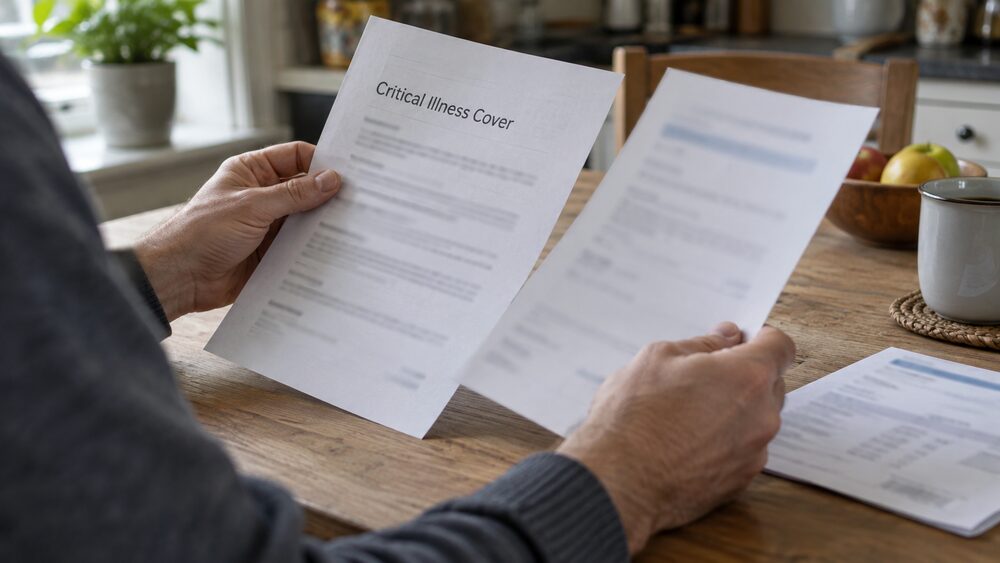
Critical illness cover is insurance that pays a one-off, tax-free lump sum if you are diagnosed with one of the serious illnesses listed in the policy. It is not about being off work: the payout is triggered by the diagnosis itself, as long as the illness meets the insurer's definition of severity. The money is yours to spend however you want, whether that is paying off the mortgage, adapting your home or simply covering living costs while you have treatment1.
The conditions covered are set out in a list in your policy documents, and most insurers' lists run to 100 or more diseases and conditions1. Every policy includes cancer, heart attack and stroke, but not every case of those illnesses qualifies: a cancer, for example, usually has to have spread or reached a specified severity before it pays2. Most policies also require you to survive for a set number of days after diagnosis before the claim is paid3.
Cover can be bought on its own or added to a life insurance policy for an extra cost4. It pays out once and then ends, so it is a single payment rather than an income. If you want cover that replaces your earnings month after month while you cannot work, that is a different product: income protection.
Critical illness cover pays a tax-free lump sum on diagnosis
The defining feature of this cover is the form of the payment. When you are diagnosed with an illness listed in your policy and it meets that insurer's definition, the insurer pays a single cash lump sum, directly to you, and the money is free of income tax because you paid the premiums yourself1. The Financial Ombudsman describes it as "a lump sum to help you while you recover"5. Unlike income protection, which replaces a portion of your salary over time, this is one payment that clears the policy.
That lump sum can be used for anything. Providers describe it as money to help while you recover, and because it is paid to you rather than to a lender or a beneficiary, there is no restriction on what it is spent on3. People commonly use it to clear a mortgage, pay for private treatment, make adaptations to a home, or simply cover household bills at a point when earnings may have dropped.
Two boundaries matter from the start. First, the illness has to be one of the listed conditions, and it has to meet the severity definition in your particular policy: not every diagnosis qualifies2. Second, the payout is not automatic on diagnosis alone, because most insurers require you to survive a set period afterwards and to have the illness verified by a UK doctor or specialist1. Both points are covered in more detail below.
Which illnesses are covered, and how severe they must be
Every critical illness policy covers cancer, heart attack and stroke5. Beyond those three, the lists widen considerably, and most insurers' policies include more than 100 diseases and conditions1. Conditions commonly covered as standard include organ failure, multiple sclerosis, Alzheimer's disease, Parkinson's disease and traumatic head injury1.
The catch is severity. Legal & General, one of the largest providers, states that because of advances in medicine, not all occurrences of cancer, heart attack and stroke are covered: a cancer needs to have spread or reached a specified severity, and some illnesses require permanent symptoms before they count2. The ombudsman makes the same point in plainer terms: "Some policies might not cover all types of these illnesses, so you'll need to check the terms of the policy you take out"5.
Severity rules bite hardest with cancer. Some policies pay a lower amount for certain types of early-stage or slow-growing cancers rather than the full sum7. Macmillan notes that cover can pay out for types of cancer "sometimes depending on the stage or grade of the cancer"8. This is why two people with the same illness can have different outcomes: the question is not just what you have, but how far it has progressed and whether it meets the wording in your specific policy.
Some policies add a further element: a total and permanent disability clause, which might pay out if you are unable to do the same or similar work as before, certain activities at work such as lifting, or any kind of work at all7. Where it exists, this extends the cover beyond the named illness list, but the definitions vary between insurers, so the policy wording is what counts.
Being unable to work is not the test
A common misconception is that critical illness cover pays only if you cannot work. It does not. As one broker puts it, "The ability to claim on a Critical Illness policy is not based on your ability to work, but meeting the criteria set out by the provider"9. Post Office makes the same point for its own cover: you do not need to be terminally ill or unable to work to make a claim, a confirmed diagnosis that meets the policy definition is sufficient3.
This is the key distinction from income protection insurance, which is designed precisely around being unable to work and pays a monthly amount rather than a lump sum. With income protection, a claim means meeting the insurer's definition of incapacity, which usually involves medical evidence10. Critical illness cover sits alongside it rather than replacing it, and the two answer different questions: one asks "what illness do you have?", the other asks "can you do your job?".
The practical consequence is that someone diagnosed with a listed illness who continues working full time can still claim in full, while someone forced off work by a condition that is not on the list may get nothing from a critical illness policy. If your main worry is losing your income through illness, the comparison page on critical illness cover or income protection sets the two side by side.
Survival periods: how long after diagnosis before it pays
Almost every policy includes a survival period: a minimum number of days you must live after diagnosis before the claim can be paid. The reason is that the product is designed to pay for living with and recovering from a serious illness, not as a fast-track life insurance payment. The periods differ noticeably between insurers:
| Provider | Survival period |
|---|---|
| Post Office | 30 days after diagnosis3 |
| LV= | at least 14 days for adult claims, not applied to children's cover11 |
| Vitality (Serious Illness Cover) | 14 days after diagnosis12 |
The range across these providers is 14 to 30 days, and each policy sets its own rule, so the number in your policy documents is the one that matters. Where the survival period is not met, the illness is instead treated under the death provisions of any life insurance element of the policy, which is one reason the two covers are often sold together.
What it costs: example premiums from £9 a month
Cost depends mainly on your age, the size of the payout you choose, the length of the term and your health. As an illustration of how age moves the price, Lloyds Bank publishes example monthly costs for its critical illness cover of £9 for ages 18 to 25, £16 for ages 26 to 50, and £24 for ages 51 to 596. Those figures are one provider's examples for a set level of cover, not a market price, but they show the shape of the curve: the same cover costs noticeably more with each age band.
At the other end of the scale, a Which? example prices a 50-year-old taking £300,000 of life insurance plus £75,000 of critical illness cover over 20 years at £127.45 a month with LV=1. That reflects a much larger combined benefit and an older applicant, which is why quotes for the same product can differ by an order of magnitude.
How much cover you can buy also has limits that vary by provider. Scottish Widows states a maximum amount of cover of £500,000 in one part of its product material, while another page for the same product states £3 million, so check the limit that applies with the insurer or your adviser before applying13. Guardian's Critical Illness Essentials includes children's critical illness cover that pays out £25,000 or 50% of your cover amount, whichever is lower14. Legal & General's adviser literature states a maximum of £4,000 a month where a Family and Personal Income Plan is chosen15, and Nationwide's guide describes support such as accommodation near a hospital for up to 3 months, up to a maximum of £1,000, under children's cover16.
Because premiums rise steeply with the payout size, many people buy critical illness cover at a lower amount than their life insurance, or add it to a decreasing policy that tracks a mortgage balance. The page on how life insurance premiums are worked out explains the factors in more detail.
Level or decreasing cover, guaranteed or reviewable premiums
Two structural choices shape both the payout and the monthly cost. The first is how the cover amount behaves over the term. Critical illness cover comes in two main types: level cover, where the payout stays the same throughout, and decreasing cover, where it falls over time, typically in step with a repayment mortgage1. Level cover costs more because the insurer's potential payout never shrinks; decreasing cover suits people whose main debt is a mortgage that is being paid down.
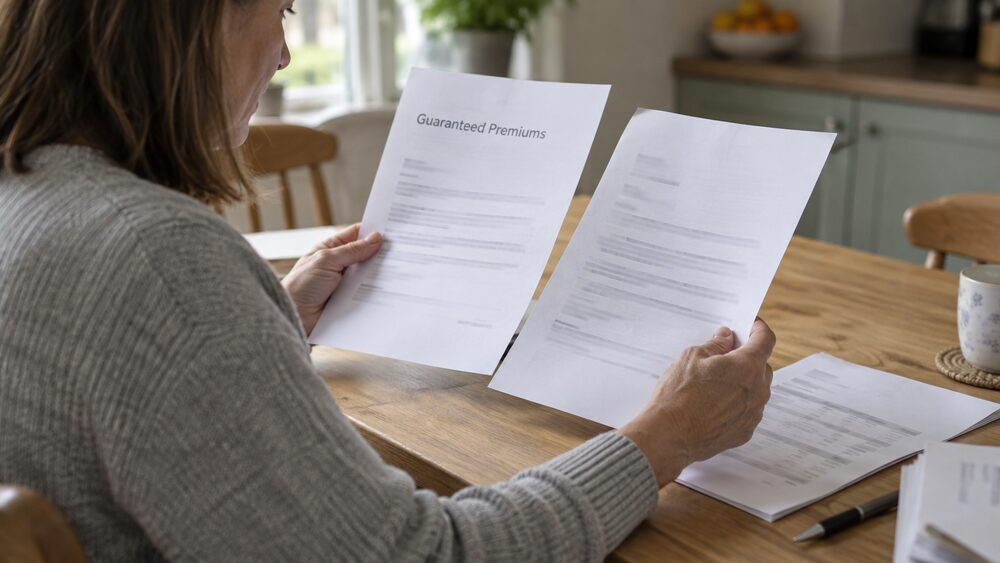
The second choice is how the premium is set. Guaranteed premiums mean you pay the same monthly amount for the life of the policy, and they usually cost more to start with. Reviewable premiums are reviewed by the insurer, usually every five years, and are likely to go up over time7. As Which? explains in the context of family income benefit, reviewable premiums "may cost less initially" but the insurer reviews them regularly and may raise them17. A warning applies to accepting those increases: some reviewable policies start with low premiums that rise at each review, and if you do not accept an increase, your cover falls18.
| Choice | What it means | Typical effect on cost |
|---|---|---|
| Level cover | Payout stays the same for the whole term | Higher monthly premium1 |
| Decreasing cover | Payout falls over the term, often tracking a mortgage | Lower monthly premium1 |
| Guaranteed premiums | Same payment for the policy's life | More expensive at the start7 |
| Reviewable premiums | Reviewed usually every 5 years, likely to rise | Cheaper at the start7 |
The comparison pages on level or increasing cover and guaranteed or reviewable premiums go deeper on both choices.
Standalone cover or added to life insurance
Critical illness cover can be bought on its own or added to a life insurance policy17. Most major insurers offer it as an add-on: Legal & General lets you add Critical Illness Cover for an extra cost when you take out its Life Insurance or Decreasing Life Insurance19, TSB offers the option at an extra cost when you take out its life insurance21, and Post Office lets customers pay extra to add it22. Many insurers also allow it on a joint policy, which increases the premium23.
The trade-off with a combined policy is what happens to the death benefit. Which? warns that if you wrap critical illness cover in with life insurance, "this often results in the payout for death being reduced if the insurer has paid out already for critical illness"24. In other words, the two benefits often share one pot: a critical illness claim eats into what would be left for your family on death. A standalone critical illness policy leaves the life insurance untouched, but costs more in total premiums because you are buying two separate policies.
Which route suits someone depends on their circumstances: a combined policy tends to suit people who want one affordable policy covering both risks and accept the reduced death benefit, while separate policies suit those who want the full life insurance amount preserved for dependants. The comparison page standalone or combined critical illness cover works through the differences.
Applying: the health questions you will be asked
Critical illness policies are individually underwritten, which means the insurer decides the price and any exclusions based on your answers. When you apply, the insurer will ask you questions about your health and require you to declare any conditions you have at that time25. You will normally also be asked about previous health problems and any major health problems in your family26. Macmillan confirms that when you buy critical illness cover, "you will be asked about your health and the health of people you are closely related to", including parents and siblings7.
Answering fully and honestly matters more here than almost anywhere in insurance, because a claim can be refused years later if the insurer discovers something that was not disclosed. The pages on applying for cover and the duty of disclosure explain what insurers can ask for, including GP reports, and what happens if information is missed out.
Having a medical condition does not mean you cannot get cover. Which? is clear that "Having a pre-existing condition doesn't mean you'll be unable to find critical illness insurance", though any cover you find is likely to be more expensive and may carry more extensive exclusions1. HSBC states that its critical illness insurance can cover pre-existing conditions, subject to the provider telling you what can and cannot be covered27. Insurers may offer cover with a specific condition excluded, cover at a higher premium, or in some cases normal terms. The page on getting cover with a pre-existing condition covers the routes in, including specialist brokers.
Where critical illness cover stops
The limits are as important as the benefits. Critical illness cover pays out only if you are diagnosed with one of the listed conditions, during the term of the policy, and only if it meets the severity definition28. Not every type of illness is covered, and early-stage or less severe cases of a listed illness may trigger a reduced payment or none at all7. The policy pays once and then ends, so a second serious illness later in life is not covered by the same policy1.
Policies also carry standard exclusions, and Phoenix lists the most common ones as linked to aviation, criminal acts, drug abuse, failure to follow medical advice, hazardous sports and pastimes, HIV/AIDS, living abroad, self-inflicted injury, and war and civil commotion28. The exact list varies between policies, so the exclusions section of your policy documents is worth reading before you rely on the cover.
Other boundaries to know:
- Term limits: the cover only pays for diagnoses during the policy term, so it ends when the term ends28.
- Survival periods: if you do not survive the required days after diagnosis, the critical illness benefit itself is not paid3.
- No cash-in value: like life insurance, cancelling typically means no refund of premiums paid, apart from possible refunds during a short grace period24.
- Combined policies: a critical illness payout may reduce the later death payout29.
If your concern is being unable to work for a long period rather than a listed diagnosis, income protection or short-term income protection may fit better, and state support such as Statutory Sick Pay is covered on the sick pay and state support page.
If a claim is turned down
Claims are refused most often on two grounds: the illness did not meet the policy's definition, or the insurer says something relevant was not disclosed at application. The Financial Ombudsman handles complaints about critical illness cover and can look at both kinds of dispute5. Its data shows this is a real but manageable problem: in the first quarter of 2026/27, 175 complaints about critical illness cover were opened, and 7% were upheld in the customer's favour30.
If a claim is refused, the steps are:
- Ask the insurer for its decision in writing, including the policy wording and medical evidence it relied on.
- Complain to the insurer using its formal complaints process, setting out why you believe the illness met the definition or the disclosure was adequate.
- If the insurer does not resolve it within eight weeks, or sends a final response you do not accept, refer the complaint to the Financial Ombudsman Service. This is free.
- Gather your medical records: the ombudsman weighs the treating specialist's evidence against the policy definition.
The ombudsman's guidance on pre-existing conditions is relevant to refusals that turn on medical history: it expects insurers to ask clear questions and to judge answers in the customer's favour where a question was ambiguous25. Free help is available from MoneyHelper, and the page on making a claim explains the claim process from start to finish.
Who provides critical illness cover in the UK
Critical illness cover is sold by most of the big protection insurers and by several high street brands, usually as an add-on to their life insurance. Legal & General offers Critical Illness Cover that can be added to its Life Insurance or Decreasing Life Insurance20. Scottish Widows, LV=, Royal London and Vitality all sell critical illness or serious illness cover, with Vitality marketing its version as Serious Illness Cover12. Guardian offers Critical Illness Essentials, which includes children's cover14.
High street banks are also in this market: Lloyds Bank publishes example costs for its critical illness cover by age band6, HSBC offers critical illness insurance that can cover pre-existing conditions27, and Halifax publishes guidance on what critical illness cover is31. Post Office sells critical illness cover that pays a tax-free cash lump sum on diagnosis3, and TSB offers critical illness cover as an option on its life insurance21.
Workplace schemes are a further route. Canada Life provides group critical illness through employers, making a tax-free payment to an employee diagnosed with one of the defined illnesses32. Cover arranged this way is a benefit of the job rather than something you own, so it ends when you leave the employer, and a payout from employer-paid cover is taxed through PAYE, unlike personally funded cover9.
Brokers and comparison services can search across these insurers, which matters if you have a medical history, since one insurer's decision on a pre-existing condition can differ from another's. The page on buying protection insurance explains the difference between going direct, using a broker and taking advice.
Sources32 cited
- Critical illness insurance explained Which?, 2026-08-24
- Critical illness cover: information you need to know Legal & General, 2026-09-26
- How much critical illness cover do I need? Post Office, 2026
- Critical illness insurance FAQs Cavendish Online, 2026-09-26
- Complaints we can help with: critical illness cover Financial Ombudsman Service, 2026-09-26
- Critical illness cover Lloyds Bank, 2026-09-27
- Protection insurance and cancer Macmillan Cancer Support, 2023-09-01
- Types of insurance Macmillan Cancer Support, 2023-09-01
- Critical illness insurance Cavendish Online, 2026-09-26
- The overlooked insurance that could pay if you're signed off work Which?, 2026-04-04
- Critical illness cover LV=, 2026-09-28
- Serious Illness Cover Vitality, 2026-09-28
- Critical illness cover Scottish Widows, 2026-09-25
- Critical Illness Cover Guardian, 2026-06-08
- Critical Illness Cover, adviser literature Legal & General, 2026-09-26
- Guide to life insurance Nationwide, 2026
- Family income benefit insurance explained Which?, 2026-09-07
- Should you consider life insurance to manage your inheritance tax bill? Which?, 2025-10-20
- Short term life insurance Legal & General, 2025-12-10
- Critical illness cover Legal & General, 2026-09-26
- Life insurance TSB, 2026
- Terminal illness cover Post Office, 2026
- Joint life insurance Cavendish Online, 2026-09-26
- Types of life insurance policy Which?, 2025-05-16
- Pre-existing medical conditions Financial Ombudsman Service, 2026-09-26
- Insurance and genetic conditions FAQs Genetic Alliance UK, 2026
- Critical illness cover HSBC, 2026
- Term assurance product guide Phoenix, 2026
- Over 50s life insurance Which?, 2025-12-03
- Quarterly complaints data Q1 2026/27 Financial Ombudsman Service, 2026
- What is critical illness cover? Halifax, 2026-09-27
- Group critical illness Canada Life, 2026-09-26


 MoneyHelperFree, impartial money and pensions guidance, set up by government
 Financial Ombudsman ServiceFree, independent help when a complaint about a firm is not put right
 FSCSProtects your money if a bank, insurer or investment firm fails
 Citizens AdviceFree advice on money, consumer and legal problems in England and Wales
 Turn2usFree benefits calculator and grants search from a charity