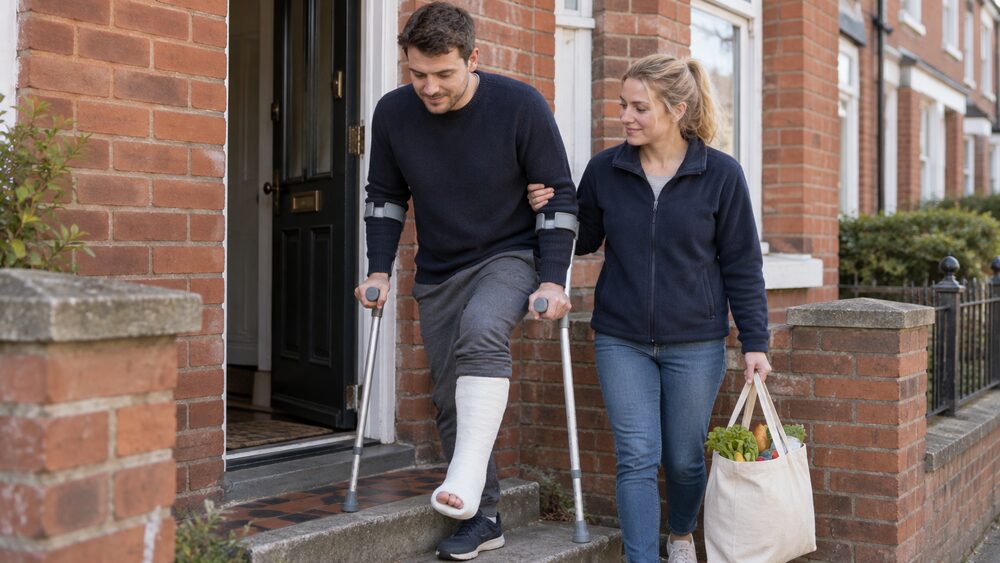
Personal accident insurance pays out only after an accident. Depending on the policy, it pays a fixed cash sum if you suffer a serious injury, die as a result of an accident, or become totally and permanently disabled1. Some policies also include a daily allowance while you recover2. It is a narrow product: unlike income protection, which pays a percentage of your income each month if illness or injury stops you working, or life insurance, which pays out on death from any cause, an accident policy responds only to the events listed in its benefit schedule.
The payouts are fixed amounts for specific injuries, set out in advance. The Financial Ombudsman Service gives the example of a policy that might pay £10,000 for loss of a limb, £8,000 for loss of an eye, and £100,000 for the death of the policyholder1. Because the sums are fixed and the trigger is a defined accident rather than your health or earnings, these policies are cheap: independent guidance on accidental death insurance puts single person monthly premiums at less than 0.01% of the sum insured, so £20,000 of cover costs less than £2 a month and £100,000 costs less than £102.
The trade-off is what the policy leaves out. Illness is not covered at all, dangerous sports are often excluded, and injuries you had before taking out the policy can lead to exclusions or restrictions on claims2. This page explains what accident, injury and fracture cover pays for, what it costs, how it differs from full life and income cover, and where to take a complaint.
What personal accident insurance pays out for
A personal accident policy pays out if you suffer a serious injury, die as a result of an accident, or become totally and permanently disabled1. The policy pays a fixed amount of money for specific injuries, depending on the level of cover1. Beyond death and the loss of a limb, policies can pay lump sums for broken bones, dislocations, burns and a range of other causes that might result in hospitalisation or your inability to work2.
The size of the cover varies widely by where you buy it. As an optional extra on car insurance, standard levels of personal accident cover range between £1,000 and £10,000, but cover can be enhanced to as much as £150,0003. Legal expenses policies, which sometimes bundle personal accident cover, can likewise be enhanced to as much as £150,0003. The principle is the same at every level: the insurer is not assessing your health or your earnings, it is offering a menu of fixed sums for listed injuries.
What counts as an "accident" is where many disputes arise. In one ombudsman case, a customer named Jay had a policy that would pay out if he lost his sight because of an accident, but the policy did not define "accident" at all5. In another, a customer named Colin had a policy that covered injury to the body caused by an accident, and the question was whether his injury fell inside that wording6. The lesson for a buyer is practical: read the definitions section of the policy, not just the payout figures, because the ombudsman decides these cases on the exact words used.
Accident cover also exists in other markets on the same principle. Accident only pet insurance pays out a fixed amount for each accidental injury and excludes illnesses entirely, and it is the cheapest type of pet insurance cover7. The structure is identical to human personal accident cover: a fixed sum per event, no cover for anything that is not an accident.
Fixed lump sums: what a broken bone is worth
The payouts for fractures are set out as fixed sums per bone, and they differ sharply between "major" and "minor" bones. One provider's benefit schedule, MetLife's EverydayProtect, shows the pattern. For its Core Cover, broken major bones, defined as arm, ankle, back, hip, mandible, leg, neck, pelvis, shoulder, wrist and skull, pay £1,000 to £5,000 per claim depending on how many units of cover are bought, from 1 to 5 units8. Minor bones, which include ear bones, facial bones other than the mandible excluding the nose, and any other bone not listed as major, pay £250 to £1,250 per claim across the same unit range8.
| Injury | Cover level | Payout per claim |
|---|---|---|
| Broken major bone (arm, ankle, back, hip, leg, neck, pelvis, shoulder, wrist, skull, mandible) | 1 to 5 units | £1,000 to £5,0008 |
| Broken minor bone (ear bones, facial bones other than the mandible, excluding the nose) | 1 to 5 units | £250 to £1,2508 |
| Child's broken major bone (excluding facial or ear bones) | 1 to 5 units | £250 to £1,2508 |
| Partial knee or ankle ligament tear (grade 2) or tendon rupture | 1 to 5 units | £500 to £2,5008 |
The unit structure matters when comparing policies. Buying more units raises every payout on the schedule proportionally, so a five-unit policy pays five times the one-unit sum for the same fracture. A child's broken major bone under the same provider's Child Cover pays £250 to £1,250, lower than the adult Core Cover sum for the same injury8.
These fixed sums are modest next to the cost of being off work for months, which is the real limitation of fracture-based cover. A £1,000 payout for a broken wrist does not replace a salary. That is why fracture benefits usually work best as a supplement to, rather than a substitute for, income protection or savings. If money is very tight, guidance on making the most of your money notes that benefits such as Personal Independence Payments can help people aged over 16 with the costs of a long-term health condition or disability9, and Personal Independence Payment is a benefit for people aged 16 to State Pension age who have problems with daily living or moving around10. These are state benefits, not insurance, and they are not limited to accidents.
Fracture cover as an add-on to income protection
Fracture cover also appears inside a different product. Included in most income protection policies, fracture cover pays a lump sum for bone fractures covered by your policy11. The mechanics mirror standalone accident cover: a fixed sum per listed fracture, paid as a one-off on top of the monthly income the policy pays if you cannot work.
The difference is what sits underneath it. Full income protection protects your income if you fall ill and cannot work, paying a percentage of your income each month1. Fracture cover bolted onto it gives you a quick cash sum for a broken bone even if the injury would not by itself trigger the monthly payments, for example because you are back at work within the policy's deferred period. Standalone personal accident cover, by contrast, offers the fracture lump sums without any monthly income behind them.
This is the same add-on pattern seen across insurance. Most car insurers offer breakdown cover as an added extra4, and critical illness cover can be added to a life insurance policy or bought separately, providing a lump sum on diagnosis of a specified serious illness12. In each case the add-on extends the parent policy rather than standing alone. When fracture cover comes as part of income protection, the fracture sums and the income payments are governed by one set of policy terms, so a claim is made once, to one insurer.
Accident only income protection: a monthly income after an injury
Accident only income protection is the halfway house between a fixed-sum accident policy and full income protection. Like full income protection it pays a monthly amount, but like an accident policy it pays only if the cause is an accident, not illness. The eligibility rules can be strict: one provider's income protection, which includes fracture cover, requires applicants to be between 18 and 59 years of age11, so 59 is the upper age limit for that policy.
The state provides a parallel, contribution-based system for industrial injuries, which is separate from any insurance. Under Scottish legislation in force from April 2026, the maximum increase of the weekly rate of disablement pension for exceptionally severe disablement is £93.60 per week, the maximum increase for constant attendance allowance is £93.60 per week except in cases of exceptionally severe disablement, and the maximum aggregate of weekly benefit payable for successive accidents is £233.90 per week13. These industrial injuries benefits are payable under the industrial injuries scheme regardless of any private cover, and a personal accident payout does not remove entitlement to them.
What accident only income protection does not do is protect against the far more common reason for long absences from work, which is illness. Full income protection pays a percentage of your income each month if you fall ill and cannot work1. An accident only version pays nothing for a heart condition, a cancer diagnosis or a mental health crisis. The comparison between short-term and long-term income protection and the guide to accident, sickness and unemployment cover set out the fuller options, and the page on what you get if you cannot work covers Statutory Sick Pay and employment and support allowance.
Cover for sports injuries: dislocations, ligament tears and tendon ruptures
Some accident policies extend beyond fractures to the soft-tissue injuries that sport produces. MetLife's Active Lifestyle Cover pays £500 to £2,500 per claim, across 1 to 5 units, for a grade 2 partial tear of a knee or ankle joint ligament, or a tendon rupture of the Achilles, hamstring, bicep brachii, quadriceps or rotator cuff8.
Two things to check in the small print are the grade of injury covered and the annual limit. The provider's documents describe the annual benefit limit differently: one states one dislocation and/or one tendon rupture or complete (grade 3) ligament tear in a policy year, while another describes one dislocation, and/or one tendon rupture or grade 3 or grade 2 ligament tear in each policy year8. A policyholder with the second wording could claim for a partial tear where the first wording would not. Where wording in your own policy is unclear, the ombudsman looks at what the policy actually says and how it was explained at the point of sale5.
Sports cover also interacts with the exclusions discussed below. Private health insurance, for example, excludes injuries from playing professional sport14, and some travel insurers exclude activities such as downhill cycling15. A sport-specific accident policy is designed to fill that gap, but only for the injuries on its own list.
Costs, age limits and who can apply
Accident cover is among the cheapest protection you can buy because the insurer is not taking on much risk. Independent guidance puts single person monthly premiums for accidental death insurance at less than 0.01% of the sum insured, so £20,000 of cover costs less than £2 a month and £100,000 costs less than £102. Premiums are paid annually or monthly, and a policy can cover either just yourself or your whole family2.
Age limits depend on the product. The income protection policy that includes fracture cover mentioned above requires applicants to be between 18 and 59 years of age11. Accident policies sold as add-ons to car insurance typically have no medical questions at all, because the payout is a fixed sum for a listed injury rather than a payment geared to your health3. For older buyers, health insurance for over 60s is a separate market with its own rules, and any new private health insurance provider typically will not cover conditions that were known to you, or for which you had symptoms, before you took out the policy16.
Who tends to suit accident cover? By circumstance rather than recommendation: people whose main worry is a specific accident risk, such as a dangerous hobby or a manual job, who want a small cash sum quickly and cheaply; people who cannot get or cannot afford full income protection; and people adding a modest fracture benefit to existing cover. Who it tends not to suit: anyone whose real exposure is illness, for whom critical illness cover or income protection is the matching product, since all critical illness policies include cancer, heart attack and stroke17.
Exclusions: dangerous sports, earlier injuries and illness
The exclusions are where accident policies are narrowest. Accidental death insurance does not pay out if you die from an illness or disease, and it excludes suicide and self-inflicted injuries, reckless or dangerous behaviour including being under the influence of drink or drugs, and some dangerous sports and activities2. Previous bodily injuries may lead to exclusions or restrictions on claims2.
The illness exclusion has a hard edge that surprises people. If a heart attack kills you, it is not covered by an accidental death policy. It may be covered if a non-life-threatening heart attack causes an accident that results in death, but only where a doctor is clear that the accident, not the heart attack, killed you2. In an ombudsman case, a customer's estate complained because the insurer declined the estate's claim under his personal accident policy after his death happened due to complications of surgery19. Whether surgery counts as an accident is exactly the kind of definitional question these policies turn on.
Comparable exclusions run through neighbouring products, which shows how standard the pattern is:
- Private health insurance excludes most chronic conditions, pre-existing medical conditions, pregnancy, injuries from playing professional sport, cosmetic surgery, and certain jobs such as oil rig workers14.
- Family income benefit policies can carry exclusions for pre-existing conditions, dangerous activities, waiting periods, specific illnesses such as cancer diagnosed within the first 12 months, and self-inflicted injuries12.
- Some travel insurers exclude activities such as downhill cycling15.
- For private medical insurance generally, you will not normally be covered for pre-existing medical conditions20.
Free accidental death cover while a life insurance application is assessed
Accidental death benefit is a separate and different policy, often provided for you while your application for full life insurance is being considered2. It exists because a life insurance application can take weeks while medical information is gathered, and the insurer offers this temporary cover so that the applicant is not unprotected in the meantime. It is free, and it ends when the insurer makes its decision on the full application.
The cover is narrow. It pays if you die within 90 days of an accident2, and it has all the same exclusions as accidental death insurance2, so death from illness during the application period is not covered. Accidental death insurance itself pays a fixed lump sum if you die as a result of an accident, often even if you die up to two years after the accident2, but the free application-stage benefit uses the shorter 90-day window.
If a death does occur during this window, the claim process is the same as for any life policy: the guide to claiming on a life insurance policy after someone dies sets out the documents needed. If the person who died had cover through work, you can contact their employer to find out whether they had life insurance and how to make a claim22.
Personal accident policies are usually sold without advice
Personal accident insurance is not usually sold on an advised basis1. This means the seller does not have to make sure the policy is suitable for your specific needs. However, the seller must give enough information, which is clear, fair and not misleading, to allow you to make an informed choice1. The distinction is explained in more depth in the guide to buying protection insurance.
The ombudsman's case files show what this means in practice. A consumer named Lisa complained about the sale of her personal accident policy, saying she was led to believe she had taken out life insurance. The insurer produced the original sales checklist, called a Personal Accident Plan, which showed the policy was sold in one of its branches and that the insurer did not give any advice about the suitability of the policy. The key facts had been explained, Lisa had been given a copy of the policy document, and she had signed the checklist. The ombudsman did not uphold the complaint, finding the policy had not been mis-sold and there was no basis to ask the insurer to refund premiums23.
The ombudsman also publishes a case where a customer thought they had bought life insurance and discovered the cover was actually personal accident insurance23, which is precisely the confusion Lisa's case turned on. The ombudsman recognises several grounds for mis-selling complaints about personal accident insurance: not understanding the policy applied for, thinking it would provide benefits in different circumstances than it actually does, already having cover, or not applying for the policy at all because it was added without the customer's knowledge to another product taken out over the phone1.
Online sales carry a similar risk of misunderstanding in other insurance markets: the ombudsman finds misunderstandings are more common where a policy was sold online, because the customer has fewer opportunities to discuss it with the insurer24. Standalone policies sold without being linked to particular credit were also a feature of the payment protection insurance market25, and where a customer would have bought a different policy that would have covered their claim, the ombudsman can ask the insurer to pay the claim26.
Complaints about accident cover and where to take them
Complaints about accident cover are relatively rare compared with other insurance lines, but they do reach the ombudsman. In Q3 2025/26, 44 new complaints about Personal Accident Insurance were opened, with a 17% uphold rate27. In Q1 2026/27, 38 new complaints about Personal Accident Insurance were opened28, alongside 532 about private medical or dental insurance and 931 about personal pensions28.
The process is the same whatever the insurance. Talk to your insurance provider first, because it needs to have the chance to put things right18. Independent guidance suggests making a formal complaint headed "Complaint", including the dates and names of the people you spoke to, and saying how you would like the problem resolved29. If the insurer does not resolve it, the Financial Ombudsman Service reviews the complaint free of charge.
There is one important wrinkle for workplace cover. If you have a complaint about the sale of a group accident policy provided by your employer, you need to ask your employer to complain to the ombudsman about the sale of the policy1. You can still complain yourself about a claim under a group policy, but complaints about the sale of a group policy must be made by your employer30. This division trips people up, so it is worth knowing before you start.
The ombudsman's accident cases show what it decides. In the case where the policy did not define "accident", the question was whether the insurer had clearly defined the term, and the ombudsman found for the customer where it had not5. In Colin's case, the policy covered injury to the body caused by an accident, and the dispute was whether his injury fell within those words6. In Lisa's case, the sale was found to have been properly made23. The outcome in each case turned on the policy wording and the sales documents, which is why keeping them matters.
Sources30 cited
- Personal accident insurance, Financial Ombudsman Service financial-ombudsman.org.uk
- Accidental death insurance explained, Which?, 2025-11-20 which.co.uk
- Legal expenses insurance reviews, Which?, 2026-01-22 which.co.uk
- Car insurance add-ons, fees and charges, Which?, 2026-01-22 which.co.uk
- Customer complains the insurer hadn't clearly defined the term accident, Financial Ombudsman Service financial-ombudsman.org.uk
- A customer complains that the definition of accident means his claim is unfairly turned down, Financial Ombudsman Service financial-ombudsman.org.uk
- Petplan pet insurance review, Which?, 2025-12-04 which.co.uk
- EverydayProtect summary of benefits, MetLife, 2026 metlife.co.uk
- Making the most of your money, National Debtline nationaldebtline.org
- Employment and support allowance, Macmillan Cancer Support, 2025-06-01 macmillan.org.uk
- Income protection, Bank of Scotland, 2026-09-27 bankofscotland.co.uk
- Family income benefit insurance explained, Which?, 2026-09-07 which.co.uk
- The Social Security (Industrial Injuries) (Prescribed Amounts) Regulations, Scottish legislation, 2026 legislation.gov.uk
- What does private health insurance cost and is it worth it, Which?, 2026-08-24 which.co.uk
- 6 surprising travel insurance exclusions to watch out for, Which?, 2026-08-04 which.co.uk
- Health insurance for over 60s, Which?, 2026-08-13 which.co.uk
- Critical illness insurance explained, Which?, 2026-08-24 which.co.uk
- Critical illness cover, Financial Ombudsman Service, 2026-09-26 financial-ombudsman.org.uk
- Customer's estate wants claim paid after death due to complications of surgery, Financial Ombudsman Service financial-ombudsman.org.uk
- Jargon buster, British Insurance Brokers' Association biba.org.uk
- Accidental Death Benefit Virgin Money, 2026
- Claiming on life insurance, Marie Curie, 2026-04-14 mariecurie.org.uk
- Thought I'd bought life insurance but discovered the cover was actually personal accident insurance, Financial Ombudsman Service financial-ombudsman.org.uk
- Fault claims and no-claims bonuses, Financial Ombudsman Service, 2025-09-16 financial-ombudsman.org.uk
- Payment protection insurance, Financial Ombudsman Service, 2026-09-26 financial-ombudsman.org.uk
- Mis-sold travel insurance, Financial Ombudsman Service, 2026-09-26 financial-ombudsman.org.uk
- Quarterly complaints data Q3 2025/26, Financial Ombudsman Service, 2025 financial-ombudsman.org.uk
- Quarterly complaints data Q1 2026/27, Financial Ombudsman Service, 2026 financial-ombudsman.org.uk
- How to complain about your insurance company, Which?, 2025-09-10 which.co.uk
- Private medical insurance, Financial Ombudsman Service, 2026-09-26 financial-ombudsman.org.uk



 MoneyHelperFree, impartial money and pensions guidance, set up by government
 Financial Ombudsman ServiceFree, independent help when a complaint about a firm is not put right
 FSCSProtects your money if a bank, insurer or investment firm fails
 Citizens AdviceFree advice on money, consumer and legal problems in England and Wales
 Turn2usFree benefits calculator and grants search from a charity