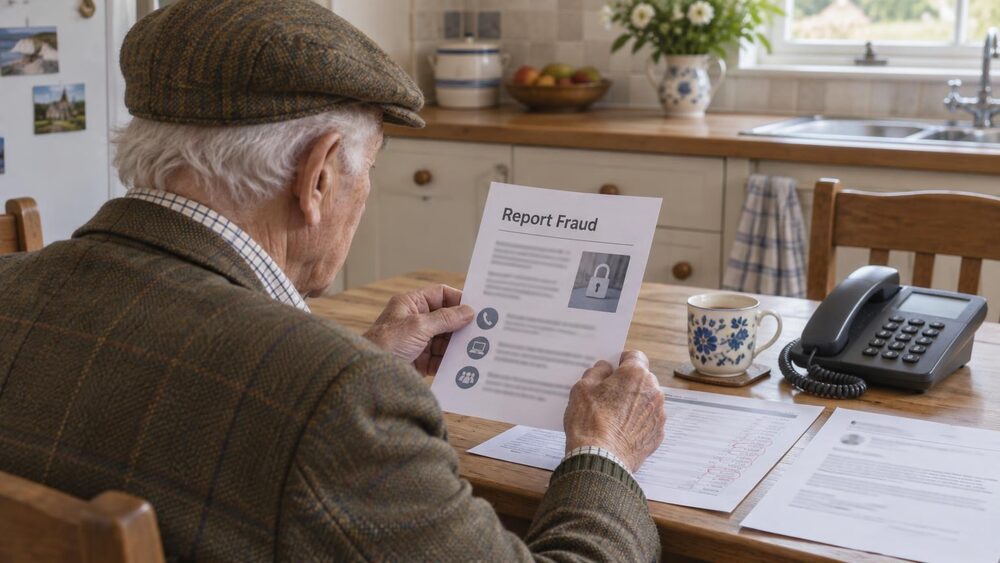
Action Fraud has been replaced by Report Fraud, according to updated guidance from the Valuation Office Agency (VOA) on staying safe from scammers1. The change is recorded in the page's update history, which lists an entry dated 26 January 2026 reading "Action Fraud has now been replaced by Report Fraud"1.
The guidance, published by HM Revenue & Customs and last updated 12 March 2026, applies to England and Wales1. It directs readers to report suspicious calls to Report Fraud on 0300 123 2040 or to use the service's online fraud reporting tool1. Suspicious emails claiming to be from the VOA should be forwarded to agentstandards@voa.gov.uk1.
"Action Fraud has now been replaced by Report Fraud."
The page sets out a checklist for identifying scam contact by phone, email or text. It says it could be a scam if the contact pressures you into making a decision, has a short deadline, is threatening or unexpected, asks for personal information such as bank details, tells you to transfer money, says you have to pay to apply for or get a relief, says you have unclaimed credits, or offers a discount, refund, rebate or grant1.
On property contact, the guidance says the VOA will always mention a specific property by its address, give a reference number and verify your identity, and will never contact you without mentioning an address, ask for money without a clear explanation, or tell you what you owe for business rates or Council Tax, because those bills are worked out by your local council1. It also says the VOA would never recommend or endorse an agent or ask an agent to act as part of, or on behalf of, the VOA1.
For emails, the guidance says to delete the message from your mailbox including deleted items, not to disclose personal information, open attachments, click links or reply, and to check that an address contains ".gov.uk" before treating it as genuine1. It says the VOA will never leave a voicemail threatening legal action, threaten arrest, or contact you for immediate payment of penalties or bills, and will never ask for personal or financial information in a text message1.
Why it matters for households
People in England and Wales who receive suspicious calls, emails or texts about their property, Council Tax band or business rates are now pointed to Report Fraud rather than Action Fraud1. The reporting route named in the guidance is the phone number 0300 123 2040 or the online fraud reporting tool1. The page does not state when the replacement took effect beyond the 26 January 2026 update entry, and no information has been reported on what happens to reports already made to Action Fraud or on any change to how cases are handled.
The guidance also draws a line between the VOA and local councils: bills for Council Tax and business rates are worked out by the local council, not the VOA, so contact demanding payment of those bills does not come from the VOA1. Anyone contacted about a Council Tax band or business rates valuation can use the VOA contact form, and queries about bills go to the local council1.
What happens next
The page's update history records a 12 March 2026 update described only as "Updated text", following a 26 January 2026 update to the Welsh version and the 26 January 2026 entry noting the replacement of Action Fraud by Report Fraud1. No further changes have been announced in the guidance. More on spotting and reporting scams is set out in the site's scams and fraud guide.
 FCA Warning ListCheck whether a firm is authorised before you deal with it
 Financial Ombudsman ServiceFree, independent help when a complaint about a firm is not put right
 Citizens AdviceFree advice on money, consumer and legal problems in England and Wales
 MoneyHelperFree, impartial money and pensions guidance, set up by government