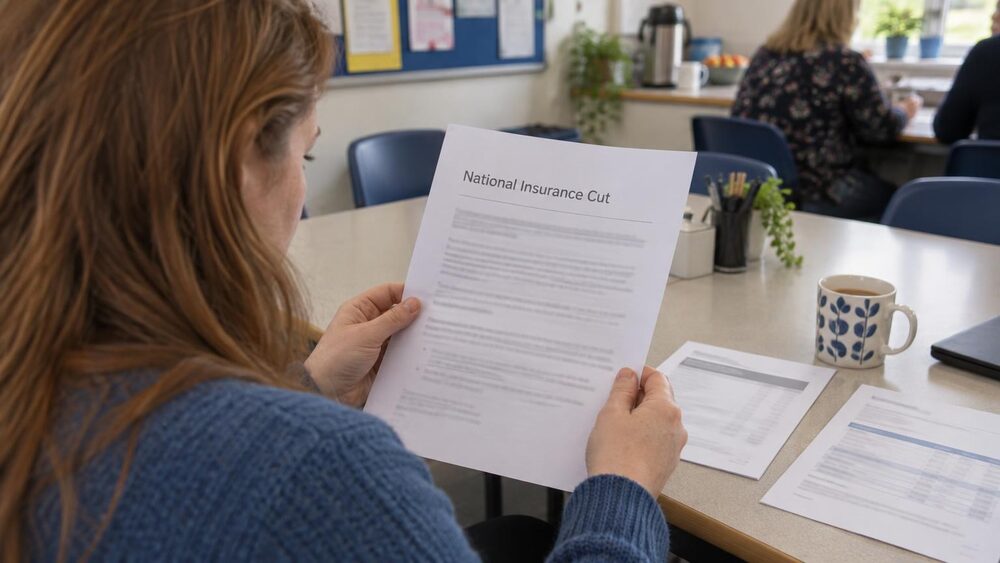
The Chancellor, Jeremy Hunt, announced a 2p cut to the main rate of employee National Insurance in his Autumn Statement, according to the Resolution Foundation1. The think tank describes it as "the first proper cut to the main NI rate since 1985"1. The employee NI cut is being introduced in January1.
The self-employed were treated differently. The Resolution Foundation says the Chancellor "could have done exactly the same for the self-employed, but he didn't"1. Instead, they get a 1p cut, combined with the abolition of the flat rate weekly NI charge they face, called Class 2 NICs1. The result is that those on higher earnings, over £32,000, get a smaller tax cut if they are self-employed than if they are employees, and the Chancellor has closed the maximum size of that gap from £940 to £750 a year1.
The Resolution Foundation sets the tax cuts against a rising overall tax burden. It says these are the biggest tax cuts since 1988, but that the tax burden has risen by 4.5 per cent of GDP between 2019-20 and 2028-29, equivalent to £4,300 per household1. It attributes this to surging debt interest and a sicker, older population1. The debt interest bill is on course to be over £120 billion by 2028-29, around 4 per cent of GDP, twice what the UK has been used to over the last two decades and the highest sustained level since the 1980s1.
On business investment, the Chancellor made the full expensing of plant and machinery permanent1. The Resolution Foundation says the OBR and the Foundation think this will boost business investment and eventually GDP by around 0.2 per cent1. Public sector net investment, by contrast, is now set to decline as a share of GDP by one-third between 2023-24 and 2028-291.
"The main rate of employee NI has been cut by 2p"
Why it matters for households
Employees paying the main rate of National Insurance will see a 2p cut from January1. The Resolution Foundation notes that the cut is structured so that it slightly reduces the tax dodging incentive for higher earners to be self-employed1.
The wider picture for household finances is set out in the same analysis. On the OBR's new forecasts, wages in 2028 are set to be no higher than they were in 20081. Disposable incomes are set to be 3.1 per cent lower in January 2025 than December 2019, a fall worth £1,900 per household1. The Resolution Foundation says incomes have never been lower at the end of a parliament than at its beginning in records running back to the 1950s, and that this is about to happen for the first time1.
Self-employed people on higher earnings, over £32,000, get a smaller tax cut than employees, with the maximum size of the gap closed from £940 to £750 a year1.
What happens next
The employee NI cut takes effect in January1. The Resolution Foundation notes that the timing has convinced many that a May election is likely, but adds that historically the polls have been more important to election timing than specific tax cuts, and that since 1950 no governing party has called an early election while trailing in the opinion polls and won1.
Sources1 cited
- Autumn Statement of intent • Resolution Foundation resolutionfoundation.org
 GOV.UKOfficial information on tax, benefits and government services
 MoneyHelperFree, impartial money and pensions guidance, set up by government
 Citizens AdviceFree advice on money, consumer and legal problems in England and Wales
 Turn2usFree benefits calculator and grants search from a charity
 Citizens Advice ScotlandFree advice across Scotland