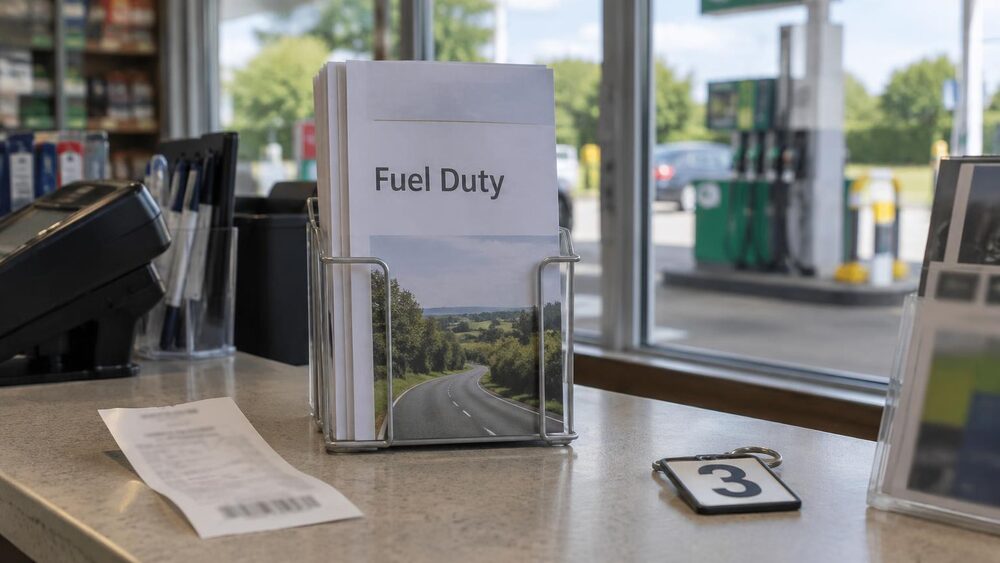
The temporary 5p cut to fuel duty will remain in place until August 2026, according to HM Revenue & Customs' published rates and allowances, which list "Continued cut rates (to 31 August 2026)"1. The cut is then phased out: duty rises by 1p in September 2026, a further 2p in December 2026 and another 2p in March 2027, returning rates to March 2022 levels2. The planned inflation increase for 2026 to 2027 has been cancelled, with fuel duty instead set to rise in line with RPI from April 20272.
Unleaded petrol duty is 0.5295 per litre until 22 March 2026, with the continued cut to 31 August 2026 and higher rates from 1 September and 1 December 2026 and 1 March 20271. The dates of the staged increases are given as 1 September 2026, December 2026 and March 20272.
The change sits alongside other motoring costs. Vehicle excise duty rates are expected to rise from April 2026 in line with inflation, which will also affect electric vehicle drivers3. Confused.com reported on 25 March 2026 that the average cost of car insurance in the UK had dropped by £66 in the past 12 months, to £711, the lowest price recorded in almost three years, but that prices had risen for some drivers in the previous three months3.
"The temporary 5p cut to fuel duty will remain in place until August 2026."
The wider Budget 2025 rates annex sets out other changes taking effect from 6 April 2026, for the tax year 2026 to 20271. Dividend tax rates rise by two percentage points from April 2026: the ordinary rate from 8.75% to 10.75% and the upper rate from 33.75% to 35.75%, with the additional rate unchanged at 39.35% and the dividend allowance staying at £5001. Income Tax bands and main rates are unchanged, with the basic rate at 20% on £1 to £37,700, the higher rate at 40% on £37,701 to £125,140 and the additional rate at 45% above £125,140, and the personal allowance held at £12,5701.
Several smaller allowances rise by 3.8% from April 2026 in line with September 2025 CPI1:
| Allowance | 2025 to 2026 | 2026 to 2027 |
|---|---|---|
| Blind Person's Allowance | £3,130 | £3,250 |
| Married Couple's Allowance (maximum) | £11,270 | £11,700 |
| Married Couple's Allowance (minimum) | £4,360 | £4,530 |
| Qualifying Care Relief annual fixed amount | £19,690 | £20,440 |
Sources differ on the Married Couple's Allowance income limit. HMRC gives £37,700 for 2025 to 2026 and £39,200 for 2026 to 20271; Which? describes the limit rising from £37,000 to £39,2002.
Why it matters for households
Fuel duty is charged per litre on petrol and diesel, so the staged increases from 1 September 2026, 1 December 2026 and 1 March 2027 feed through to pump prices for anyone buying fuel, whether for a private car or a business vehicle1. The cut that has held duty down since March 2022 ends on 31 August 2026, and the three later steps return the rate to its March 2022 level2. From April 2027 duty is set to rise with RPI rather than by the cancelled 2026 to 2027 inflation increase2.
For households with dividend income, the two percentage point rise in the ordinary and upper rates applies from 6 April 2026, while the first £500 of dividend income remains tax-free1. The 3.8% uplift to smaller allowances also takes effect from 6 April 20261. National Insurance rates and thresholds for employees and the self-employed are unchanged for 2026 to 2027, with Class 1 employee contributions at 8% between the Primary Threshold and Upper Earnings Limit and 2% above it, and Class 4 at 6% between the Lower and Upper Profits Limits and 2% above1. More detail is in our guides to tax and National Insurance.
What happens next
The continued fuel duty cut runs to 31 August 2026, with increases from 1 September 2026, 1 December 2026 and 1 March 20271. The 2026 to 2027 tax year changes, including the dividend rate rises and the 3.8% allowance uprating, take effect from 6 April 20261. Vehicle excise duty rates are expected to rise from April 2026 in line with inflation3.
 GOV.UKOfficial information on tax, benefits and government services
 MoneyHelperFree, impartial money and pensions guidance, set up by government
 Citizens AdviceFree advice on money, consumer and legal problems in England and Wales
 Turn2usFree benefits calculator and grants search from a charity
 Citizens Advice ScotlandFree advice across Scotland