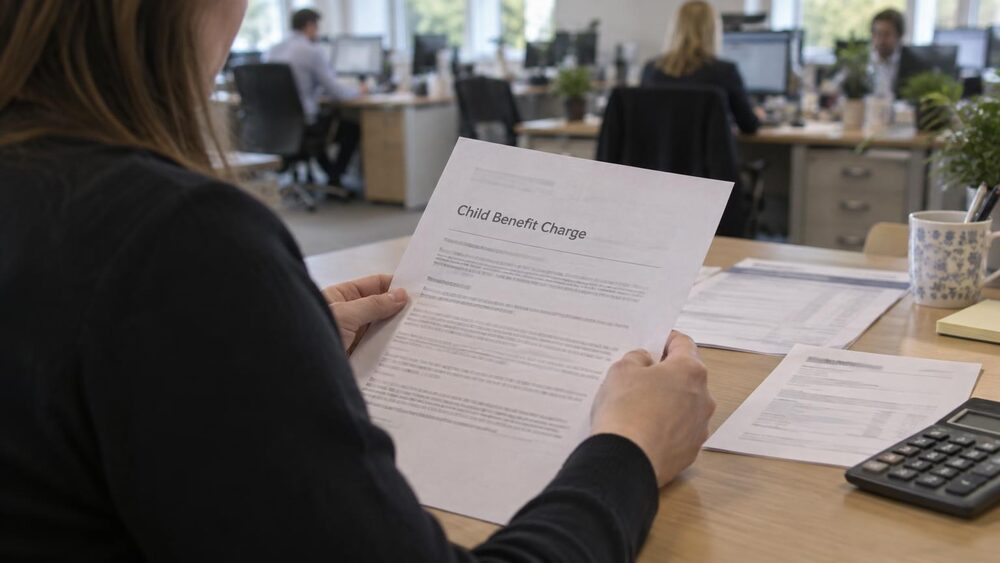
The government announced in July 2023 that it intends to let employed customers pay the High Income Child Benefit Charge (HICBC) through their tax code, removing the need for them to register for Self Assessment1. The change was set out in a written statement to Parliament dated 18 July 20231.
The HICBC applies where someone in a household claiming Child Benefit has an income of more than £50,000 a year. Joint income is not counted, so a couple where both earn £49,000 are not affected. HMRC withdraws 1% of the benefit for every extra £100 earned above £50,000, and on incomes above £60,000 the value of Child Benefit is taxed away completely1.
The government's own words on the plan were:
"The government will provide details in due course on how it will enable employed customers to pay through their tax code, without the need to register for Self Assessment."
The announcement followed earlier confirmation that HMRC was examining whether the charge could be administered through PAYE instead of self-assessment, which would make it easier for employees to pay1. The government has not said when the tax code route will be available; the details are described as coming "in due course"1.
Separately, in the Spring Budget of March 2024 the Chancellor announced two changes taking effect from April 2024: the threshold at which parents start to pay the charge rises from £50,000 to £60,000 a year, and the upper income threshold at which Child Benefit is fully taxed away rises from £60,000 to £80,0001. The Chancellor also asked HMRC to go further and move to a household basis for assessing income, which the blog reporting these changes said was stated to occur in April 2026, though it noted the decision would fall to a future Chancellor1.
| Measure | Before | From April 2024 |
|---|---|---|
| Income at which the charge starts | £50,000 | £60,000 |
| Income at which Child Benefit is fully taxed away | £60,000 | £80,000 |
Why it matters for households
Under the current system, an employed parent whose income exceeds £50,000 must register for Self Assessment to pay the charge, even where all their tax is otherwise collected through PAYE1. The July 2023 announcement is intended to remove that step for employed customers, so the charge would be collected through the tax code instead1. No date has been given for when this will happen1.
The charge affects families claiming Child Benefit where one person's income is above the threshold. Because it is based on the amount of Child Benefit received, larger families face a steeper withdrawal: for a family with three children, the value of Child Benefit was £3,100 a year from April 2024, equivalent to paying back 31p for every pound earned over £50,000 until the benefit is fully taxed away at £60,0001. The reporting notes that the charge has also affected take-up, with the proportion of eligible children for whom Child Benefit is claimed falling from 97% in 2012 to 89% in 2022, which it links to the introduction of the HICBC in 20131.
What happens next
The government has said it will provide details in due course on how employed customers will be able to pay through their tax code without registering for Self Assessment1. No timetable for that has been reported. The move to a household basis for assessing income was stated to occur in April 2026, but the reporting notes that decision will fall to a future Chancellor1.
Sources1 cited
- Is it time to change the High Income Child Benefit Charge? entitledto.co.uk
 GOV.UKOfficial information on tax, benefits and government services
 MoneyHelperFree, impartial money and pensions guidance, set up by government
 Citizens AdviceFree advice on money, consumer and legal problems in England and Wales
 Turn2usFree benefits calculator and grants search from a charity
 Citizens Advice ScotlandFree advice across Scotland