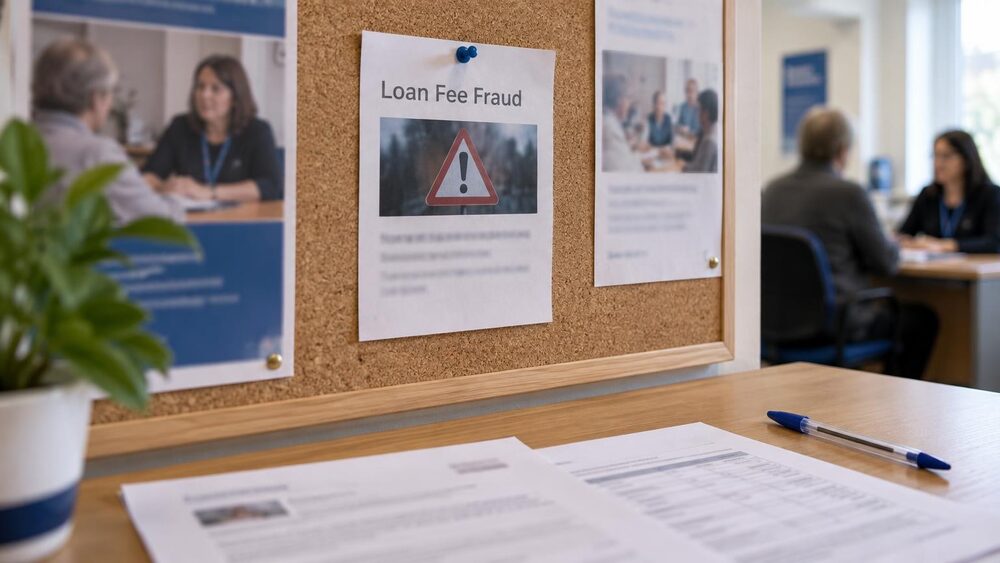
The Financial Conduct Authority (FCA) has issued a warning about the dangers of loan fee fraud in the run up to Christmas, and found that cases of loan fee fraud are up by a fifth compared to last year1. The warning was reported on 14 December 20221.
Loan fee fraud, also called advance fee fraud, is a scam in which a fraudster asks for an upfront fee, usually between £25 and £450, in order to take out a loan1. Victims who have made several online loan applications are contacted by scammers via text, email or telephone and are offered a non-existent loan1. In some cases more than one fee is requested1. Victims are told the fee acts as a deposit, administrative fee, insurance or is required because of their bad credit history, and will be refunded later1. Scammers may ask for the fee to be paid in an unusual way, such as via Western Union or in vouchers, and may pressure victims to pay as soon as possible1.
People experiencing financial difficulties, those with a poor credit history and those on a low income are particularly vulnerable to scammers preying on their inability to access mainstream loans1. Personal information may have been obtained from an unsecure broker or loan comparison website, and scammers can also target people through fake loan companies advertised on social media1.
The FCA's research also looked at Christmas spending. It found that two in five consumers felt pressured by family and friends to conduct Christmas spending as usual this year, and a third of those who felt pressured were worried about how they would afford to pay for Christmas1. One in eight consumers said they planned to take out a loan to cover their Christmas shopping1.
"The FCA found that cases of loan fee fraud are up by a fifth compared to last year."
Why it matters for households
Anyone searching for a loan, particularly people who have applied to several lenders online, can be contacted by someone offering a loan that does not exist1. The money lost is the upfront fee itself, which the FCA puts at usually between £25 and £450, and which is not returned1. Because the loan is never provided, a household that has already paid a fee is left without the borrowing it was seeking and without the fee1. The FCA identifies people in financial difficulty, those with a poor credit history and those on a low income as particularly exposed, because scammers target people who cannot access mainstream loans1. The warning comes as one in eight consumers said they planned to borrow to cover Christmas shopping1.
The FCA's register can be used to check whether a lender is authorised, and its consumer helpline is 0800 111 67681. Suspicious firms can be reported to the FCA through its reporting form1. If you have been scammed, report it to Action Fraud, and suspicious websites should be reported to the National Cyber Security Centre at www.ncsc.gov.uk1. Our guides explain how upfront fee loan and prize scams work, how to check a firm against the FCA Warning List and ScamSmart, and what to look for if a lender asks for a fee before lending. There is also guidance on the risks of borrowing to pay for Christmas and on loan fees and charges more generally.
What happens next
No further FCA action or timetable has been reported1. The FCA's warning covers the period in the run up to Christmas 20221.
 FCA Warning ListCheck whether a firm is authorised before you deal with it
 Financial Ombudsman ServiceFree, independent help when a complaint about a firm is not put right
 Citizens AdviceFree advice on money, consumer and legal problems in England and Wales
 MoneyHelperFree, impartial money and pensions guidance, set up by government