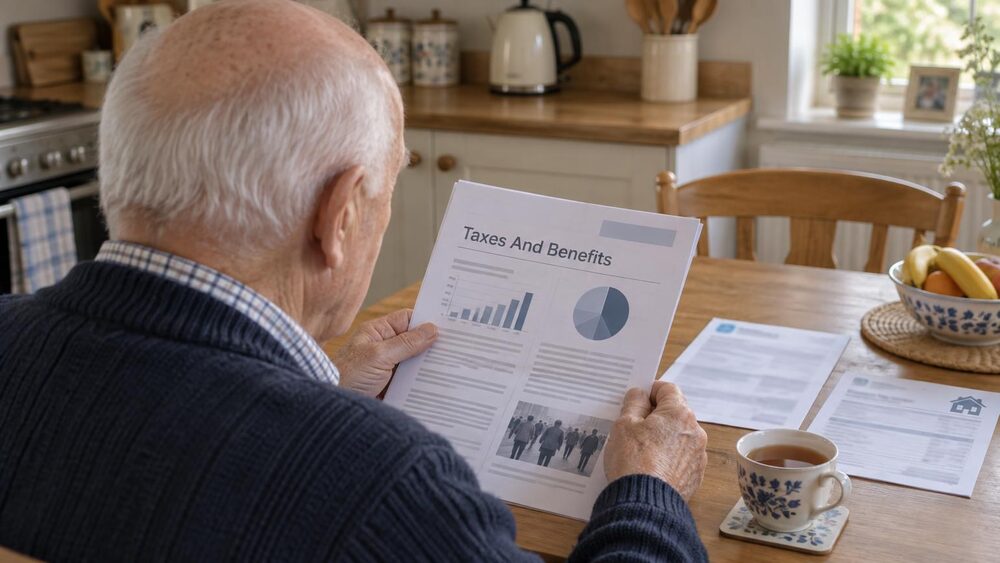
The Office for National Statistics (ONS) published its effects of taxes and benefits on UK household income bulletin for the financial year ending (FYE) 2021 on 29 July 2022. It reported that the proportion of individuals receiving more in benefits than they paid in taxes rose from 47.5% to 55.0% over the year, the largest annual increase since records began in 19771.
The ONS said reductions in indirect taxes and increased benefits-in-kind, largely in response to the coronavirus pandemic, drove the change1. Indirect taxes fell by 24% between FYE 2020 and FYE 2021, which the ONS linked to policy changes such as a temporary reduction in Value Added Tax (VAT) and to lower overall spending during the pandemic. Benefits-in-kind rose by 15%, with increased NHS spending the main driver. Mean cash benefits were broadly constant, with a nominal increase of £44, and direct taxes fell slightly, by 2%1.
The bulletin also reported that median household income before taxes and benefits was £34,000 in FYE 2021, rising to £37,600 after taxes and benefits. The richest fifth of people had average income before taxes and benefits of £107,600, more than 13 times the poorest fifth's £8,200. After all taxes and benefits, that gap narrowed to 3.7 times, with average final income of £79,200 for the richest fifth and £21,400 for the poorest fifth1.
Income inequality fell by 1.6 percentage points after all taxes and benefits between FYE 2020 and FYE 2021, following a decade of relative stability. Indirect taxes pushed inequality up by 3.8 percentage points: the poorest fifth paid 22.9% of disposable income in indirect taxes such as VAT, against 9.1% for the richest fifth1.
The ONS published a correction on 18 July 2023, after quality assurance identified a processing error in the FYE 2021 dataset affecting post-tax and final income across a range of tables. Revised post-tax and final income remained within 0.1% of previously reported values. The corrected proportion of individuals receiving more in benefits than they paid in taxes was 55.0%, up from the 54.2% first reported, and the corrected Gini coefficient for final income inequality was 29.3%, down from 29.9%1.
"Ongoing quality assurance identified a processing error relating to the dataset 'The effects of taxes and benefits on household income' for financial year ending 2021."
Why it matters for households
The figures cover FYE 2021, which ran from April 2020 to March 2021 and took in the first year of the coronavirus pandemic, so they describe incomes during that period rather than current circumstances1. The rise in the share of people receiving more in benefits than they paid in taxes reflects a year in which indirect taxes fell and benefits-in-kind, chiefly NHS spending, rose, rather than a change to the tax and benefit rules themselves1.
The distributional detail shows who was affected and how. The poorest fifth saw cash benefits rise by 1.9%, a nominal increase of £217, direct taxes fall by 17.3% and indirect taxes fall by 20.6%, with benefits-in-kind up 17.2%1. Mean final income rose across all income quintiles: by 8.4%, or £1,670 in cash, for the poorest fifth, and by 3.4%, or £2,570, for the richest fifth, against an average rise of 6.4%1.
Retired individuals were far more likely than non-retired individuals to receive more in benefits than they paid in taxes, at 87.6% against 47.2%, largely because State Pension and Pension Credit are classified as cash benefits. The number of non-retired individuals in that position rose by 8 percentage points over the year1. The bulletin sits within the wider picture of tax and benefit treatment of household income.
What happens next
The ONS lists the next release of this bulletin as to be announced1.
 GOV.UKOfficial information on tax, benefits and government services
 MoneyHelperFree, impartial money and pensions guidance, set up by government
 Citizens AdviceFree advice on money, consumer and legal problems in England and Wales
 Turn2usFree benefits calculator and grants search from a charity
 Citizens Advice ScotlandFree advice across Scotland