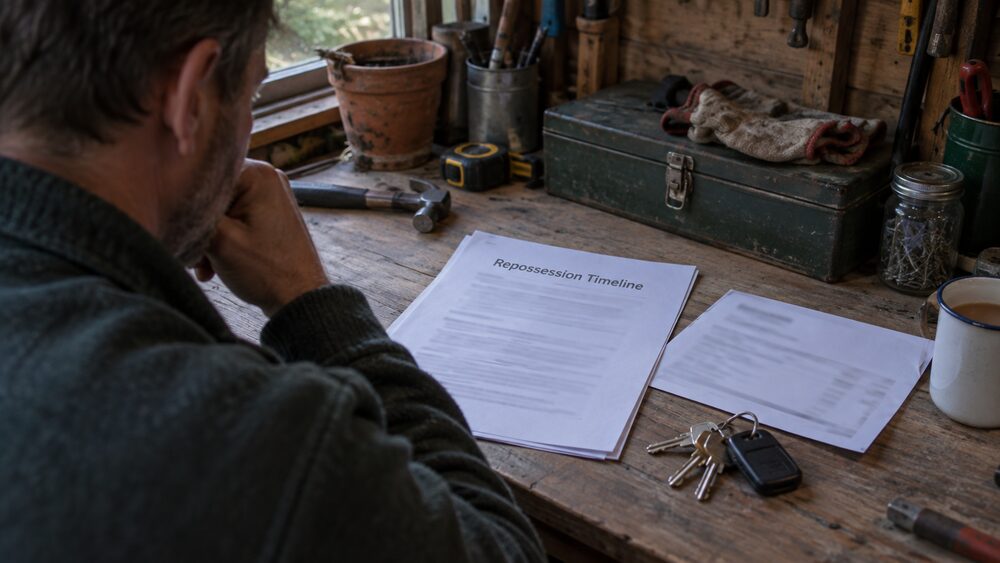
Repossession is when your mortgage lender asks a court to evict you so it can sell your home to pay off your mortgage1. For a residential mortgage it cannot simply take the property back: if the property is your home, the lender will normally need a court order, and it has to repossess and evict you before it can sell1.
The official court statistics give the clearest answer on timing. In April to June 2026, the median average time from a mortgage claim reaching court to repossession was 49.1 weeks in England and Wales, up from 42.9 weeks in the same period in 20253. That average hides a wide split. Where a judge makes an outright possession order, the median was 45 weeks, an increase of 5.3 weeks. Where the order is suspended, so you stay in the home on conditions, the median was 120.7 weeks, a decrease of 22.4 weeks3.
So the honest answer is: months, not weeks, and often more than two years if a judge suspends the order. The process can also be paused, delayed or stopped at several points, and free advice is available at every one of them.
The stages of mortgage repossession and how long each takes
The process runs in a fixed order, and each stage has its own rough duration.
It starts with arrears. Most lenders do not start repossession action until you have missed at least 3 payments4. If you miss repayments and cannot agree a repayment plan, the lender might start court action7. Before that, lenders have a range of forbearance options: reducing your payments for a set period, charging interest only for a while on a repayment mortgage, giving a payment holiday, or extending the mortgage term to reduce payments, depending on your payment history and whether the difficulty is short or long term8.
The claim then goes to court. In July to September 2025, the median time from claim to order was 8 weeks, unchanged from the same period in 20249. The hearing itself is short: about 10 minutes10. You are advised to arrive about 30 minutes early to the court building10.
After an order, the lender applies for a warrant, and bailiffs attend. In April to June 2026 the median warrant to repossession time was 10.1 weeks, up from 9.6 weeks a year earlier3. Once you are evicted, arrangements to remove your furniture and possessions should usually be within two weeks of the eviction2.
Why a suspended possession order slows repossession down
A suspended possession order is the single biggest reason a repossession takes years rather than months. The court makes the order but does not let the lender enforce it as long as you keep to a repayment plan, for example paying £50 a month on top of the normal mortgage payment1. Because the order sits there unenforced while you pay, the clock runs on.
The gap is stark in the statistics. Suspended orders took a median of 120.7 weeks from claim to repossession in April to June 2026, against 45 weeks for outright orders3. In the earlier July to September 2025 data the same split showed 114.7 weeks for suspended orders and 42.9 weeks for outright orders9.
A court can often stop repossession altogether if you show you can repay the arrears by the end of the mortgage term12. Your lender will usually delay repossession action if you can show you are prioritising your mortgage arrears and can pay them off over time12. You can make a repayment proposal at any stage of the process13.
There are other brakes. Breathing space pauses the repossession process for up to 60 days while you get debt advice4. If you are a tenant in a property being repossessed, you can ask for up to 2 months' delay in the eviction process, and the judge can delay the date on a possession order by up to 2 months14. Under the Mortgage Repossessions (Protection of Tenants etc) Act 2010, the court may postpone the date for delivery of possession for a period not exceeding two months on the tenant's application15.
When a borrower dies: repossession can take up to 6 months
When the person who owed the mortgage dies, the debt does not disappear with them. How long you have before the lender repossesses depends on the lender, and can take up to 6 months16. That window is the time to work out whether the mortgage will be paid from the estate, by a surviving borrower, or by a sale.
The type of mortgage matters. With a lifetime mortgage, you usually do not have to make repayments while you remain in the home, and the loan is paid back after you move out or die17. The debt is repaid once you die or move into long-term care and the property is sold, and it grows over time, eroding the property's value18. For a couple, repayment is not made until the last remaining person living in the home either dies or moves into care, and the loan and rolled-up interest is then repaid by the estate19.
If the mortgage was an ordinary repayment mortgage, the mortgage is usually for a long period, typically up to 25 years, paid back by monthly instalments20. Those instalments still fall due after a death, which is why the 6-month window matters. There is more detail on what happens to a mortgage when someone dies.
What can make repossession faster or slower
Several things move the timetable in one direction or the other.
Slower: a suspended order rather than an outright one3; a repayment plan the court accepts1; breathing space, which pauses the process for up to 60 days4; a claim on a mortgage payment protection policy, which may lead the lender to postpone repossession action21; and the general reality that the process can take many months, giving you time to get help and stop it going further22.
Faster: an outright possession order, where the median is 45 weeks3; a lender that has not agreed a repayment plan7; and, in Scotland, a shorter notice period, where a borrower usually gets at least 21 days' notice of the court date23.
The Mortgage Charter is the biggest single protection. Lenders signed up to it have agreed not to repossess until at least 12 months after you first miss payments24. The commitment is not to force a borrower to leave their home without their consent, unless in exceptional circumstances, in less than a year from their first missed payment5. Before June 2023, lenders could start repossession orders after three months of arrears26.
Do I still owe money after my home is repossessed and sold?
Yes, if the sale does not cover what you owe. You remain responsible for mortgage payments until the home is sold27. That includes any arrears, ongoing mortgage and interest payments, buildings insurance, and penalty charges for missed payments27. After you have been evicted, the lender will still add interest to your mortgage account until the property is sold2.
When the home is sold, the lender and any other secured debts use the money to clear your debt with them. You get any money left over, and if the sale does not cover your debt, you may be asked to pay this back22. In Scotland the position is the same: you will have to pay back the difference if the sale does not cover what is left on your mortgage28.
The shortfall can be pursued for a long time. Mortgage lenders may try to recover a mortgage shortfall for up to 12 years29. One source puts the recovery period at up to 20 years, so the sources give different outer limits30. Lenders have 12 years to try to recover a mortgage shortfall through the courts, and six years to recover interest owing31.
There is also a credit record consequence. When your home is repossessed it stays on your credit record for up to 6 years32. Repossession will affect your credit rating, which can make it harder to get another mortgage, and you may have to pay a larger deposit and a higher interest rate28. It is easier after about 3 years if your finances improve32. There is more on borrowing again after a repossession.
Selling your home yourself before repossession
A mortgage repossession hearing gives a borrower a chance to explain to a judge why the home should be kept or sold by the borrower10. Lenders should give a borrower the chance to sell the home to pay off the debt, and the borrower must be able to show that active steps to sell are being taken33. A borrower can also ask for the possession order to be postponed for a longer period, for example three months, to allow a sale11.
Selling yourself is one option among several. The alternatives include agreeing a repayment plan with the lender, asking the court to suspend the order, using breathing space, or, in Scotland, applying to the Home Owners' Support Fund, which is available where your bank or mortgage lender wants to begin repossession proceedings in court34. The right route depends on your equity, your income and how far the process has gone.
Where to get free help if your home is at risk
Free, impartial advice is available across the UK, and getting it early changes what happens next.
- Shelter England covers missed mortgage payments, court hearings, paying off arrears, selling to avoid repossession and finding a home after repossession4.
- Shelter Scotland covers the sheriff court process and what happens after repossession23.
- Shelter Cymru covers going to court, sale by a mortgage lender and repossession by a landlord's lender27.
- Housing Rights in Northern Ireland covers sorting out mortgage problems, being taken to court and losing a home you own33.
- National Debtline covers mortgage arrears and secured debt2.
- Business Debtline covers mortgage arrears, credit reference agencies and selling assets to clear debt11.
- StepChange covers house repossession and bankruptcy22.
- nidirect covers mortgage arrears or payment difficulties and advice to avoid losing your home21.
- Macmillan covers managing debt and understanding your mortgage if you are affected by cancer43.
If you think a lender has treated you unfairly, the Financial Ombudsman Service handles complaints about financial difficulties with mortgages24. In Scotland, the Home Owners' Support Fund can help where court proceedings have started34.
Sources44 cited
- What happens when a lender sells your home Shelter England, 2026
- Mortgage arrears (England and Wales) National Debtline, 2026
- Mortgage and landlord possession statistics: April to June 2026 Ministry of Justice, 2026
- How to deal with missed mortgage payments Shelter England, 2026
- Mortgage Charter HM Treasury, 2023
- Mortgage arrears and possessions House of Commons Library, 2026
- Repossession GOV.UK, 2026
- Mortgage arrears or payment difficulties nidirect, 2025
- Mortgage and landlord possession statistics: July to September 2025 Ministry of Justice, 2025
- Mortgage repossession hearings Shelter England, 2026
- Mortgage arrears (England and Wales) Business Debtline, 2026
- How to pay off mortgage arrears Shelter England, 2026
- Debt and legal advice Shelter England, 2025
- Going to court Shelter Cymru, 2026
- Mortgage Repossessions (Protection of Tenants etc) Act 2010, section 1 legislation.gov.uk, 2010
- Changing tenancy and home ownership after a death Scope, 2026
- Equity release Financial Ombudsman Service, 2026
- Retirement interest-only mortgages explained Which?, 2026
- What is equity release? Equity Release Council, 2026
- Money jargon A to Z Citizens Advice Scotland, 2026
- Advice to avoid losing your home nidirect, 2025
- House repossession StepChange, 2026
- Court Shelter Scotland, 2025
- Financial difficulties with mortgages Financial Ombudsman Service, 2023
- FCA Mortgage Charter uptake data FCA, 2024
- What to do if you can't pay your mortgage Which?, 2025
- Sale by mortgage lender Shelter Cymru, 2026
- After repossession Shelter Scotland, 2025
- Credit reference agencies (England and Wales) National Debtline, 2026
- Credit reference agencies (Scotland) Business Debtline, 2026
- Whose debt is it? Shelter Cymru, 2026
- Find a home after repossession Shelter England, 2026
- Sorting out mortgage problems Housing Rights, 2026
- Home Owners' Support Fund: who can apply mygov.scot, 2026
- Private sale and rent-back schemes Shelter Cymru, 2026
- Selling your home to avoid repossession Shelter England, 2025
- Repossession by a landlord's lender Shelter Cymru, 2026
- Taken to court by your mortgage lender Housing Rights, 2026
- Losing a home you own Housing Rights, 2026
- What is secured debt? National Debtline, 2026
- Selling assets to clear debt (England and Wales) Business Debtline, 2026
- Selling assets to clear debt (Scotland) Business Debtline, 2026
- Managing debt Macmillan Cancer Support, 2026
- Understanding your mortgage Macmillan Cancer Support, 2022






 MoneyHelperFree, impartial money and pensions guidance, set up by government
 StepChangeFree debt advice and solutions from a charity
 Financial Ombudsman ServiceFree, independent help when a complaint about a firm is not put right
 Citizens AdviceFree advice on money, consumer and legal problems in England and Wales
 ShelterFree housing advice from a charity