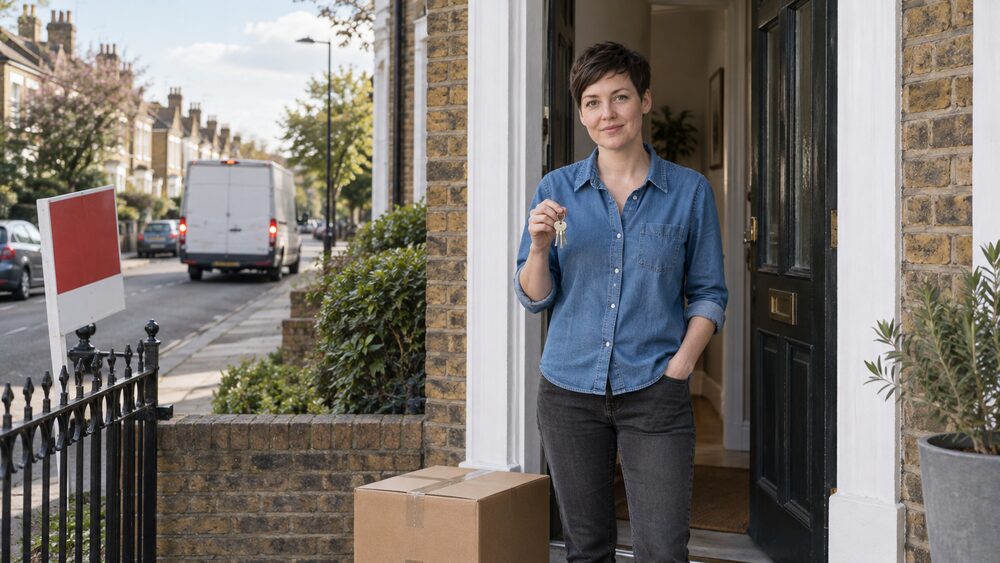
When you separate and own a home together, there are usually two routes: one of you buys the other out, or you sell the home and split the proceeds. MoneyHelper sets out four options in total: sell the home and both move out; one partner buys the other out; keep the home without changing ownership; or transfer part of the property's value from one partner to the other1.
Neither route happens automatically. If you own the home jointly, you have to get the joint owner's permission to sell the property, so one person cannot simply put it on the market2. A buyout means one of you takes on the whole property and the other's share is paid out, usually by remortgaging in one name. A sale means the home goes on the open market, the mortgage is cleared, and what is left is divided.
The figures matter from the start. In 2026 the average cost of moving is £13,018, based on buying and selling an averagely priced UK house of £292,000, and selling alone averages £4,9103. The average price of an existing resold property in England was £288,000 in May 20264. Whatever you decide, the mortgage still has to be paid until the property is sold5.
Your two options: buy your ex out or sell the home
The choice is rarely just about money. It turns on whether one of you wants to stay, whether either can afford the home alone, and whether you can agree on what the property is worth.
| Buyout | Sale | |
|---|---|---|
| What happens | One owner takes on the whole property and pays the other's share | Home goes on the open market, mortgage cleared, remainder divided |
| Who it suits | The person who wants to stay, where children are settled or the home has been adapted | Couples who both want a clean break, or where neither can afford the whole property |
| Main obstacle | The person staying must borrow enough on one income | Depends on finding a buyer |
| Costs | Conveyancing, valuation, mortgage arrangement fees, possible stamp duty land tax return | Estate agent fees, conveyancing, possibly survey and removals |
A buyout keeps the sale costs down to one transaction rather than two, and it avoids the disruption of a move. The catch is that the person staying must be able to borrow enough on their own income, and must pay the departing person their share.
A sale converts the home into cash, clears the mortgage, and lets each person start again. The costs are higher because you are selling, and possibly buying again, and the timing depends on finding a buyer.
There are two further options worth knowing about. You can keep the home without changing ownership, which defers the decision but leaves both names on the mortgage. Or you can transfer part of the property's value from one partner to the other, which shifts some equity without a full buyout1.
If the home is jointly owned, remember the permission rule: neither of you can sell without the other's agreement2. That cuts both ways. It protects you from being forced out, and it means you cannot force a sale through on your own either.
How a buyout works
A buyout is a purchase. One of you buys the other's share of the property, and the buyer usually needs a mortgage to fund it. In practice this means remortgaging the home into one name, borrowing enough to pay off the existing mortgage and to pay the departing owner their share of the equity.
The mechanics follow an ordinary house purchase. The buyer's and seller's legal representatives swap signed contracts, and the buyer pays the deposit7. Here the "seller" is your ex-partner and the "buyer" is you, but the conveyancing steps are the same, and a solicitor will handle the transfer of the title.
The lender's view is the deciding factor. A mortgage lender will assess whether the person staying can afford the loan alone, and will want the property valued. If the numbers do not work, the buyout cannot proceed on those terms, and the fallback is usually a sale.
There is a variation where a third party helps. A joint mortgage allows two people to buy a property together, with both names on the mortgage and the property deeds, which is how a parent and adult child sometimes buy together2. That structure can help someone stay in a home they could not otherwise afford alone, though it brings its own risks if the arrangement later changes.
One route that is sometimes suggested, and should be treated with caution, is a sale and rent back. These schemes, also called "sale and rent back", say they let you stay in your home by agreeing that you become a tenant, but the risks include eviction when the tenancy ends, paying less than the property is worth with high rent, and losing help with housing costs8.
Working out the equity and each person's share
Equity is what the home is worth minus what is owed on it, and each owner's share depends on how you owned it and what you agreed. In shared equity schemes in Scotland, the split is set by the share bought: under the New Supply Shared Equity scheme a buyer pays for usually between 60% and 80% of the home's cost, with the Scottish Government holding the rest, and on a sale the proceeds follow the same proportions, so a 70% share means 70% of the selling price and 30% to the Scottish Government9. Under the Open Market Shared Equity scheme the buyer's share is usually between 60% and 90% of the home's cost11. Where a shared owner's home increases in value over a number of years, they receive that additional equity if they sell12.
The valuation is the foundation of the whole calculation, and it needs to be one both of you accept. In Scotland, if you decide to transfer the home to one of you, it should be valued at the date you separated, with a current valuation also obtained if significant time has passed1. Where a scheme uses a formal valuation, the requirements can be specific: a Help to Buy equity loan valuation may require at least 6 comparable properties and sale prices from the last year if the property has increased or decreased in value13.
If you disagree with a valuation, some schemes allow a challenge. Under the House Sales Scheme in Northern Ireland, an independent valuer assesses the market value, and if you disagree you can ask for a redetermination by Land & Property Services, whose valuation is final and can go up or down14.
Shared ownership arrangements show how a share is calculated in practice. If you sell your home, you get the same share of the selling price that you own, so if you own 25% of the home you get 25% of the selling price15. Under the Open Market Shared Equity scheme in Scotland, if you have a 70% share and sell, you get 70% of the selling price and the Scottish Government gets 30%16.
The same principle applies to a buyout between two people: each person's share of the equity is what they are entitled to, and the buyout price is the departing person's share. Where the home has increased in value, a shared owner receives that additional equity if they sell17.
Getting a mortgage in your own name
The person staying usually needs a new mortgage in their own name. That means passing the lender's affordability checks on a single income, and it means the lender will value the property.
There is a clear upside to getting a name off a joint mortgage. The person whose name is taken off the mortgage should be able to borrow more to buy themselves a home than if their name was still on their ex-partner's mortgage1. That matters for the departing partner, who may want to buy somewhere else.
Taking a name off without remortgaging is not usually possible. A lender will not normally release one borrower from the debt while the other remains liable, because that changes the risk. In practice the route is a new mortgage in one name, which pays off the old one.
If the sale price is less than what you need to pay off the mortgage, you need your lender's permission to sell18. That situation, where the mortgage is bigger than the value of the home, is negative equity, and it changes the arithmetic of both options.
There are alternatives if the timing is difficult. A bridging loan can cover a gap, and one option is a let-to-buy arrangement, by remortgaging your current home onto a buy-to-let mortgage and using the equity released to buy a new property19. Let-to-buy means having two mortgages at the same time: a buy-to-let mortgage on the existing home and a standard residential mortgage on the new home20. Lenders will usually want proof that you are buying a new home at the same time as switching your mortgage, often a copy of your mortgage offer for the new home20.
Mortgage fees are part of the calculation. On a hypothetical £250,000 loan, one comparison found a two-year deal with a fee paid upfront costing £32,679 in total over the deal period, against £31,992 for a no-fee deal, making the no-fee deal £687 cheaper21. Over a five-year period the same comparison found £80,199 for a fee paid upfront against £79,980 for a no-fee deal, £219 cheaper21. The lesson is that a lower rate is not automatically the cheaper deal once the fee is counted.
Selling the home and splitting the proceeds
A sale converts the home into money. The mortgage is repaid first, then the costs of selling are met, and what remains is the equity to be divided.
The costs come off the top. Selling an averagely priced property averages £4,910, and the full cost of buying and selling an averagely priced UK house of £292,000 averages £13,018 in 20263. Conveyancing disbursements when buying, usually fees for third party services like local searches, could add up to £700 or even more3.
If you cannot agree over the proceeds of the sale, your solicitor can ask the court to decide how the proceeds are to be divided22. That is the backstop when negotiation fails.
Some schemes show how proceeds are split by share. Under the Open Market Shared Equity scheme, if you ever choose to sell the home, the Scottish Government will get a share of the money23. Under the Mortgage to Shared Equity scheme, the sale price is split between the Scottish Government and the owner based on the level of equity each holds24.
Where a home is jointly owned and one owner dies, the position can become more complicated: the home may have to be sold if there is not enough money elsewhere in the estate to pay the deceased's debts25. That is a reminder that joint ownership carries obligations beyond the couple themselves.
Costs to budget for with either option
Both routes carry costs, and they differ in shape. A sale involves estate agent fees, conveyancing, and possibly a survey and removal costs. A buyout involves conveyancing, a valuation, mortgage arrangement fees, and potentially a stamp duty land tax return.
| Cost | What triggers it | Figure |
|---|---|---|
| Full cost of moving | Buying and selling an averagely priced UK house of £292,000 | £13,018 (2026)3 |
| Selling costs alone | Selling an averagely priced property | £4,910 (2026)3 |
| Conveyancing disbursements | Third party services such as local searches when buying | Up to £700 or more3 |
| Additional dwellings surcharge | Buying an additional property in England and Northern Ireland | 5%9 |
The stamp duty question catches people out. A stamp duty land tax return can be needed where you take over a property and pay money or take on a debt, for example a mortgage, for the property26. However, the property transferred because of divorce or civil partnership dissolution is excluded26.
If you already own another home, higher rates for additional dwellings can apply. The surcharge is 5% for buying additional properties in England and Northern Ireland9. But where HMRC views you as replacing your main residence, even though you own an interest in another property, standard stamp duty rates apply9. Married couples are treated as a single unit for stamp duty purposes, so HMRC will treat you as if you are part of the same household9.
There is a timing rule behind the replacement test. The higher rates legislation refers to a period of three years ending with the effective date of the transaction in which the purchaser, or their spouse or civil partner, disposed of the sold dwelling27.
On a sale, the seller's costs are deducted before the split. On a buyout, the buyer usually pays the legal costs of the transfer, and the departing owner may negotiate for those to be shared. Either way, the figures above give a starting point for the budget conversation.
When you cannot agree: mediation and the courts
Disagreement is common, and there are steps between negotiation and a courtroom. Mediation is the usual first move, and a court claim for money is available if mediation does not work10.
If you are married or in a civil partnership and you think your ex-partner will try to sell or give away your property or things you own together, you can apply to the court for an injunction to stop them22. If your partner owns the property and you are married or in a civil partnership, you might need to apply for "home rights" to help stop your partner from selling your home22.
If you jointly own the home and cannot agree on a sale, a court order may be the route. If you still cannot get permission to sell, it may be possible to get a court order allowing the sale to go ahead5. The same principle applies to proceeds: if you cannot agree, your solicitor can ask the court to decide how they are divided22.
There are limits on what the state will do. The Scottish Government cannot buy out your partner's share of the property under the Home Owners Support Fund11. That scheme is not a route to a forced buyout between separating owners.
If a mortgage goes unpaid, the lender's powers are real but bounded. Your mortgage lender has to repossess your home and evict you before they can sell it, and must ask the court for a possession order and get court bailiffs to evict you18. A lender should give you the chance to sell your home to pay off the debt, and you must be able to show that you are taking active steps to sell8. If you cannot pay a secured loan, the lender can apply to the courts and force you to sell your home to get their money back28.
Where to get free help and advice
Free, impartial help exists, and it is worth using before costs build up. MoneyHelper runs a free pensions and divorce appointment service, and is encouraging people who may be considering or going through a divorce to talk to an expert there6.
The Housing Loss Prevention Advice Service provides free legal advice and representation as soon as your landlord or letting agent gives you a written notice that they intend to evict you12. It provides advice to tenants and homeowners as soon as they are served with a written notice asking them to leave their home29, and you can get free legal advice through it30. Its scope covers illegal eviction, rent arrears, mortgage arrears, issues with welfare benefits payments, debt concerns, and disrepair and other problems with housing conditions28.
For the wider money picture, MoneyHelper's guidance on dividing the family home and mortgage during divorce or dissolution sets out the options and the process1. Debt advice charities offer free help with mortgage arrears and secured debts, and the Financial Ombudsman Service can look at complaints about mortgages, including equity release31.
Many estate agents provide free valuations, which tell you how much your home is likely to sell for5. That is a no-cost way to start the conversation about what the home is worth and what each share might be.
Sources31 cited
- Dividing the family home and mortgage during divorce or dissolution MoneyHelper, 2026-09-25
- Guarantor mortgages Which?, 2026-04-02
- Cost of moving calculator HomeOwners Alliance, 2026
- UK House Price Index for May 2026 GOV.UK, 2026
- Selling your home voluntarily Shelter Cymru, 2026-08
- Just four in ten aware that pensions can be part of a divorce settlement Money and Pensions Service, 2026-01-05
- Help to Buy: Equity Loan repayment guide GOV.UK, 2024-07-29
- Sorting out mortgage problems Housing Rights, 2026
- Will I have to pay extra stamp duty on my new home? Which?, 2026-08-17
- Options if you're owed money GOV.UK, 2026-09-27
- Home Owners Support Fund: who can apply mygov.scot, 2026-07-14
- Notices of possession served from 1 May 2026 GOV.UK, 2026-04-07
- How to get a valuation of your Help to Buy home GOV.UK, 2025-08-18
- House Sales Scheme nidirect, 2026-02-18
- Shared ownership: after buying mygov.scot, 2018-05-25
- Open Market Shared Equity scheme: after buying mygov.scot, 2026-03-17
- Open Market Shared Equity scheme: buyer information Scottish Government, 2025-09-19
- What happens when a lender sells your home Shelter England, 2026-01-27
- Bridging loans explained Which?, 2026-06-23
- Let-to-buy explained Which?, 2026-06-23
- Are mortgage fees worth paying to secure the best rates? Which?, 2026-01-30
- What happens to an owned home after separation? One Parent Families Scotland, 2025-02-13
- Open Market Shared Equity scheme: how it works mygov.scot, 2026-03-17
- Home Owners Support Fund information booklet Scottish Government, 2015-04
- Debt when someone dies nidirect, 2026-06-26
- Check if you need to send a Stamp Duty Land Tax return GOV.UK, 2026-06-26
- Stamp Duty Land Tax: higher rates for additional dwellings legislation.gov.uk, 2026
- Secured loan debt StepChange, 2026-09-25
- Mortgage and landlord possession statistics: April to June 2026 GOV.UK, 2026-08-19
- Repossession GOV.UK, 2026-09-26
- Equity release complaints Financial Ombudsman Service, 2026-09-26



 MoneyHelperFree, impartial money and pensions guidance, set up by government
 Citizens AdviceFree advice on money, consumer and legal problems in England and Wales
 Turn2usFree benefits calculator and grants search from a charity
 GOV.UKOfficial information on tax, benefits and government services