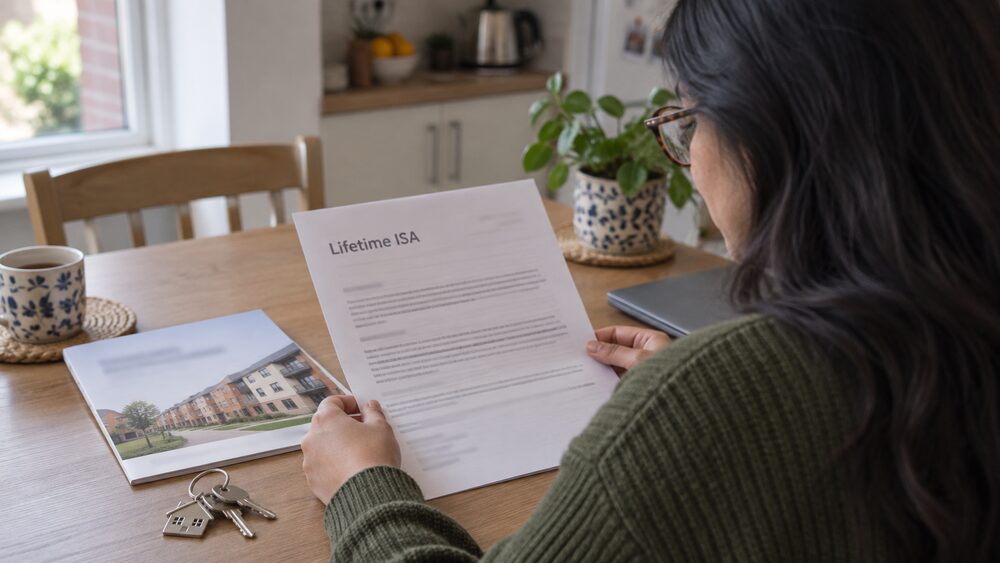
Yes, you can use a Lifetime ISA towards a shared ownership home, provided the purchase meets the same conditions as any other first home bought with one. You must be a first-time buyer, the account must have been open for at least 12 months, and the property's full purchase price must be £450,000 or less1.
Yes, you can use a Lifetime ISA towards a shared ownership home, provided the purchase meets the same conditions as any other first home bought with one. You must be a first-time buyer, the account must have been open for at least 12 months, and the property's full purchase price must be £450,000 or less1.
The £450,000 cap is the rule that catches most shared ownership buyers out. It applies to the whole property value, not just the share you are buying, and it applies in all areas of the UK2. So a 25% share of a £500,000 home is still a purchase price over the cap, and the Lifetime ISA cannot be used for it.
Where the purchase does qualify, your savings and the government bonus come out charge-free, and you can keep the account open afterwards. If it does not qualify, a 25% withdrawal charge applies to whatever you take out1.
Can you use a Lifetime ISA for shared ownership?
Shared ownership is a purchase, so the Lifetime ISA rules treat it like any other first home. The scheme lets you buy a share of a property and pay rent on the rest, and the deposit on that initial share can come from Lifetime ISA savings and the accrued government bonus6.
The same conditions apply as for a standard first-home purchase. You must be a first-time buyer, the property must cost £450,000 or less, and the account must have been open for at least 12 months before you withdraw1. The 12-month clock runs from the first payment into the account, not from when you opened it7.
One feature of shared ownership matters for the future. Buying an initial share gives you a legal interest in the property, which means you would not in future meet the definition of a first-time buyer8. That affects later purchases, not the Lifetime ISA withdrawal itself.
If you have a Help to Buy ISA or a Lifetime ISA, you can use it to pay a deposit for a home through Right to Shared Ownership or Rent to Buy9. Those are separate routes into shared ownership, and the same Lifetime ISA conditions apply.
The £450,000 limit applies to the full property value
The cap is £450,000, and it is set against the purchase price of the home rather than the slice you are buying2. This is the single most common reason a shared ownership purchase fails the Lifetime ISA test.
The rule is written as a maximum house purchase price of £450,000, and it applies in all areas of the UK2. There is no London uplift and no regional variation. The property price cap of £450,000 is described in official analysis as supporting most first-time buyers across the UK10.
For comparison, the older Help to Buy ISA scheme had a lower limit of £250,000, or £450,000 in London2. That scheme is closed to new savers, but the difference shows how the Lifetime ISA cap was set.
In practice, the cap means the share percentage is irrelevant to eligibility. A 50% share of a £450,000 home has a purchase price of £450,000 and qualifies. A 25% share of a £500,000 home has a purchase price of £500,000 and does not. If the full value is above the cap, the Lifetime ISA cannot be used for that purchase at all, whatever the size of your share.
Who qualifies: first-time buyers, the 12-month rule and age limits
Three conditions decide whether a shared ownership purchase can use Lifetime ISA money: your first-time buyer status, how long the account has been open, and your age when you opened it.
You must be a first-time buyer. The Lifetime ISA is designed to help you receive a bonus on your savings when you use them to buy a home11. The account can be opened between the ages of 18 and 395.
The account must have been open for at least 12 months before you use it to buy your first home7. A Lifetime ISA must be open for at least 12 months before you can use it to buy your first home7. If you open an account and try to buy within the year, the withdrawal will not qualify.
There is also a rule about who is lending you the money. You cannot use your savings to buy a home if you are getting a private mortgage from a relative, which covers a parent, grandparent, child, grandchild or sibling, someone married to or in a civil partnership with your relative, your spouse or civil partner, a relative of your spouse or civil partner, or someone married to or in a civil partnership with a relative of your spouse or civil partner1. A first-time residential purchase will not qualify as a withdrawal from a Lifetime ISA if the purchase is funded by a loan from a person connected to the account investor12.
Buying with a partner: both savers can use their bonus
If you are buying a shared ownership home with someone else, and you are both first-time buyers who have each held a Lifetime ISA for at least 12 months, you can both use your Lifetime ISAs to buy the home4. That means two bonuses on two sets of savings.
The official guidance confirms this: if the person you are buying with has a Lifetime ISA, you can both use your savings and government bonus, and you must both be first-time buyers and meet all the conditions1. Saving separately in two Lifetime ISAs can double the government bonus a couple can receive13.
There is a wrinkle if only one of you is a first-time buyer. Both parties in a couple do not have to be first-time buyers to benefit from the Lifetime ISA bonus, but at least one person has to be6. If your partner has owned before, you are still entitled to use your own bonus towards the price of the home you are buying together14.
One thing you cannot do is hold a Lifetime ISA jointly. You cannot have two account holders on a cash ISA, so couples cannot use them to save together13. Each Lifetime ISA is held in one name, which is why the two-account approach is the way couples use the bonus twice.
The 25% withdrawal charge if the purchase does not qualify
If the shared ownership purchase does not meet the rules, taking money out triggers a 25% government withdrawal charge. Withdrawals that are not for a first home or retirement incur a withdrawal charge of 25%10. If you withdraw for something other than paying for retirement or buying your first home, you pay a 25% penalty15.
The charge is calculated on the amount you take out, and it bites harder than it first appears. If you wish to withdraw the entire pot, a 25% charge will apply to the total amount in your ISA, including the government bonus1. For a partial withdrawal, you will have to withdraw more than the amount you need, to cover your needs and the 25% withdrawal charge1.
The charge applies to withdrawals not for a first home or retirement at 60 or over16. If you are under 60 and not buying a first home, the charge is 25% of the amount you want to withdraw17.
There is one exception worth knowing. If you die, your Lifetime ISA ends on the date of your death, and there is no charge to withdraw the funds or assets from your account1.
What happens if the purchase falls through
A shared ownership purchase can collapse after you have started the withdrawal process, and the rules allow for that. The original Lifetime ISA can be re-opened, and the amount you had saved replaced18.
That matters because the alternative would be losing the bonus and the tax-free wrapper on money you never spent. The provider handles the reinstatement, so the practical step is to tell them as soon as the purchase falls through rather than leaving the account dormant.
If you have already withdrawn and the purchase does not complete, the money needs to go back into the Lifetime ISA within the provider's process. The Financial Ombudsman Service has looked at cases where a customer lost the bonus after cashing in a Lifetime ISA, which shows how much turns on getting the timing and the paperwork right8.
A qualifying purchase releases the money charge-free; a failed purchase allows the account to be re-opened.
Do you have to close the Lifetime ISA after buying?
No. There is no requirement for Lifetime ISA users to close an account after a house purchase19. You can keep it open and carry on saving into it, within the £4,000 annual limit3.
That matters for shared ownership specifically, because you may want to buy further shares later. You can use your Lifetime ISA towards the deposit when you buy your initial share, but if you make any withdrawals to buy further shares, those are subject to the 25% government withdrawal charge20. Staircasing, as buying extra shares is called, is not a qualifying withdrawal.
So the account stays useful for retirement saving even after the purchase. The Lifetime ISA is intended for house purchase and saving for retirement, either in the alternative or in combination21. Cash Lifetime ISAs may not be the best way to save for retirement, but stocks and shares Lifetime ISAs can be a useful complementary retirement saving vehicle for some people, including the self-employed22.
You can also hold a Lifetime ISA alongside one or more of the various ISA types23. The annual contribution limit is £4,000 per tax year, and you can open and pay into one Lifetime ISA per tax year, though you are free to have multiple accounts with different providers3.
Lifetime ISA being replaced: what it means for your savings
The Lifetime ISA is being replaced by a new First Time Buyer ISA. Once available, this new product will be offered in place of the Lifetime ISA24. The government published a consultation on the implementation of a new, simpler ISA product to support first time buyers in June 202625.
The important point for anyone saving now is that nothing changes immediately. It will remain possible to open a Lifetime ISA until the new product becomes available, and for account holders to continue to save into their Lifetime ISA in line with the existing rules indefinitely24. From April 2028 you will no longer be able to open a Lifetime ISA26.
So a shared ownership purchase planned in the next couple of years can still use a Lifetime ISA opened now, provided the other conditions are met. The account keeps its existing rules, including the £450,000 cap and the 25% withdrawal charge, for as long as it is held.
How a Lifetime ISA affects Universal Credit
A Lifetime ISA counts as capital for Universal Credit. As with other savings and investment products, it counts towards the calculation of Universal Credit19.
The valuation is done on a specific basis. In calculating entitlement to Universal Credit, it is the realisable value of the Lifetime ISA that is used, meaning the amount after deduction of the withdrawal charge, not the amount held in the account19. If you are under 60 and have a Lifetime ISA, 25% can be ignored to cover the withdrawal of the government bonus27.
That treatment is worth checking before you claim, because the balance in the account is not the figure used. The realisable value is lower, which can matter if you are near a capital threshold.
There is a wider warning attached to Lifetime ISAs. Saving in a Lifetime ISA instead of a pension scheme may affect current and future entitlement to means tested benefits28. If you save in a Lifetime ISA instead of enrolling in or contributing to a qualifying scheme, occupational pension scheme or personal pension scheme, you may lose the benefit of employer contributions and your entitlement to means tested benefits may be affected21.
Sources28 cited
- Withdrawing money from your Lifetime ISA GOV.UK, 2026-09-28
- Annual savings statistics: background and methodology GOV.UK, 2025-09-18
- ISA basics NS&I, 2026-09-01
- Lifetime ISA FAQs Skipton Building Society, 2026-09-26
- Saving for your first home Newcastle Building Society, 2026-09-26
- Types of savings accounts The Nottingham, 2026-09-26
- 6 Lifetime ISA myths busted Which?, 2025-05-06
- Customer loses bonus after Lifetime ISA cashed Financial Ombudsman Service, 2026-09-26
- Right to Buy and Right to Acquire Scope, 2026-04-01
- Home ownership in England House of Lords Library, 2025-09-11
- How to get a mortgage Building Societies Association, 2023-01-19
- The Lifetime ISA (Amendment) Regulations 2024 legislation.gov.uk, 2024-04-06
- Should you open a joint savings account? Which?, 2026-02-09
- Lifetime ISA for first home Hargreaves Lansdown, 2026-09-26
- Lifetime ISA vs pension Which?, 2026-03-23
- What is a Lifetime ISA The Nottingham, 2026-09-25
- LISA vs stocks and shares ISA interactive investor, 2026-09-26
- Guide to Lifetime ISAs Barclays, 2026
- Lifetime ISA report Treasury Committee, 2025-09-11
- Using a Lifetime ISA Skipton Building Society, 2026-09-25
- COBS 14 Annex 1 FCA Handbook, 2026-04-06
- Lifetime ISA report Treasury Committee, 2025-06-30
- Can I open a Lifetime ISA alongside other ISAs? AJ Bell, 2026
- Tax update 2026: simplification, modernisation and fairness GOV.UK, 2026-06-23
- First Time Buyer ISA consultation GOV.UK, 2026-06-23
- 2 years left to open a Lifetime ISA Which?, 2028
- What counts as capital Turn2us, 2026-06-09
- COBS 14.5 FCA Handbook, 2026-04-06






 MoneyHelperFree, impartial money and pensions guidance, set up by government
 FSCSProtects your money if a bank, insurer or investment firm fails
 Financial Ombudsman ServiceFree, independent help when a complaint about a firm is not put right
 GOV.UKOfficial information on tax, benefits and government services
 Citizens AdviceFree advice on money, consumer and legal problems in England and Wales