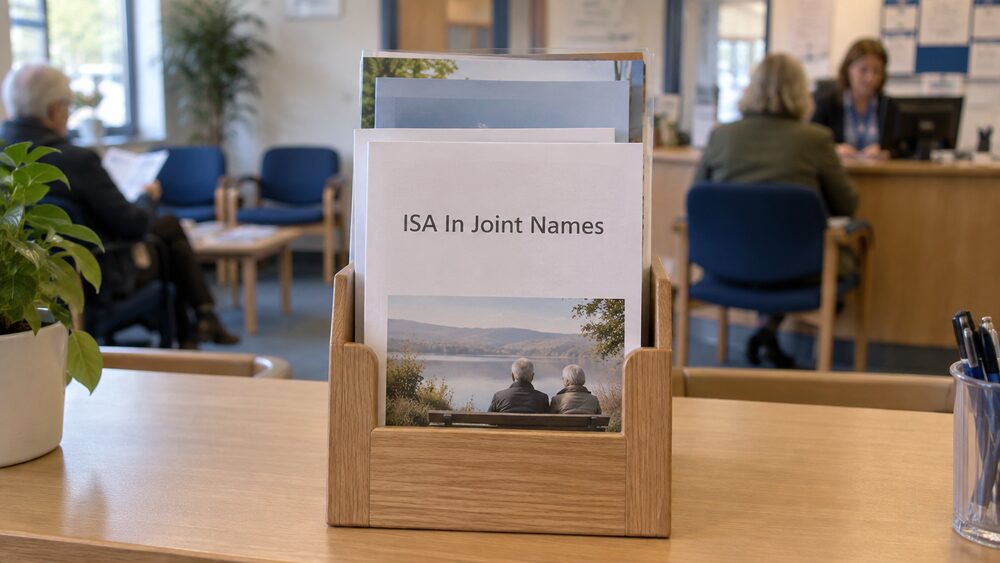
An ISA cannot be held in joint names. Every ISA is a single-name account, opened by one person using their own National Insurance number, and the money in it belongs to that person alone. The Consumer Council puts it plainly: "this type of account is individual and is opened using your national insurance number. ISAs cannot be held in joint names"1. Nationwide says the same of its own accounts: "No, ISAs can only be opened by one person as a sole account"2.
An ISA cannot be held in joint names. Every ISA is a single-name account, opened by one person using their own National Insurance number, and the money in it belongs to that person alone. The Consumer Council puts it plainly: "this type of account is individual and is opened using your national insurance number. ISAs cannot be held in joint names"1. Nationwide says the same of its own accounts: "No, ISAs can only be opened by one person as a sole account"2.
That does not stop a couple saving tax-free together. Each person has their own £20,000 ISA allowance, so two people can shelter £40,000 between them in a tax year3. What a couple cannot do is put both allowances into one account, or hold one ISA between them.
The practical answer, then, is two ISAs rather than one joint ISA. A joint savings account can be the place the money builds up, but the moment it goes into an ISA it must go into an account in one name, and it counts against that person's allowance2.
Why ISAs are single-name accounts
The tax break is what makes an ISA an ISA, and that break is tied to a person. An ISA is "a type of savings account where you don't have to pay tax on the interest or returns your savings earn"9, and the money stays free of UK Income Tax and Capital Gains Tax "while you keep the money in ISAs"10. Because the relief attaches to an individual, the account has to belong to an individual.
Providers state the rule in their own terms. Aegon says "No, ISAs can only be held in a single name"11. Newcastle Building Society notes "ISAs can only be held in a single name"12. Loanpad's terms say an ISA "will be registered in your name alone and cannot be held jointly with any other person"13. The rule is not a quirk of one bank; it runs across cash ISAs, stocks and shares ISAs and the rest.
For a couple, the consequence is simple to state and easy to act on: if you want two allowances working, you need two accounts, one in each name. A joint savings account can feed either or both, but it cannot be the ISA itself.
How couples can each use a £20,000 allowance
The annual ISA allowance is £20,000 per person per tax year14. It is not a household allowance and it is not doubled or halved by marriage. Each partner has their own, which is why a couple can shelter £40,000 in a year between them3.
That is the whole point of the two-account approach. If one partner has used their allowance and the other has not, the unused allowance cannot be transferred. It simply goes unused for that year. The allowance does not roll over, so a partner who pays in nothing in a tax year does not build up a larger allowance for later.
There is a separate allowance that does pass between spouses and civil partners, but it is not the ISA allowance. Married Couple's Allowance has an income limit of £39,20015, and it is a different relief with its own conditions. It does not let one partner use the other's ISA subscription.
Opening an ISA each: age, residency and National Insurance number
To open an adult ISA you need to be 18 or over, a UK resident, and to hold a valid National Insurance number6. Providers set this out in the same terms: Harpenden Building Society, for example, requires applicants to be "at least 18 years old and a UK resident and hold a valid National Insurance number to open a cash ISA"16. Newcastle Building Society says "to open an ISA you'll need to be 18 and have a National Insurance number"17.
The National Insurance number is what ties the account to one person, which is why a joint application is not possible. It is also why a joint bank account cannot be used to open an ISA: the account has to be in a single name, opened with that person's number1.
A couple opening ISAs each will therefore go through the process twice, once per person. Each application is assessed on that person's own details, and each account is owned by that person alone.
More than one ISA of the same type in a tax year
The rules changed on 6 April 2024. Since then, "you can now open and pay into more than one ISA of the same type in a tax year"7. The legislation behind the change permits "an individual to subscribe to more than one ISA account of the same type in a tax year"6. Barclays confirms the same: "You can also open and pay into more than one of the same type of ISAs in the same tax year"17.
So a couple is not limited to one cash ISA each. Each partner can hold several cash ISAs, or several stocks and shares ISAs, with different providers, as long as the total paid in across that person's ISAs stays within their £20,000 allowance14. There is "no specific limit for how many Isas you can hold overall"14.
One provider's page says there are no limits on how many ISAs you can have, subject to eligibility for each type, and that since the start of the 2024/25 tax year you can open the same type of ISA under as many providers as you like if aged 18 or over, with only one Lifetime ISA payable into per tax year and total payments capped at £20,000. Another provider's page says more than one ISA of the same type can be opened, with up to £20,000 in cash ISAs across different providers in the same tax year. The two are not ruled to be in conflict, but they are worded differently, and the £20,000 cap applies either way.
What happens to an ISA when a spouse or civil partner dies
An ISA does not simply stop at death. It can continue as a "continuing ISA", and that status "lasts until either the administration of the estate is complete, the Isa is closed, or three years have passed since the person's death (whichever is soonest)"8.
Alongside that, a surviving spouse or civil partner can inherit an extra ISA allowance. NS&I states: "You can now inherit an additional ISA allowance if your spouse or civil partner dies, up to the value of their ISA at the date of death"7. This is known as an Additional Permitted Subscription, or APS, and it lets the survivor "inherit ISA savings from your spouse or civil partner when they pass away, keeping the savings in a tax-free environment"18. The extra allowance sits on top of the survivor's own £20,000 annual allowance19.
The APS has been available since 3 December 2014. As one provider explains, "Since 3 December 2014, where a person holding an ISA dies and that person was married or in a civil partnership, the sur..."20. The entitlement is not lost if the ISA money itself goes to someone else: a partner "would still be entitled to an increased Isa allowance" even if the ISA assets were left to a child, funded with the survivor's own money8.
Inheritance tax: spouses and civil partners compared with other heirs
Inheritance tax treatment follows the same dividing line as the ISA rules: spouses and civil partners are treated differently from everyone else.
Anything left to a surviving spouse or civil partner is exempt from inheritance tax21. Which? states that "anything left to a surviving spouse or civil partner is exempt from inheritance tax"21, and that "transfers between spouses or civil partners, whether during lifetime or on death, are exempt from inheritance tax"22. Independent Age notes the same for a whole estate: "the entire estate is left to a surviving spouse or civil partner" is exempt23. The exemption also applies to other assets, such as joint life annuities where the chosen survivor is a spouse or civil partner24.
That exemption does not extend to unmarried partners, however long they have lived together. Which? warns: "Keep in mind that married couples and civil partners can inherit from one another tax-free - this does not apply if you're unmarried"25. An unmarried partner inheriting an ISA may face inheritance tax where a spouse would not.
ISAs themselves are not exempt from inheritance tax. The tax-free status of an ISA covers income tax and capital gains tax while the holder is alive; it does not shelter the value of the ISA from inheritance tax on death. The protection for a couple comes from the spousal exemption, not from the ISA wrapper.
Paying into a partner's ISA, and moving joint savings in
A partner can pay money into your ISA, but the money counts against your allowance, not theirs, and it becomes your money. Because an ISA cannot have two account holders, a couple cannot use one ISA to save together2. If the aim is to use both allowances, each partner needs their own account.
Moving money from a joint savings account into an ISA is straightforward. The money can be paid into your own ISA, and once inside it is free from UK Income Tax and Capital Gains Tax while it stays there10. What matters is that the payment counts against your £20,000 allowance and the ISA is in your name alone1.
Transfers between ISAs are separate from this and do not use up allowance. "Transferring funds between ISAs won't affect your tax-free ISA allowance"26, and money saved in previous years can be moved from ISA to ISA without losing the tax breaks27. A cash ISA can also be transferred into a stocks and shares ISA, in whole or in part, without losing tax benefits on the money moved28.
Where to get help
If a subscription has gone wrong, or a provider has applied the rules in a way that seems incorrect, an ISA provider has a complaints process and the Financial Ombudsman Service can look at unresolved complaints. For free, impartial guidance on how ISAs work, MoneyHelper is the government-backed service, and the tax charity TaxAid helps people on lower incomes with tax problems.
Sources30 cited
- Savings accounts Consumer Council
- Joint savings accounts Nationwide Building Society
- Should you open a joint savings account? Which?
- One million more people set to pay income tax Which?
- 5 tax year end moves interactive investor
- The ISA Regulations 2024 legislation.gov.uk
- NS&I Direct ISA NS&I
- Additional permitted subscription Newcastle Building Society
- ISA basics NS&I
- ISA allowances NS&I
- Guide to ISA Aegon
- Savings frequently asked questions Newcastle Building Society
- Explanatory memorandum to the ISA Regulations 2024 legislation.gov.uk
- Cash ISA rules and allowances Which?
- Rates and allowances GOV.UK
- Online Single Access ISA Harpenden Building Society
- Tax year end planning Barclays
- Can you inherit an ISA? Which?
- Lifetime ISA vs pension Which?
- Inheritance tax property changes Which?
- Things to do after a death Independent Age
- How much money can I pass on without paying inheritance tax? Which?
- Wills, trusts and lifetime trusts Which?
- Inheritance tax on pensions: summary of responses GOV.UK
- Can you inherit ISA savings tax free? Which?
- What is an ISA? Post Office
- What is an ISA? Trustnet
- Cash vs stocks and shares ISA Legal & General
- Are ISAs still worthwhile? Which?
- Family lending a hand Santander




 MoneyHelperFree, impartial money and pensions guidance, set up by government
 FSCSProtects your money if a bank, insurer or investment firm fails
 Financial Ombudsman ServiceFree, independent help when a complaint about a firm is not put right
 GOV.UKOfficial information on tax, benefits and government services
 Citizens AdviceFree advice on money, consumer and legal problems in England and Wales