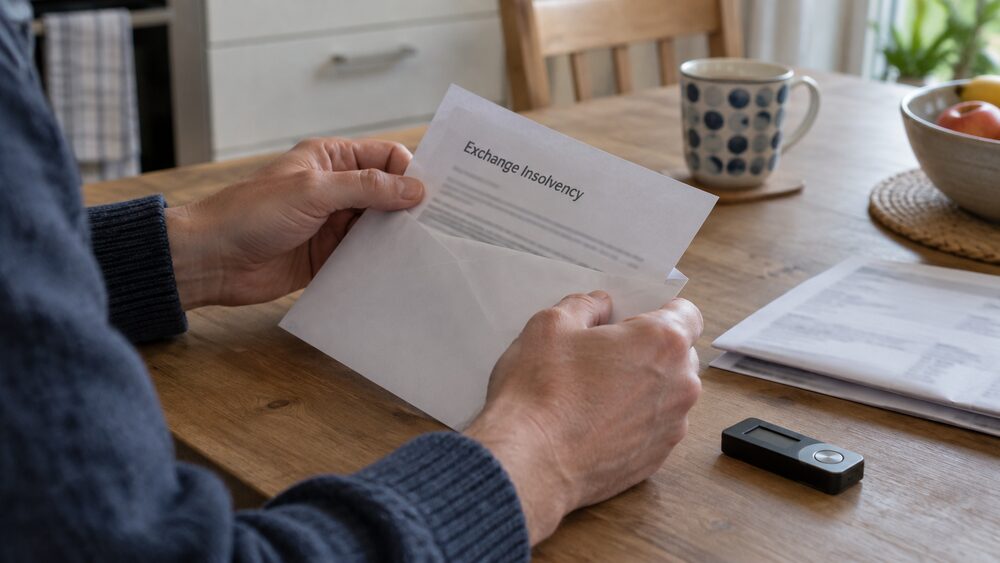
When a crypto exchange fails, the coins you hold on it do not come with a safety net. Cryptoassets are on the Financial Services Compensation Scheme's list of things it does not cover, and the scheme says most cryptoassets are not protected because they are not regulated, including virtual currencies such as Bitcoin and Litecoin1. The Financial Ombudsman Service says plainly that it cannot currently help with complaints about cryptocurrencies3.
When a crypto exchange fails, the coins you hold on it do not come with a safety net. Cryptoassets are on the Financial Services Compensation Scheme's list of things it does not cover, and the scheme says most cryptoassets are not protected because they are not regulated, including virtual currencies such as Bitcoin and Litecoin1. The Financial Ombudsman Service says plainly that it cannot currently help with complaints about cryptocurrencies3.
That is the short answer, and it is worth sitting with before anything else. The money you sent to an exchange is not sitting in a UK bank account with deposit protection behind it. If the firm goes into administration, you join a queue of creditors, and consumers in that queue are near the bottom4.
This page sets out what actually happens when an exchange collapses, where you stand in an insolvency, the warning signs that a firm is in trouble, and the steps that reduce the risk of losing everything. It also covers where to get help, and where that help stops.
What happens to your crypto when an exchange collapses
The first thing to understand is that an exchange failure is not like a bank failure. When a regulated UK bank or building society goes bust, customers get their money back automatically under the Financial Services Compensation Scheme6. That automatic return exists because deposits are a protected category. Crypto held on an exchange is not.
The largest example in recent years is FTX, which collapsed and filed for bankruptcy in November 2022, going from an estimated value of $32 billion7. Customers who had coins on the platform found themselves waiting on an insolvency process rather than a compensation scheme.
What happens next depends on how the firm held your assets. If the platform held your money in a client money account, that money is protected, and you would not have to wait for administrators to get it back1. That is the good case, and it applies to money, not to coins. Where your crypto was held in the firm's own name, or was lent out or used by the business, you are a creditor of the estate.
There is a second layer of risk that catches people out. Products that track crypto, such as crypto exchange-traded notes, carry issuer risk on top of market risk: if the organisation behind the note goes bust, you would lose some or all of your investment, and if the issuer defaults you could lose your entire investment even if the cryptocurrency performs well8. The same principle applies to an exchange: the firm's failure is a separate risk from the coins going up or down.
No FSCS protection for crypto held on an exchange
The Financial Services Compensation Scheme is the backstop most people assume covers them. For crypto, it does not. The scheme's own rules state that it does not protect qualifying cryptoassets because they are not a "specified investment" under the UK regulatory regime10. Its guidance is blunter still: crypto assets are virtual currencies and not FCA regulated, which means they are not FSCS protected11.
The scheme's published list of exclusions names cryptoassets directly, alongside peer-to-peer lending, money held on pre-paid credit cards, Christmas and other savings clubs, boiler room scam investments, losses arising purely from investment performance, and some electronic payment services or currency bureaux1. Peer-to-peer platforms are not protected either should they collapse12.
There is a further trap worth knowing about. The scheme cannot protect e-money or payment services firms, and it cannot protect you if an e-money firm or payment services firm fails13. Some crypto firms operate through e-money permissions, which can give an impression of regulatory cover that does not extend to your coins.
Does the FCA regulate crypto exchanges in the UK?
Partly, and the distinction matters. Most cryptocurrencies are not regulated by the Financial Conduct Authority, which is why they sit outside the compensation scheme5. But dealing in investments is a regulated activity in the UK, so trading platforms require authorisation from, and are regulated by, the FCA13.
That means a UK platform can be authorised for its regulated business while the coins you buy and hold on it remain unregulated. The authorisation covers the firm's conduct in specified areas, not the asset. It is a common source of confusion, and it is why "is this firm regulated?" is the wrong question on its own. The better question is whether the specific thing you are doing is a protected activity.
The Financial Ombudsman Service draws the same line. It can look at complaints about account closures, disputed transactions, IT failures and problems with switching services16, and about stocks and shares, including transactions, transfers between firms or share-dealing platforms, or charges17. It cannot currently help with complaints about cryptocurrencies3. If your complaint is about how a regulated platform handled your account, there may be a route. If it is about the crypto itself, there currently is not.
Where you stand in an insolvency: custody and creditor claims
If an exchange goes into administration or liquidation, the question that decides your outcome is who legally held your coins. Custody arrangements vary, and the paperwork you agreed to when you opened the account is what governs it.
Where you are a creditor, you are an unsecured creditor. Consumers in that position are near the bottom of the list for repayment by the insolvency practitioner and may recover little or nothing4. Secured creditors and preferred creditors rank ahead of you. This is not a crypto-specific rule; it is how insolvency works, and it applies to consumer prepayments generally.
The rules are not always applied consistently. A review of insolvency practice found that the rules around insolvency are not being consistently applied by all stakeholders, with particular issues observed in some UK-wide organisations18. That is a finding about process, not a promise of a better outcome, but it explains why outcomes vary between cases.
Two related points are worth knowing. When a consumer enters bankruptcy, their assets, including any right to compensation, pass to the trustee in bankruptcy19. And if you suspect someone of breaking the terms of their bankruptcy, you can complain to the official receiver handling the insolvency20. In around 20 to 30 per cent of bankruptcies, it is a creditor petition that leads to a bankruptcy order21.
Will I get my crypto back if an exchange goes into administration?
Sometimes, in part, after a long wait, and often not at all. There is no scheme that steps in. What you recover depends on what the insolvency practitioner can find and realise, and on where you rank.
For means-tested benefits, cryptocurrencies are treated in the same way as other investments, and you would need to provide evidence of current value such as a screenshot of your crypto wallet13. That is a benefits rule rather than an insolvency rule, but it illustrates how crypto is treated: as an asset with a value that has to be evidenced, not as money in an account.
If you paid for crypto by card, there is a narrow route that sometimes helps. If you can provide evidence of a breach of contract, for example goods not delivered or a service not carried out, you can ask your card provider to attempt to recover the payment under the chargeback scheme22. This is not a crypto protection and it does not apply simply because an exchange failed. Where a continuous payment authority was used and money was taken after you withdrew it, your card issuer should give you a refund, including any interest or charges added to your account because the payment was taken23.
Warning signs an exchange is in trouble
Some failures are sudden. Many are not, and the warning signs tend to look the same across scams and genuine distress.
Pressure to act quickly is the classic marker: scammers often create urgency to make you invest fast24. Alongside it sit lack of information, lack of regulation, fake endorsements and poorly designed websites24. Aggressive, opaque or unrealistic approaches, incentives to buy before a specific deadline, and minimum order levels can all be signs of a scam5.
The Financial Services Compensation Scheme lists seven red flags worth memorising: being asked for money or payment details; contact through an unusual channel such as WhatsApp; a phone number that is not on the firm's website; an email not ending @fscs.org.uk; an unregulated firm such as a cryptoasset provider; compensation offered in a foreign currency or by a firm in another country; and American spellings or spelling errors2.
On the account itself, watch for transactions you did not make25. More broadly, unusual payments or direct debits appearing on your bank statements, important mail going missing, bills arriving for things you have not bought, and new credit cards appearing on your credit record are all signs that something has gone wrong with your identity or accounts26.
Ways to reduce the risk of losing your crypto
There is no way to make crypto holdings protected, because the protection does not exist for this asset class. What you can do is reduce the number of ways you can lose it.
The first is to understand what you are actually holding. Crypto exchange-traded notes are a very high risk investment, and the performance of most cryptoassets can be highly volatile, with their value dropping as quickly as it can rise12. There is a risk of losing money due to cyber-attacks, financial crime and firm failure8. Those are three separate risks, and a firm failing is only one of them.
The second is to limit how much sits with any one firm. Because an exchange failure makes you an unsecured creditor, the amount you hold on a platform is the amount at risk if that platform fails. Spreading holdings does not remove the risk, but it changes the shape of it.
The third is basic account hygiene, which matters because crypto fraud often starts with access to your email or phone. Use a secure website which displays the company's contact details27. Treat your one-time passcodes as carefully as you would your PIN25. Regularly check your credit card and bank statements for suspicious activity and monitor your credit report28. If your data is breached, report lost or stolen documents to the issuer, check bank statements and your credit report, watch out for phishing, use strong passwords and multi-factor authentication, and consider applying for Cifas protective registration29.
Where to get help and how to report a problem
If you cannot withdraw your crypto, start with the firm in writing, and keep a record of every request and response. There is no recall mechanism and no compensation scheme to fall back on, so documentation is what you will have if the firm later enters insolvency.
If you think you have been defrauded, report it to Report Fraud over the phone or via their website, and contact Citizens Advice, who will pass your report on to Trading Standards. Call 999 in an emergency, or 101 if you are not in immediate danger and want to report an incident30. Phishing websites can be reported to the National Cyber Security Centre31.
For debt problems that follow a loss, free and impartial help is available. StepChange sets out your rights if you are being harassed by creditors, including that creditors must not take payments without your permission32. MoneyHelper provides free guidance on money matters, including choosing a bank account33.
Where a complaint is about a regulated firm's conduct rather than the crypto itself, the Financial Ombudsman Service may be able to help. It publishes quarterly complaints data by product, which shows the volume of complaints it receives across areas such as credit broking and Help to Buy and Shared Equity Loans34. Complaints about investments it can look at include transactions, transfers between firms or share-dealing platforms, and charges17. Complaints about cryptocurrencies it cannot currently take3.
If a firm you are owed money by enters insolvency, the official receiver handling the case is the route for reporting suspected breaches of bankruptcy terms20. For wider context on how protection works across financial products, see Cryptoassets: the rules and your protection and Are cryptoassets protected by the FSCS?.
Sources34 cited
- FSCS protected leaflet, November 2025 Financial Services Compensation Scheme, November 2025
- Episode 46 transcript Financial Services Compensation Scheme, 2025
- Electronic money complaints Financial Ombudsman Service, 2026-09-26
- Consumer prepayments and insolvency House of Commons Library, 2026-09-26
- Crypto fraud Take Five, 2026-09-26
- Protect your money NS&I
- Investing in crypto Financial Services Consumer Panel
- Crypto ETNs: risks explained Freetrade, 2026
- Complex assets Lloyds Bank, 2026-09-27
- COBS 4.16 risk summary Financial Conduct Authority, 2025-10-08
- Scams: what to look for Financial Services Compensation Scheme, 2026-05-05
- Innovative Finance ISAs explained Which?, 2026-07-08
- The rise of armchair retail trading House of Commons Library, 2026-09-15
- Check your money is protected Financial Services Compensation Scheme, 2026-09-25
- Investment scams Age UK, 2026-04-13
- Banking and payments complaints Financial Ombudsman Service, 2026-09-25
- Stocks and shares complaints Financial Ombudsman Service, 2026-09-26
- Stage Three Review final report AiB, 2026-03-12
- Ombudsman approach to PPI redress Financial Ombudsman Service, 2026-09-27
- Complain about someone bankrupt GOV.UK, 2026-09-27
- Bankruptcy R3, 2026-07-20
- Choosing a bank account for your Universal Credit payment MoneyHelper, 2026-09-25
- Payday loans National Debtline, 2026-09-25
- Crypto scams Royal Bank of Scotland, 2026-09-25
- Digital wallet fraud Take Five, 2026-09-26
- Protect your identity nidirect, 2025-10-28
- Identity theft Information Commissioner's Office, 2026-09-25
- Identity theft Information Commissioner's Office, 2026-09-25
- What steps can I take if I've been affected by a personal data breach? Information Commissioner's Office, 2026-09-25
- How to spot and avoid AI scams Which?, 2026-08-07
- Consumer advice: other problems Isle of Anglesey County Council, 2025-10
- Harassed by creditors StepChange, 2026-09-25
- Pensions Financial Services Compensation Scheme, 2026-09-25
- Quarterly complaints data Q1 2026/27 Financial Ombudsman Service, 2026











 MoneyHelperFree, impartial money and pensions guidance, set up by government
 FSCSProtects your money if a bank, insurer or investment firm fails
 FCA Warning ListCheck whether a firm is authorised before you deal with it
 Financial Ombudsman ServiceFree, independent help when a complaint about a firm is not put right
 Citizens AdviceFree advice on money, consumer and legal problems in England and Wales