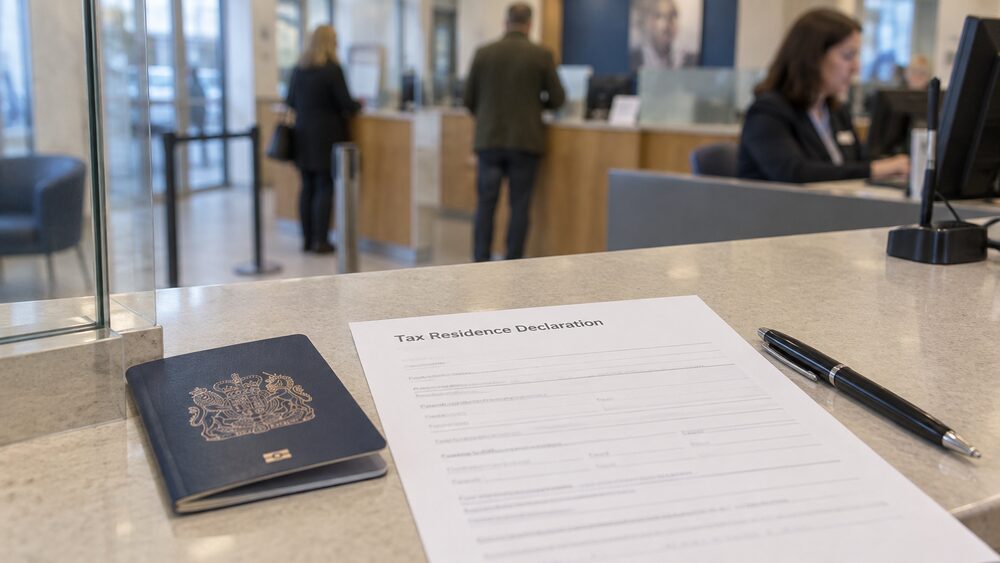
The Common Reporting Standard, usually shortened to CRS, is an international agreement under which banks, building societies, investment platforms and insurers pass information about their customers to tax authorities. It was developed by the Organisation for Economic Co-operation and Development (OECD) and approved by the OECD Council in July 2014, and it came into effect on 1 January 20161. Over 100 countries have committed to exchanging information on a multilateral basis under it2.
In practice, the CRS means that a financial institution in the UK must identify accounts held by people who are tax resident outside the UK and report those accounts to HM Revenue and Customs (HMRC), which then exchanges the information automatically with foreign tax authorities every year1. The same happens in reverse: a UK tax resident with an account abroad should expect that account to be reported to the tax authority in the country where it is held and passed on to HMRC.
For most people this changes nothing about their tax bill. If you are UK tax resident and all your accounts are in the UK, your accounts are not reported under the CRS. The rules bite when you are, or become, tax resident in more than one country, and that is why a bank or platform may write to you asking where you pay tax.
What the Common Reporting Standard is
The Common Reporting Standard is a set of rules under which the tax authorities of participating countries share information about financial accounts automatically. It was developed by the OECD and approved by the OECD Council in July 2014, and it came into effect on 1 January 20161. HMRC describes the same arrangement from the tax side: over 100 countries have committed to exchange information on a multilateral basis under the CRS2.
The word "common" is the point. Before the CRS, tax authorities largely relied on requests made one at a time, or on information that taxpayers volunteered. Under the CRS, financial institutions in each participating country do the collecting. A bank in the UK must identify accounts held by persons who are resident for tax purposes outside the UK and report them to HMRC, and HMRC then passes that information to the tax authority of the other country1. A bank in Spain, Ireland or Singapore does the same for accounts held by UK tax residents, and the information flows back to HMRC.
The CRS applies to both personal and non-personal or entity customers, so it is not only individuals who are caught: companies, trusts and other entities can be reportable too1. What triggers reporting is tax residence, not citizenship or nationality. A British citizen who is tax resident only in the UK is not reported by a UK bank; a person of any nationality who is tax resident in France and holds a UK account is.
Why your bank asks where you pay tax
Banks and other financial institutions already pass a great deal of information to HMRC as a matter of routine. After the end of each tax year, your bank or building society tells HMRC how much interest you earned3. HMRC also checks how much tax you have paid using information from employers, pension providers, banks and building societies, and may send a Simple Assessment tax bill if you have not paid enough4. Firms must also provide you with regular statements of account, appropriate to the type of service provided5.
The CRS adds an international layer to this domestic reporting. Because a UK institution must identify and report accounts held by people who are tax resident outside the UK1, it needs to know where each customer is tax resident. For most customers it can establish this from the information it already holds, but where it cannot, or where there are signs the customer may be resident abroad, it writes to ask.
The request often arrives as a form asking you to state your country or countries of tax residence. It is not a marketing exercise and not optional for the institution: it is required to collect this information under the CRS1. The reason it lands on your doormat is usually one of three things: you opened a new account, your circumstances suggest a foreign address or other overseas connection, or the institution is reviewing its existing customer records.
Self-certification: the form you are asked to fill in
When a financial institution cannot establish your tax residence from its records, it asks you to certify the details yourself. This process is called self-certification, and institutions are required to collect this information under the CRS1. The form typically asks for your name, home address, date of birth, every country in which you are tax resident, and a taxpayer identification number for each of those countries.
For UK purposes, the taxpayer references in everyday use are your National Insurance number, which government services routinely ask for6, and, for people within Self Assessment, the Unique Taxpayer Reference, which HMRC uses on its notices7. If you are asked for proof of identity alongside the form, the documents are the familiar ones: a driving licence, passport, recent bills or official documents8.
Accuracy matters on this form. HMRC expects people to keep records that allow them to send accurate tax returns and other documents, and the standard it applies is one of taking reasonable care9. Records must be kept by anyone who has to send HMRC a Self Assessment tax return, both to fill in the return correctly and to provide documents if HMRC checks it10. A self-certification is one of those documents: it is the basis on which a bank decides whether an account is reportable, so a copy forms part of the records that support the return.
UK tax residents with UK-only accounts are not reported
The most common worry the CRS prompts, that HMRC is sending your everyday current account details to foreign governments, is misplaced for most people. The reporting requirement applies to accounts held by persons who are resident for tax purposes outside the UK1. If you are UK tax resident and your accounts are in the UK, they are not reported under the CRS.
Tax residence is decided by the rules of each country, not by where your money is. A person can be tax resident in two countries at once, which is why the form asks you to list every country of tax residence rather than just one. Where two countries both tax the same income, a double-taxation agreement may relieve one side of the charge: you do not need to report your income to HMRC if you have already claimed tax relief under such an agreement11.
Residence for tax and residence in the everyday sense do not always match either. When you are not UK resident you are not normally liable to UK tax on capital gains you realise, though there are exceptions, including gains on UK residential property and gains within a period of temporary non-residence12. The tax rules that follow a move abroad are covered in more detail in the guides to foreign income and UK tax and double taxation.
What gets reported: from your name to your account balance
Where a personal account holder is found to be CRS reportable, financial institutions must generally report a defined set of information: name, address, date of birth, place of birth in some circumstances, tax residence jurisdictions, taxpayer identification numbers, account number, the balance or value at the end of the reporting period, whether the account was closed, the account type, gross amounts paid or credited, whether a valid self-certification is held, whether the account is joint and how many holders it has, and whether the account is new or pre-existing1.
For non-personal or entity customers the list is similar: the name and address of the entity, its tax residence jurisdictions and taxpayer identification numbers, the account type and number, the balance or value at the end of the reporting period or the date of closure, gross amounts paid or credited, whether a valid self-certification is held, whether the account is new or pre-existing, and in certain circumstances details of controlling persons1.
The CRS reporting rules set out a defined list of data points for people and for entities.
Two things are worth noticing. First, the CRS reports the existence and size of the account, not the underlying transactions: gross amounts paid or credited, and the balance at the end of the period. Second, it reports whether a valid self-certification is held, so a missing or unanswered form is itself information that travels to the tax authority.
How the information reaches other countries: over 100 jurisdictions exchanging each year
The exchange is automatic and annual. Financial institutions report to HMRC, and the information is automatically exchanged annually with foreign tax authorities1. Over 100 jurisdictions have signed up to participate in the CRS1, and HMRC describes the same commitment from its own side: over 100 countries have committed to exchange information on a multilateral basis under the OECD's standard2.
Information moves from your self-certification, through your bank and HMRC, to the tax authority of the other country.
The receiving country then has what it needs to check whether the account has been declared on a tax return there. The CRS itself does not create a tax charge: it is an information system, not a tax. What it does is remove the practical difficulty a tax authority used to face in finding out about accounts held abroad. If you have income or gains that should have been declared and were not, HMRC operates a Worldwide Disclosure Facility for telling it about offshore matters, and that route exists precisely because the information is now shared routinely2.
Accounts opened before 2016 are covered too
The CRS came into effect on 1 January 2016, and that date divides accounts into two kinds: new accounts, opened on or after 1 January 2016, and pre-existing accounts, opened before that date1. The distinction affects the process, not the coverage.
For new accounts, the institution collects the self-certification as part of the account opening, so the question about tax residence is built into the application. For pre-existing accounts, the institution reviews the customer information it already holds, such as addresses and other indicators, and writes to customers whose tax residence it cannot establish or who appear to have an overseas connection. This is why a form can arrive for an account you have held for many years without any change to the account itself.
So the answer to the common question is yes: an account opened decades before the CRS existed is still reported if the holder is tax resident outside the UK. The date of the account changes how the institution identifies you, not whether you are in scope.
Joint accounts, closed accounts and business customers
Three situations cause more confusion than the rest. The first is joint accounts. A joint account with one owner who is tax resident in a CRS reportable jurisdiction is treated as a reportable account, and the full balance and the amounts paid or credited are reported without being split among the joint account holders1. So if one of two holders is tax resident abroad, the whole account balance appears in the report, attributed to the reportable holder. Joint account holders have other rights in banking that operate independently of the CRS: where a personal current account is held jointly, a firm must enrol each holder in the transaction alerts it provides13, and where a firm considers it is entitled to set off a debt due solely from one consumer against a joint account's credit balance, it should explain that right to all the consumers in whose names the account is held14.
The second is closed accounts. Closing an account does not remove it from the system: if a reportable account is closed during a reporting period, its details need to be included in the CRS return for that period1. The report will show the closure alongside the account's details.
The third is business customers. The CRS legislation affects both personal and non-personal or entity customers1, so a small business, a family company or a trust can be asked to self-certify. For entities, the institution may also need to identify controlling persons in certain circumstances1, which means the form may ask about the people behind the entity as well as the entity itself.
What happens if you do not complete the form
Ignoring a self-certification request has consequences with the institution, not just with the tax authority. Bank of Ireland UK states that it may not open new accounts or offer additional products and services to customers who choose not to provide the required CRS information, and that it may report details of existing customers who do not provide it1. Other institutions operate comparable policies, and the practical effect is that an unanswered form can freeze your relationship with the bank: no new account, no additional product.
The form itself is not a tax return, but the accuracy rules that apply to your dealings with HMRC are a useful standard to hold it to. HMRC can charge a penalty if your records are not accurate, complete and readable10, and it expects you to take reasonable care in the documents you send9. A self-certification that wrongly states you are tax resident only in the UK, when you are in fact resident elsewhere, is the kind of document that can resurface years later, because the CRS exchange means the other country's tax authority may hold information that contradicts it.
If you are unsure of your tax residence, the honest answer is to say so and take advice rather than guess. The form is a statement of fact about your position, and the position is determined by the residence rules of each country involved, not by what is convenient to write.
Moving abroad and your UK bank account
A move abroad is the event most likely to make the CRS relevant to you. What matters is where you become tax resident. If you tell your UK bank you are now tax resident in another participating country, your account becomes reportable and its details go to HMRC and then to that country's tax authority1. If you remain UK tax resident, your UK accounts are not reported.
Moving abroad also changes your UK tax obligations in ways that sit alongside the CRS. You usually have to send a Self Assessment tax return if you live abroad and you rent out property in the UK, you have taxable savings interest from UK banks or building societies, you have a pension outside the UK and you were UK resident in one of the five previous tax years, or you have any other untaxed UK income11. HMRC usually sends refunds by cheque unless you give bank account details on your tax return11. Keeping a UK account while abroad, and what banks require to open one, is covered in the guide to banking while you live abroad, and the practicalities of offshore accounts in Jersey, Guernsey and the Isle of Man are covered separately.
Proof of identity and address can be more awkward from overseas. NS&I, for example, asks savers who live outside the UK for a certified copy of a bank statement issued within the last three months15, and opening a UK account generally requires ID such as a driving licence, passport, recent bills or official documents8. Telling your bank about the move also matters for the CRS: the bank cannot report your account to the right country if it does not know you have gone.
Your right to know how your data is used
The CRS involves your personal data moving between countries, and data protection law gives you rights over that. An organisation must inform you if it is using your personal data, and the information it must give includes why it is using the data, what type of data it is, how long it will be kept, who the recipients are and the reasons for any transfer, details of overseas transfers, your information rights, where the data came from, and how to contact the organisation, as well as your right to complain to the Information Commissioner's Office (ICO)16.
You can also ask an organisation for copies of the information it holds about you by making a subject access request, and the ICO explains how to get a response to one17. This is the practical route if you want to see what your bank has recorded about your tax residence, or what it holds that led it to send you a self-certification form. Retention periods are usually set out in the organisation's privacy notice or on its website17.
The same rights apply to the credit reference files that sit behind many financial relationships: you can request your statutory credit report verbally or in writing, and the credit reference agencies usually provide an online form as well18.
Where to find out more about your own reporting
If you think income or gains from abroad may not have been declared, HMRC's Worldwide Disclosure Facility is the route for telling it about offshore matters, and its guidance notes that over 100 countries now exchange information under the CRS2. Gains on foreign life insurance policies are one example of an offshore matter that people overlook: HMRC's helpsheet explains how these are taxed and, where a gain does not exceed £10,000 and you are not within Self Assessment, how to report it by contacting HMRC with your National Insurance number19.
For routine checks on your tax position, HMRC writes to you rather than the other way round. If you have paid too much or too little tax by the end of the tax year on 5 April, HMRC sends a tax calculation letter, known as a P800, or a Simple Assessment letter20. If you disagree with a correction notice, the guidance sets out what information you need to give, including your National Insurance number and the reference from the notice7.
Be careful about anyone contacting you out of the blue about tax. HMRC publishes tips on avoiding Self Assessment scams and warns against giving details to unexpected contacts claiming to be from it21. For general help with a dispute or an unresolved problem, Citizens Advice can refer complaints to Trading Standards, and it shares complaint information nationally with enforcement authorities including the Competition and Markets Authority and regulators22. Free, impartial money guidance is also available from MoneyHelper, and the wider rules on consumer protection in UK financial services are explained elsewhere on this site.
Sources22 cited
- Common Reporting Standard: tax reporting Bank of Ireland UK, 2026-09-25
- Worldwide Disclosure Facility: make a disclosure HM Revenue and Customs, 2016-09-05
- How you pay tax on savings interest HM Revenue and Customs, 2026-09-28
- Understand your Simple Assessment tax bill HM Revenue and Customs, 2026-09-25
- BCOBS 4.2.1R: statements of account Financial Conduct Authority, 2025-03-24
- Support a child or partner's student finance application HM Revenue and Customs, 2026-09-26
- Disagree with a Revenue correction notice HM Revenue and Customs, 2026-08-13
- Choosing a bank account for your Universal Credit payment MoneyHelper, 2026-09-25
- Reasonable care: tax returns and other documents HM Revenue and Customs, 2018-02-14
- Keeping your pay and tax records HM Revenue and Customs, 2026-09-26
- Tax on your UK income if you live abroad HM Revenue and Customs, 2026-09-26
- Residence, domicile and the remittance basis: RDR1 HM Revenue and Customs, 2025-05-16
- BCOBS 8.4: alerts for banking customers Financial Conduct Authority, 2026-09-25
- BCOBS 4.1.4A G: joint account set-off disclosure Financial Conduct Authority, 2011-02-24
- NS&I: evidence of identity NS&I, 2026-04-15
- Your right to be informed if your personal data is being used Information Commissioner's Office, 2026-09-26
- Getting a response to your subject access request Information Commissioner's Office, 2026-09-26
- Credit: your data protection rights Information Commissioner's Office, 2026-09-25
- HS321: gains on foreign life insurance policies HM Revenue and Customs, 2026-07-14
- Tax overpayments and underpayments HM Revenue and Customs, 2026-09-25
- HMRC tips on avoiding Self Assessment tax scams HM Revenue and Customs, 2019-11-20
- Consumer protection rights HM Government, 2026-09-25






 MoneyHelperFree, impartial money and pensions guidance, set up by government
 FSCSProtects your money if a bank, insurer or investment firm fails
 Financial Ombudsman ServiceFree, independent help when a complaint about a firm is not put right
 FCA Warning ListCheck whether a firm is authorised before you deal with it
 Citizens AdviceFree advice on money, consumer and legal problems in England and Wales