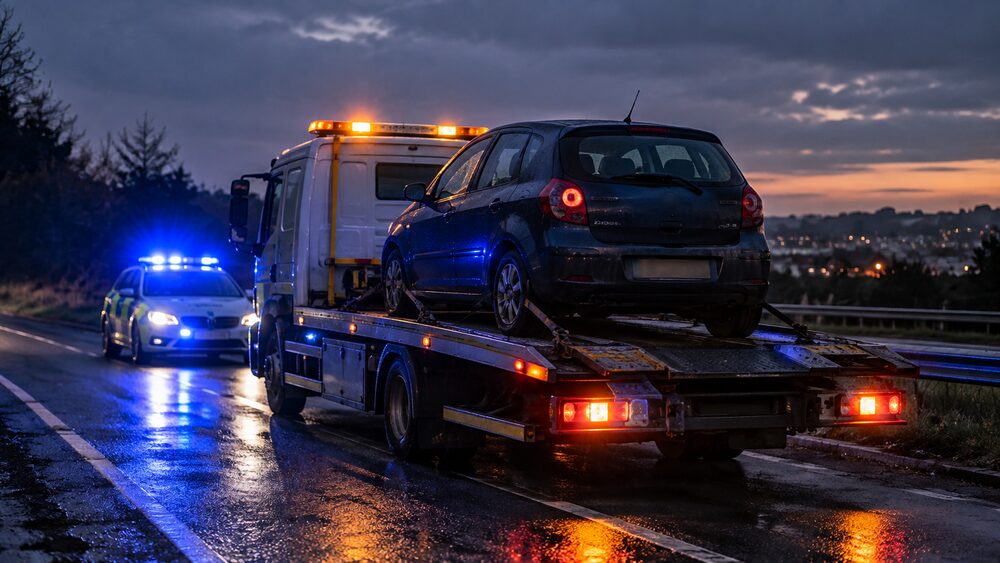
Driving without valid insurance is a criminal offence in the UK, and the consequences reach further than most people expect. You must have motor insurance to drive your vehicle on UK roads, and the minimum the law requires is third-party cover1. The police can deal with it by fixed penalty, by seizing the car, or by sending the case to court, and a conviction follows you onto your licence and into every insurance quote you get afterwards.
The headline penalty is a fixed penalty of £300 and six penalty points. Where the case goes to court, the penalties are higher: a maximum fine of £5,000 and five to 10 penalty points on your driving licence for each offence of failure to stop or failure to report, and the court has the power to disqualify you from driving3. A fixed penalty may not exceed £1,000 under the legislation that governs it4.
This page sets out what the offence is, what each penalty involves, how vehicle seizure works and how to get a car back, what a criminal record can affect, why insurance costs more afterwards, and where to get free help if you are charged.
Driving without insurance is a criminal offence
The rule itself is short. You must have motor insurance to drive your vehicle on UK roads, and the minimum the law requires is third-party cover1. Northern Ireland applies the same principle: you have to have motor insurance before you can drive your vehicle in a public place6.
The offence is not limited to having no policy at all. A failure to provide your insurance details without a reasonable excuse is also an offence, and failure to stop and failure to report an accident are two separate criminal offences3. Those carry their own penalties: a maximum fine of £5,000 and five to 10 penalty points on your driving licence for each offence3.
There is also a category of driving that looks insured but is not. Driving under a fraudulent policy, for example one arranged through a ghost broker, can mean the insurance is invalid, a fine and six points on your driving licence, being unable to make insurance claims, having your vehicle seized and paying a fine to release it, paying costs if you are at fault in an accident, and having to buy another genuine policy7. Fronting, where a driver is put on someone else's policy to get a cheaper premium, can mean all or part of the insurance claim is refused, the policy is cancelled, prosecution for fraud which can lead to a criminal record, and difficulty getting insurance again in future7.
Fixed penalty: £300 and 6 penalty points
For straightforward cases, the police can issue a fixed penalty rather than take the matter to court. The fixed penalty for driving without insurance is £300 and six penalty points. Fixed penalty notices are issued for parking, dangerous driving and other minor offences, and the consequences include points being added to your licence as well as a financial penalty8.
Penalty points, also called driving endorsements, are issued by courts to anyone convicted of a driving offence9. They are not a fine and they are not a warning: they sit on your licence and insurers take them into account. For comparison, a speeding offence carries three to six points, while drink driving can see you given up to 119.
The fixed penalty route is not available for every case, and it is not the end of the matter if you do not pay. A fixed penalty may not exceed £1,000 under the legislation that sets the framework4. Where a fixed penalty is not paid or the case is too serious, it moves to court.
When the case goes to court
Court is where the penalties become open-ended. The penalties for each offence of failure to stop or failure to report include a maximum fine of £5,000 and five to 10 penalty points on your driving licence, and the court also has the power to disqualify you from driving for either offence, and is likely to do so when both offences are committed on the same occasion3.
If you are convicted of a driving offence, the court decides the penalty points. The court may set a higher fine than you can afford if you do not attend10. In some cases, you can go to prison for not paying a court fine10. Enforcement for an unpaid court fine in England can include taking the money from your wages or benefits, sending bailiffs, registering the fine, and in extreme cases prison if you are deliberately not paying11.
Scotland has its own enforcement route. If you do not pay a fine set by the sheriff court, fines enforcement officers can call at your home, or you could even go to prison12. If a creditor takes enforcement action against you for an unpaid debt, you have the right to apply to the court for Time to Pay12.
Vehicle seizure: how police take an uninsured car
Seizure is one of the most immediate consequences, and it does not wait for a conviction. Driving without insurance can lead to fines, penalty points or having your driving licence revoked, or the car being seized13. A car kept on public roads without tax or insurance can be clamped or impounded13.
The seizure power sits alongside the insurance requirement rather than replacing it. Because you must have motor insurance to drive on UK roads, a car that cannot be shown to be insured is exposed to being taken off the road1. Driving under a fraudulent policy carries the same risk: having your vehicle seized and paying a fine to release it is one of the listed consequences7.
If your car is stolen, the position is different and the police must be told immediately14. Most motor insurance policies have an exclusion saying people should take reasonable care to protect their vehicle from loss or damage, and where there is no evidence the customer recognised the risk, the Financial Ombudsman Service might say they have not been reckless and it is unfair to apply the exclusion15.
Getting a seized vehicle back
Recovering a seized car usually means resolving the insurance position and paying what is owed. Driving under a fraudulent policy can mean having your vehicle seized and paying a fine to release it7. Where a car is kept on public roads without tax or insurance, it can be clamped or impounded13.
There is a separate route for losses caused by someone else. If you allow someone to drive your car when they are not insured to do so and they are involved in an incident that results in a non recoverable claim, the no claims discount will be reduced under the terms of a typical motor policy16. Uninsured loss recovery exists for the opposite situation: it can recover your policy excess, hire car charge, any other out of pocket expenses caused by the third party's negligence, plus costs to pursue a personal injury claim17.
If you are not at fault, you can pay the excess then pursue the insurer of the other driver to reimburse it once the claim is settled3. Motor legal expenses insurance covers repair costs if you do not have a comprehensive motor insurance policy, for accidents that were not your fault18.
A criminal record and what it can affect
A conviction for driving without insurance is a criminal conviction, and it can affect more than your driving. What it does not do is damage your credit file: a criminal record will not affect your credit score or appear in your history19.
Where it does bite is insurance and eligibility for schemes. Insurers ask about motor convictions and fixed penalty offences in the last five years. In one case the Financial Ombudsman Service examined, an insurer asked whether the customer had any motor convictions or fixed penalty offences in the last five years and he answered no; the insurer then cancelled his insurance policy and turned down his claim after it discovered he had not mentioned a conviction, having also established by checking his driving licence that he had a DR10 (drink driving) conviction two years before taking out the policy20.
Serious driving matters can also close off schemes. Any serious driving endorsements, convictions or disqualifications in the past five years may disqualify you from the Motability scheme21. For a grant from Independent Driving Solutions, an application may not be approved if your driving licence is not valid or expires within 12 months22.
Insurance costs more after a conviction
A conviction follows you into your next quote. Insurers ask about motor convictions and fixed penalty offences in the last five years, and non-disclosure can mean your insurer will refuse to pay out for any claims made and, worse still, terminate your cover entirely23. You must tell your insurer immediately if you or your named driver are banned from driving or receive a non-motoring conviction, otherwise it may cancel your policy and any claims may be rejected23.
The same disclosure duty applies to accidents. You must tell your insurer that you have been in an accident, even if you do not claim, and a failure to do so can give your insurance company the right to refuse to cover you in the future3. You must also report the accident to your insurer, even if you are not intending to make a claim6. It will also be a condition of your insurance policy that you report the accident to your insurance company within a reasonable time, and what is reasonable differs between policies3.
There is one thing a conviction does not do. A criminal record will not affect your credit score or appear in your history19. If you are turned down for credit, the reason will be something else, such as the lender not being able to confirm your identity, which affects your credit score because you become more of a risk24.
Where to get help if you are charged
Free, impartial help exists, and it is worth using it before enforcement escalates. StepChange and Citizens Advice both publish guidance on court fines and enforcement. If a court fine is not paid, the court can take the money from your wages or benefits, send bailiffs, register the fine, and in extreme cases impose prison if you are deliberately not paying11. A penalty charge notice that is not paid can be registered in the County Court, the local authority can use bailiffs or enforcement agents, and extra fees will be added8.
If you are dealing with several debts at once, it helps to know which are treated as priority. A liability order can mean your driving licence could be revoked and your passport could be revoked25. Criminal fines, including debt incurred under the Proceeds of Crime Act, cannot be included in a Debt Relief Order26.
If you are involved in an accident, do not admit liability; take the name and address of the other driver, and details of their insurance, and witness details, and call the police if anyone is injured. After an accident, you may incur expenses which are not covered by your policy, such as the cost of hiring a car while yours is repaired or compensation for personal injury, and these might be claimed against a third party.
If an uninsured or hit and run driver injures you or damages your property, you may be able to claim compensation from the Motor Insurers' Bureau5. If you do not have insurance, you will not be able to make a claim for damage to your property.
Sources26 cited
- Vehicle insurance GOV.UK
- Is self-insurance ever a good idea? Which?
- I've been in a car accident: do I have to claim on my insurance? Which?
- Fixed penalties legislation legislation.gov.uk
- Compensation for victims of uninsured drivers GOV.UK
- Motor insurance explained nidirect
- Top car insurance scams: how to avoid falling victim Which?
- Parking fines and debt StepChange
- How penalty points impact your car insurance premiums Which?
- Court debts and fines StepChange
- Paying a court fine Citizens Advice
- Time to pay debt mygov.scot
- Car tax, insurance and SORN guide Post Office
- Vehicle theft British Insurance Brokers' Association
- Vehicle theft Financial Ombudsman Service
- Which insurance policies are worth keeping? Which?
- Uninsured loss recovery British Insurance Brokers' Association
- Independent Driving Solutions Motability Foundation
- Eight myths around your credit score debunked Which?
- Insurer cancelled policy and turned down claim saying customer made a misrepresentation Financial Ombudsman Service
- Motability car scheme explained Which?
- Have my penalty points pushed up my car insurance premiums? Which?
- Liability order StepChange
- Managing money Mental Health and Money Advice
- Your business and household budget Business Debtline
- Accident checklist British Insurance Brokers' Association

 MoneyHelperFree, impartial money and pensions guidance, set up by government
 Financial Ombudsman ServiceFree, independent help when a complaint about a firm is not put right
 FSCSProtects your money if a bank, insurer or investment firm fails
 Citizens AdviceFree advice on money, consumer and legal problems in England and Wales
 GOV.UKOfficial information on tax, benefits and government services