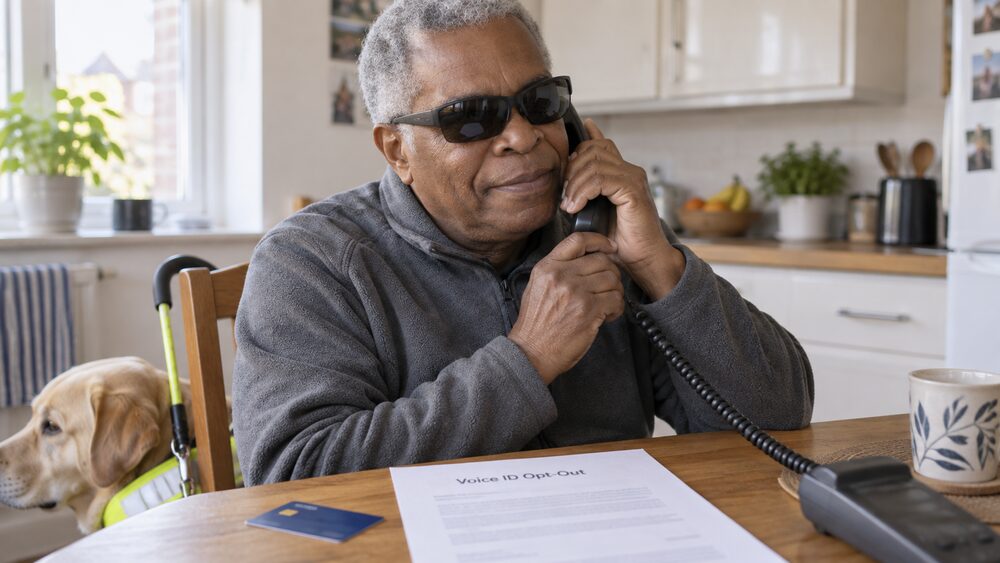
Voice ID is optional. Banks that use it describe enrolment as something you agree to, and they describe opting out as something you can do at any time. Coventry Building Society says an advisor will talk to you about how to enrol and will ask for your consent, and that you can withdraw consent at any time by calling 0800 121 88 991. AIB NI says you can choose to opt out or to delete your voiceprint at any time by calling a Customer Service Advisor2.
Refusing Voice ID does not cut you off from telephone banking. Banks keep other ways to check who you are, and several say that if Voice ID cannot verify you they will fall back to another method. Coventry Building Society says that if it cannot verify you by Voice ID it will aim to verify you another way, calling from your registered phone number1. Santander asks callers who cannot ring from a registered number for a Personal ID or a debit or credit card number plus a security number3.
What changes if you opt out is the method, not the access. You go back to the security questions, passwords or grid cards the bank used before, and you keep the same account and the same phone line. The sections below set out how Voice ID works, what consent looks like in practice, the alternatives, where it can go wrong, and where to take a complaint.
How Voice ID works when you call your bank
Voice ID is a way of confirming who you are by the sound of your voice rather than by questions. AIB NI describes it as a simple, fast and secure way to authenticate customers over the phone4. When you speak, the system recognises over 100 features of your unique voice and compares them against the voiceprint stored from your enrolment2. Halifax puts it more plainly: you can confirm your identity by using your voice in Telephone Banking5.
Enrolment follows a set pattern. AIB NI says the next time you call you will be given the opportunity to enrol, that you verify in the normal way first, then repeat the phrase "My Voice is my Password" to capture your voiceprint, and that a text confirms when it is set up4. HSBC says registering for Voice ID is simple and available 24/76. Coventry Building Society says that if you do not have a Telephone Grid Card and Telephone Password, it can still enrol you onto Voice ID by completing another form of verification, calling from the number you have registered with it1.
Once enrolled, the voiceprint stands in for the older checks. Coventry Building Society says Voice ID authenticates you using your voice print, so you will not need to use your Telephone Password and Telephone Grid Card1. Royal Bank of Scotland says that this means you do not have to use your PIN and password when you call7. The rollout is not complete everywhere: AIB NI says that while it is phasing in Voice ID on its Debit, Credit and Branch lines you may still be asked some security questions4, and Coventry Building Society asks customers to keep their Telephone Password and Telephone Grid Card safe while Voice ID is rolled out1.
Consent: you are asked before you are enrolled
The banks that publish on this are consistent: enrolment is offered, not imposed. Coventry Building Society says an advisor will talk to you about how to enrol onto Voice ID and will ask for your consent1. That is the point at which you can say no, and the bank's own wording leaves the decision with you.
Consent is also something you can take back later. Coventry Building Society says you can withdraw consent for Voice ID at any time by calling 0800 121 88 991. AIB NI says you can choose to opt out or to delete your voiceprint at any time by calling a Customer Service Advisor2. Royal Bank of Scotland says you can unenroll at any time by speaking to its telephone banking team7. first direct goes further and says that if you really, really do not want Voice ID applied to your account, it will be happy to discuss all the options with you8.
Two groups get specific treatment. first direct says that if you have a disability that affects your voice, you can opt out of Voice ID and it can still continue to verify you on the phone in its usual way8. HSBC says it does not recommend setting up Voice ID if you use a voice box or speech synthesiser, since some of these use a standard voice that will not be unique to you6. Bank of Scotland gives the same warning, adding that they might be a security risk as some speech synthesiser machines have the same voice9.
If you believe you were enrolled without being asked, the practical step is to contact the bank and ask for the voiceprint to be deleted, then ask for confirmation in writing. If the bank will not act, the complaint routes in the last section apply.
Other ways to prove who you are on the phone
Opting out does not leave you without a route into telephone banking. Banks describe a fallback as standard. Coventry Building Society says that if it is unable to verify you via Voice ID, it will aim to verify you another way, calling from your registered phone number1. first direct says that in the unlikely event it cannot verify you using Voice ID, it will be able to verify you using a different method8.
What the alternative looks like depends on the bank and on how you are calling.
- Calling from a registered number. Coventry Building Society treats this as the first fallback when Voice ID does not work1.
- Personal ID or card details. Santander says that if you cannot call from a registered number, you will be asked to provide your Personal ID or a debit or credit card number as well as your Security Number3.
- Telephone Password and Telephone Grid Card. Coventry Building Society asks customers to keep these safe while Voice ID is rolled out, which means they remain a live method1.
- A different method chosen by the bank. first direct says it will verify you using a different method if Voice ID fails8.
Some banks also use voice checks for specific jobs rather than for every call. AIB NI's Confirm by Voice service, used to approve online card purchases, requires a landline, or a mobile phone if you have been unable to use a mobile or password to confirm your online purchases, plus Voice ID set up and Phoneline or Online Banking10.
Voice ID is not the only biometric route into an account. Which? reported in 2017 that voice and video ID is also used by challenger and online banks such as Atom, Monzo and Starling11. C. Hoare & Co. says it has implemented voice biometrics for increased security during its identification and verification process, available on request to customers who wish to enrol12.
Is Voice ID safer than a password or PIN?
Banks present Voice ID as an additional check rather than a replacement for every safeguard. Santander says Voice ID will recognise if someone is trying to impersonate you or play a recording of you, as your voice is unique to you3. Bank of Scotland says that since your voice is unique, someone else will not be able to use Voice ID on your behalf9.
The comparison with passwords and PINs is not straightforward, because the two do different jobs. A PIN or password is something you know and can share, deliberately or under pressure. A voiceprint is something about you, which is why banks argue it is harder to pass off. But the same industry guidance that covers PINs still applies to every call: banks will never contact you to ask for your personal identification number, or for a whole security number or password13. Which? states the same rule, that a bank will never ask for your PIN, or for a whole security number or password, either over the phone or via email14.
That rule matters most when someone claims to be your bank. Ofcom has required telephone networks to identify and block spoofed calls where technically feasible, to make sure a number is formatted correctly in the UK's 10 or 11-digit format, to check the do-not-originate list, and to identify and block calls from abroad that are spoofing a UK caller ID15. Which? has reported on cases where banks were failing customers on fraud protection when it came to verifying whether a call was genuine15.
Where Voice ID can go wrong
The most common failure is a voiceprint that will not match. AIB NI says that if your voiceprint fails to work repeatedly, it can always be set up again, and that it can delete your existing voiceprint and let you set up a new one2. Coventry Building Society says that if it cannot verify you via Voice ID, it will aim to verify you another way1. So a failed match costs you time on the call, not access to your money.
Voice changes are the usual reason. A cold, a throat operation or a gradual change in how you speak can all move your voice away from the stored print. first direct's opt-out for customers with a disability that affects their voice exists for exactly this reason, and it says it can still verify you on the phone in its usual way8. HSBC and Bank of Scotland both warn against setting up Voice ID if you use a voice box or speech synthesiser, because some of these use a standard voice that will not be unique to you6.
There is a second, sharper risk: a caller who is not your bank. Voice ID protects the bank against an impostor pretending to be you. It does nothing to protect you against an impostor pretending to be the bank. The rules above are the defence: no genuine bank asks for your PIN or a whole security number or password13, and identity theft guidance says to be wary about unexpected contact, such as emails, calls or messages, from organisations asking you to confirm your personal information16.
If fraud does happen, the consequences can follow you. Which? has reported on a cancelled card loophole that can allow fraud to follow you14, and on what to do if you are being chased for a debt that is not yours17. If you become a victim of identity fraud, contact your bank, your credit card company and the local police on the non-emergency phone number 101 as soon as possible, and report the incident to Action Fraud18.
Will I lose access to phone banking if I refuse Voice ID?
No. Every bank that discusses opting out pairs it with an alternative route. Coventry Building Society says that if it cannot verify you via Voice ID it will aim to verify you another way, calling from your registered phone number1. first direct says it will verify you using a different method if Voice ID fails8. Santander's fallback for callers who cannot ring from a registered number is a Personal ID or a debit or credit card number plus a Security Number3.
What you may notice is a slower call. Voice ID is designed to remove the security questions, so opting out means answering them again. Royal Bank of Scotland notes that Voice ID means you do not have to use your PIN and password when you call7, and Coventry Building Society notes that it replaces the Telephone Password and Telephone Grid Card1. Those are the steps you keep if you opt out.
Eligibility is a separate question from consent. Halifax says that if you are eligible and hold a bank, savings or credit card account with it, you can set up Voice ID to confirm your identity by voice in Telephone Banking5. Lloyds Bank uses the same wording for eligible customers holding a bank, savings or credit card account19. first direct says you can use Voice ID if you live overseas8. Being eligible is not the same as being enrolled, and being enrolled is not a condition of using the phone line.
Where to get help or complain
Start with the bank. Ask for the voiceprint to be deleted, ask what alternative verification it will use, and ask for the answer in writing. If the bank does not resolve it, the complaint can go to the free Financial Ombudsman Service once you have its final response or its time limit has passed20. The Financial Ombudsman Service costs nothing to complain to, and calls for guidance are free21. Its decisions are binding on the business17.
For a complaint about a claims management company rather than a bank, the Claims Management Ombudsman takes complaints online or by calling its helpline on 0800 023 4567, and cannot speak to you in person at its offices or regional hubs22. Complaining directly to a provider is free and you can do it yourself23. If you want help drafting it, see writing an effective complaint letter or email.
Free and impartial help is available if the problem is wider than one call.
- MoneyHelper covers banking basics and how to take a complaint forward20.
- Independent Age runs a free helpline and offers a free, confidential benefits check24.
- The Consumer Council in Northern Ireland helps consumers with financial services problems26.
- Victim Support runs a free, 24/7 helpline on 0808 16 89 111 for victims of crime, including fraud27.
- Make the Call is a free government helpline in Northern Ireland that can advise on benefits you may be entitled to26.
If you think someone has used your identity, contact your bank, your credit card company and the police on 101, and report it to Action Fraud18. Identity theft guidance says to be wary about unexpected contact from organisations asking you to confirm your personal information16. For more on how banks check who you are, see Voice ID and biometric security checks with your bank, and for stopping unwanted approaches, see stopping unwanted calls, texts and marketing from financial firms.
Sources27 cited
- Telephone services FAQs Coventry Building Society, 2026
- Voice ID FAQs AIB NI, 2026
- On the telephone Santander, 2026
- Voice ID AIB NI, 2026
- Banking at home Halifax, 2026
- Phone banking HSBC UK, 2026
- Royal Bank telephone banking Royal Bank of Scotland, 2026
- Telephone banking first direct, 2026
- Voice ID Bank of Scotland, 2026
- Confirm by Voice AIB NI, 2026
- Biometric banking: how to log in with your eyes Which?, 2017
- Fraud prevention C. Hoare & Co., 2026
- What is identity theft? Which?, 2026
- Beware the cancelled card loophole Which?, 2026
- Is it really your bank calling? Which?, 2022
- Identity theft Information Commissioner's Office, 2026
- Identity fraud: what to do if you're being chased for debt that's not yours Which?, 2025
- ID fraud is on the rise: how to stay safe Which?, 2024
- Mental health and your bank Lloyds Bank, 2026
- Credit union current accounts MoneyHelper, 2026
- Complaining about your lender Business Debtline, 2026
- Complain Claims Management Ombudsman, 2024
- PPI complaints Age UK, 2025
- Support for carers Independent Age, 2026
- Helping someone to claim benefits Independent Age, 2026
- Manage and maximise your money Consumer Council for Northern Ireland, 2026
- What to do if your bank won't refund you after a scam Which?, 2026


 Citizens AdviceFree advice on money, consumer and legal problems in England and Wales
 MoneyHelperFree, impartial money and pensions guidance, set up by government
 Financial Ombudsman ServiceFree, independent help when a complaint about a firm is not put right
 GOV.UKOfficial information on tax, benefits and government services
 StepChangeFree debt advice and solutions from a charity