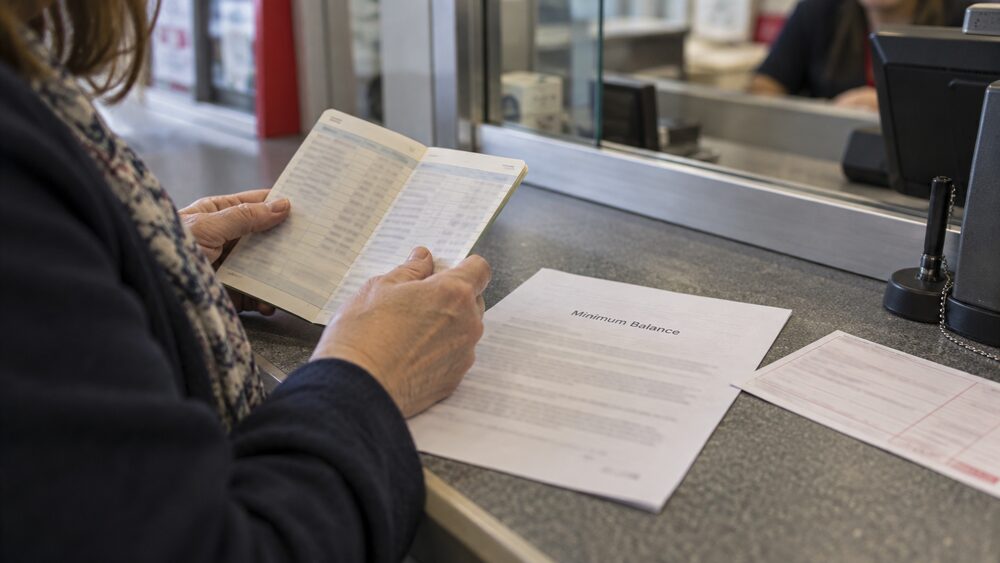
For most savings accounts and cash ISAs in the UK, the minimum cash balance is £1. NS&I says of its Direct ISA and Direct Saver that "You just need to keep a balance of at least £1 to keep your account open"1. Building societies set the same figure: Principality, Swansea and Chorley all require £1 to be held, and Chorley adds that if the balance falls below £1 the account will be closed3.
That is the general rule, not a universal one. Some accounts set a much higher minimum, and a few will close the account if the balance drops below it. The minimum also matters in a completely different context: when a creditor or HMRC takes money from your bank account, the law and guidance set a floor below which they cannot go.
Most savings accounts and cash ISAs need just £1 to stay open
The £1 minimum is the standard across the savings market, and it appears in the key facts documents that providers must give you before you open an account. NS&I's Direct ISA and Direct Saver both state the £1 rule1. Online ISA Fixed Saver and Online Easy Access Cash ISA from one provider say: "You'll need the minimum balance of £1 in the account to open it and keep it open"15.
Building societies follow the same pattern. Chorley's Easy Access Cash ISA (1 Withdrawal) states: "The minimum account balance to be maintained is £1. Should the balance reduce below £1 the account will be closed"3. Its three-withdrawal version carries identical wording17. Principality's online and branch instant access cash ISAs both say: "You must keep at least £1 (the minimum balance) in the account"4. Swansea's Cash ISA Instant Access Savings Account sets a minimum withdrawal of £1, or less if closing the account, and a minimum balance of £16.
Not every provider is quite so uniform. Cambridge Building Society says some Cash ISAs require a minimum opening balance to open and maintain the account, and that at Cambridge this amount varies depending on the ISA chosen18. So the £1 figure is the common case, not a rule that binds every account. The document that governs your account is its own terms, and that is where the figure for your account will be stated.
Accounts that set a higher minimum balance
A £1 minimum is normal for straightforward savings, but accounts built for a different purpose can set the bar much higher. A self-invested personal pension (SIPP) cash account held with one provider requires £1,000, and the provider states: "should the balance drop below the minimum of £1,000, we reserve the right to close the account"7.
That is a different kind of account from a cash ISA. A SIPP holds investments, and the cash account inside it is a working balance used for dealing and charges rather than a savings pot. A minimum of £1,000 reflects that role. The same logic applies to investment platforms generally: cash sits in the account between trades and to cover fees, and the platform may set a floor so the account remains viable to administer.
NS&I's own products show how much the figure varies by product type. Direct Saver has a minimum deposit of £1 and requires at least £1 to remain unless you are closing the account19. Income Bonds are different: the minimum withdrawal is £500, and at least £500 must remain in the account21. Guaranteed Income Bonds require an investment of between £500 and £1 million22. So within one provider, the minimum can range from £1 to £500 depending on which product you hold.
The practical point is that "minimum balance" means different things in different accounts. In a cash savings account it is a rule to keep the account open. In an investment or pension account it is often a working balance the provider needs to run the account. Check the key facts document for the specific account rather than assuming the £1 rule applies.
Help to Save: no minimum balance
Help to Save works differently from an ordinary savings account. The legislation states plainly that "there is no requirement that a minimum credit balance must be maintained in the account (with the result that an account with a nil balance is not automatically closed)"10. The same wording appears in the earlier Saving Gateway rules23.
So a Help to Save account with nothing in it stays open. The minimum you can pay in is £1, or a smaller amount agreed by the provider11. There is no restriction on the maximum or minimum amount you can withdraw, or on when you withdraw it, subject to the provider's normal business hours11.
What does end the account is time, not a low balance. A Help to Save account closes four years after you open it, and you cannot reopen it or open another one24. The scheme's own evaluation notes that take-up was low at the time of the research. StepChange points out that because you are only allowed one Help to Save account, closing it means you cannot open another in future25.
Credit union savings held against a loan
Credit unions work on a different model from banks, and that changes what your savings balance means. If you borrow from a credit union, your savings are usually tied to the loan. One credit union states that borrowers only need to keep in their savings account enough to cover one loan repayment, plus £1, and that it encourages all members to keep up regular savings of at least £5 per month, in addition to making loan repayments26.
The reason is the relationship between savings and borrowing. Independent guidance notes that if you are a member of a credit union, you can usually borrow at least two or three times the amount you have in savings, depending on the credit union's loan policy27. Your savings act as a form of security and as evidence of the saving habit the credit union expects.
In practice this means you cannot usually withdraw your credit union savings down to zero while you have a loan outstanding. The minimum you must leave is set by the credit union's own policy, and it can be expressed as a multiple of your repayment rather than a flat figure. If you are considering a credit union loan, ask what savings balance you must maintain for the life of the loan before you sign, because the answer varies between credit unions.
What happens if your balance drops below the minimum
The consequence depends on the account. In a straightforward savings account or cash ISA, the usual outcome is that the account is closed. Chorley states it directly: "Should the balance reduce below £1 the account will be closed"3. If you want to empty an account, the cleaner route is to tell the provider you are closing it rather than withdrawing to a nil balance and leaving it.
In an investment or pension account, the provider may reserve the right to close the account if the balance falls below the minimum, as the SIPP cash account does at £1,0007. That is a right the provider holds, not an automatic closure, but it means a low balance can put the account at risk.
NS&I's switching service handles the same issue for transfers between its own accounts. If the amount you are switching would take the balance on the old account below its minimum, you must mark on the form that you want to close that account29. That is a useful illustration of the general principle: a transfer that empties an account is a closure, and the paperwork needs to say so.
For current accounts, the minimum is often about activity rather than balance. MoneyHelper notes that some accounts might require you to pay in a minimum amount each month, earn a certain salary, pay a monthly fee, have a good credit history or own a smartphone. Those conditions are different from a minimum balance, but they can have the same effect if you stop meeting them.
Bank arrestment in Scotland: £1,000 left untouched
Scotland has its own rules on what a creditor can take from a bank account, and they set a floor that works in your favour. Bank arrestment freezes money in your bank account30. The law provides that where the sum in the account exceeds £1,000, only the balance above that figure can be attached12.
Independent guidance confirms the figure: "At present, a minimum of £1000 must be left free from arrestment. This amount is known as the 'protected minimum balance'"13. Citizens Advice Scotland puts it plainly: "There's a protected amount of £1,000 that can't be taken to pay off a debt. You can still use this amount"33. Scottish Parliament research refers to "the funds in the account are below the legally protected minimum balance (currently £1,000)"34.
The £1,000 figure is recent. It was increased from £566 by a Stage 2 amendment to the Coronavirus (Recovery and Reform) (Scotland) Bill35. Before that, a 2021 consultation proposed raising the protected minimum from £529.90 to £566.5136. Going further back, the protected amount was set at £370 by the Diligence Against Earnings (Variation) (Scotland) Regulations 2006.
Can creditors take everything in my bank account?
Outside Scotland, the rules differ, and the answer depends on who is taking the money. For HMRC debts, the Direct Recovery of Debt powers allow money to be taken from bank accounts without a court order in some circumstances, but at least £5,000 must be left across your accounts after any money is taken14. HMRC can use these powers when the debt is at least £1,000, and they apply to individual, joint and business accounts37.
That £5,000 floor is a significant protection, but it is not a general rule that applies to every creditor. It is specific to HMRC's debt recovery powers. Other creditors generally need a court order or another legal route before they can take money from your account, and the process differs between England, Wales, Scotland and Northern Ireland.
If you are struggling with debt, free and impartial help is available. StepChange, National Debtline and Business Debtline all publish guidance on what creditors can and cannot do, and on the options for dealing with problem debt27. MoneyHelper covers how to open, switch or close a bank account, including what to do if a provider will not let you keep an account.
Sources38 cited
- Direct ISA NS&I, 2026-09-04
- Direct Saver NS&I, 2026-09-04
- Easy Access Cash ISA (1 Withdrawal) Chorley Building Society, 2026-09-25
- Online Easy Access Cash ISA Principality Building Society, 2026-09-25
- Branch Instant Access Cash ISA Principality Building Society, 2026-09-26
- Cash ISA Swansea Building Society, 2026
- SIPP and SSAS Teachers Building Society, 2026-09-26
- Index-linked Savings Certificates NS&I, 2024-05-15
- Fixed Interest Savings Certificates NS&I, 2024-05-15
- The Help to Save Regulations 2018 legislation.gov.uk, 2018-01-24
- The Help to Save Regulations 2018 (made) legislation.gov.uk, 2018-01-24
- Debtors (Scotland) Act 1987, section 73F legislation.gov.uk, 2022-11-01
- Court fines (Scotland) National Debtline, 2026-09-25
- County court action for tax debt TaxAid, 2026-06-19
- Online ISA Fixed Saver summary box HTB, 2026-09-11
- Online Easy Access Cash ISA summary box HTB, 2026-09-11
- Easy Access Cash ISA (3 Withdrawals) Chorley Building Society, 2026-09-25
- How does a Cash ISA work? Cambridge Building Society, 2026-09-26
- Direct Saver brochure NS&I, 2024-07-01
- Make a withdrawal from your savings NS&I, 2025-09-01
- Income Bonds brochure NS&I, 2024-07-01
- Guaranteed Growth Bonds NS&I, 2026-09-15
- The Saving Gateway Accounts Regulations 2009 legislation.gov.uk, 2009-11-11
- Annual savings statistics: background and methodology GOV.UK, 2025-09-18
- Help to Save scheme StepChange, 2026-09-25
- Loans Keep Credit Union, 2026-07-30
- Debt consolidation (Scotland) Business Debtline, 2026-09-26
- Debt consolidation (England and Wales) National Debtline, 2026-09-25
- Switching NS&I, 2026-06-10
- Diligence (Scotland) National Debtline, 2026-09-25
- Council tax arrears (Scotland) Business Debtline, 2026-09-26
- Diligence StepChange, 2026-09-25
- Creditor takes money from my bank account (Scotland) Citizens Advice Scotland, 2026-09-25
- Research briefing SB 23-31 Scottish Parliament, 2023-08-29
- Committee report on the Coronavirus (Recovery and Reform) (Scotland) Bill Scottish Parliament, 2022-07-02
- The Diligence against Earnings and Bank Arrestment (Miscellaneous Amendments) (Scotland) Regulations 2021 legislation.gov.uk, 2021-11-10
- Tax credit overpayments (Scotland) National Debtline, 2026-09-25
- Tax credit overpayments (England and Wales) Business Debtline, 2026-09-26


 Citizens AdviceFree advice on money, consumer and legal problems in England and Wales
 MoneyHelperFree, impartial money and pensions guidance, set up by government
 Financial Ombudsman ServiceFree, independent help when a complaint about a firm is not put right
 GOV.UKOfficial information on tax, benefits and government services
 StepChangeFree debt advice and solutions from a charity