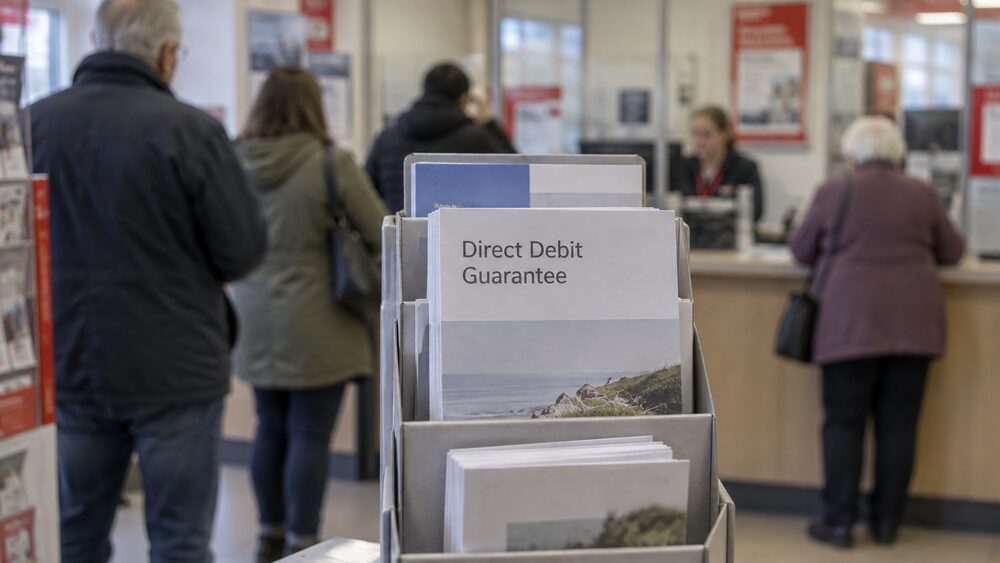
If a company takes money from your account each month, the rules that protect you depend on how you agreed to pay. A Direct Debit is set up with your bank using your sort code and account number, and it comes with the Direct Debit Guarantee. A continuous payment authority (CPA) is set up with the company using your card details, and it does not have that guarantee.
The difference matters when something goes wrong. If a Direct Debit is taken in error, after you cancel it, or fraudulently, you are entitled to a full and immediate refund from your bank1. If a CPA payment goes wrong, your rights come from different rules, and you may need to contact the company or your card issuer rather than your bank.
This page explains what each payment method is, who your agreement is with, how to cancel, and what refund rights you have when a payment goes wrong.
A CPA starts when you give your card details
A continuous payment authority is a type of regular payment made using your debit or credit card. It is set up when you give your card details to a company so they can take payments from you6. You do this by giving them your credit or debit card details, and they can then take money on agreed dates without asking each time7.
A CPA can also be called a recurring transaction or a regular card payment6. Your bank may use any of these terms. The Financial Conduct Authority calls them recurring card payments, and notes they are sometimes called continuous payment authorities8.
CPAs are common for magazine subscriptions, gym memberships, some debt collection agencies and payday loans6. When you apply for a payday loan online, you may be asked to give the company access to your bank account or credit union account through a CPA9. Payday lenders may also set up a direct debit or a CPA with your bank account, or ask you to post-date a cheque10.
The Post Office uses a CPA for its Drop & Go auto top-up service. By setting up auto top-up, you establish a continuous payment authority that authorises Post Office Ltd to debit your payment card to top up your account11.
Strong Customer Authentication rules apply differently to Direct Debits and CPAs. Direct debits of fixed or variable amount that are initiated by the payee only, without any direct intervention from the payer, are out of scope of SCA. However, creating an e-mandate under a scheme requires SCA12.
Direct Debit or CPA: who your agreement is with
The key difference is who holds the agreement. With a Direct Debit, you give permission to a business or organisation to collect money from your account, usually for bills or subscriptions13. The company sets up the Direct Debit using your sort code and account number1. You need to sign a mandate with the company you want to pay, and the company then sets up the Direct Debit with your bank14.
With a CPA, your agreement is with the company, not your bank. You have given them permission to take payments from your card. This means that to cancel, you generally need to contact the company rather than your bank.
A continuous payment authority is not covered by any bank guarantee and can only be cancelled directly with the business that holds the authority15. This was the position set out in a 2012 report, and the same point was made in 2009 guidance16.
However, you can also ask your card issuer to block payments. Danske Bank states that you can cancel a continuous payment authority at any time by contacting the merchant, or you can contact them to block the payment2. Under the Payment Services Regulations 2017, if you have been misled or tricked into agreeing to a CPA, your bank or card provider must cancel the payment authority17.
For Direct Debits, you can cancel at any time18. If you cancel a Direct Debit, your bank should ensure that no payments are taken, whether or not you owe money to the company1.
The Direct Debit Guarantee does not cover a CPA
The Direct Debit Guarantee is a protection scheme offered by all banks and building societies that accept instructions to pay Direct Debits19. It applies to all banks and building societies taking part in the Direct Debit scheme1.
Under the Guarantee, if the bank or an organisation you are paying makes a mistake, your bank must refund the payment to you13. If a payment error is made by the payee company or your bank or building society, you are entitled to a full and immediate refund of the amount paid20. This covers payments taken after the Direct Debit is cancelled, payments taken on the wrong date, and wrong amounts being collected21.
Payments made by CPA are not covered by the Direct Debit Guarantee, but the law offers similar protections6. Recurring card payments are not covered by the Direct Debit Guarantee8. A continuous payment authority is not covered by any bank guarantee15.
The Financial Ombudsman Service has dealt with cases where a bank failed to cancel a Direct Debit. In one case, the ombudsman reminded the bank of its responsibilities under the Direct Debit Guarantee scheme, which covers exactly this sort of situation22.
For CPAs, there is no equivalent to the Direct Debit Guarantee1. However, if you withdraw your CPA and money is still taken from your account, this is an unauthorised transaction. Your card issuer should give you a refund, including any interest or charges added because the payment was taken3.
| Feature | Direct Debit | Continuous Payment Authority |
|---|---|---|
| Set up with | Your bank, using sort code and account number | The company, using your card details |
| Covered by Direct Debit Guarantee | Yes1 | No6 |
| Cancel with | Your bank or the company | The company or your card issuer2 |
| Refund if error | Full and immediate refund20 | Refund if unauthorised3 |
| Notice of changes | Must be notified in advance20 | Firm must not amend terms without consent23 |
Control over future payments: bank instruction or supplier agreement
With a Direct Debit, you give a company permission to take money from your account on an agreed date. With a standing order, you tell your bank to transfer money on a fixed date24. The main advantage of Direct Debits is flexibility, as the payments can vary in amount or frequency1.
The company is in control of when and how much is taken under a Direct Debit19. However, the payee must notify you in advance each time there is a change to the amount, date or frequency20. Your energy supplier has to let you know about a payment increase before it happens, which is part of the Direct Debit Guarantee25.
For CPAs, the FCA rulebook states that a firm must not amend the terms of a continuous payment authority without first obtaining the customer's consent, after having fully explained the reason for the amendment23. This rule has applied since 1 April 20144.
Where a customer is in financial difficulties, a firm must not request payment on a CPA more than twice on the same agreement once it has already been refused4. The FCA's Consumer Credit sourcebook sets out this limit26. The nidirect guidance states that a CPA must not be used more than twice to recover money from your bank account10.
For Direct Debits, you cannot revoke the payment order after the end of the business day preceding the day agreed for debiting the funds5. This means you need to cancel before that deadline if you want to stop a specific payment.
If you have a power of attorney, both the donor and the attorney can set up, amend or cancel regular payments and Direct Debits while the donor has mental capacity. If the donor lacks mental capacity, only the attorney can do so27.
Refund rights when a payment goes wrong
If a Direct Debit payment is made wrongly, you are entitled to receive a refund from your bank16. Under Regulation 79, you are entitled to an unconditional refund from your payment service provider of the full amount of any Direct Debit transaction5. If the originator or the bank makes an error, you are guaranteed a full and immediate refund of the amount paid1.
Direct Debit indemnity is a way of claiming back unauthorised Direct Debits. This includes where you were not given required advance notice of a change of amount or date, or were debited an incorrect amount, earlier than the agreed date, or in error14.
For CPAs, the position is different. If you withdraw your continuous payment authority and the money is still taken from your account, this is an unauthorised transaction. Your card issuer should give you a refund, including any interest or charges added because the payment was taken3.
If you have been misled or tricked into agreeing to a CPA, you have rights under the Payment Services Regulations 2017, and your bank or card provider must cancel the payment authority17.
The Financial Ombudsman Service has considered cases where a customer asked their bank to cancel a CPA and the bank cancelled the card instead. The ombudsman also dealt with a case where a customer complained that the bank failed to cancel a Direct Debit22.
"We also reminded the bank of its responsibilities under the Direct Debit Guarantee scheme which covers exactly this sort of situation."
If you need to withdraw a CPA, sample letters are available. National Debtline provides a letter to withdraw your continuous payment authority from a buy now pay later company28, a letter to withdraw from a payday loan company29, and a letter to withdraw from your card issuer30. Business Debtline provides similar letters for payday loan companies31 and card issuers32.
You will need to write to your card issuer asking for the payment to be stopped33. The letter tells your card issuer that you are withdrawing your authority for payments to be debited from your card30.
How to cancel each type of payment
The process for cancelling depends on which type of payment you have.
To cancel a Direct Debit:
- Contact your bank or building society. You can cancel at any time18.
- Your bank should ensure that no payments are taken after cancellation1.
- If a payment is still taken, you are entitled to a full and immediate refund under the Direct Debit Guarantee20.
To cancel a CPA:
- Contact the company that holds the authority. You can cancel at any time2.
- Alternatively, contact your card issuer to block the payment2.
- If money is still taken after you withdraw the CPA, contact your card issuer for a refund3.
- If you have been misled or tricked into agreeing to the CPA, your bank or card provider must cancel it17.
If you are in financial difficulties, a firm must not request payment on a CPA more than twice on the same agreement once it has been refused4.
What happens when you switch bank accounts
When you switch bank accounts, your Direct Debits, standing orders and bill payments are automatically redirected to your new account34. Banks have worked together to make sure this happens34.
The switching service is free of charge. At the request of a consumer, transferring and receiving payment service providers must provide access to the switching service35.
If you have a CPA, switching bank accounts does not automatically update your card details. Once you have opted out of a CPA, you will need to provide your new card details yourself to any merchant you have CPA agreements with2.
If you are switching energy supplier and pay by Direct Debit, you can still switch if you have owed your supplier money for less than 28 days. Your debt will be added to your final bill36.
For more on switching bank accounts, see Switching your bank account: a step-by-step checklist.
Where to get help
If you have a problem with a Direct Debit or CPA that you cannot resolve with your bank or the company, you can complain to the Financial Ombudsman Service. The ombudsman handles complaints about banking and payments, including regular payments13.
Free, impartial help is available from:
- MoneyHelper for general guidance on money matters
- National Debtline for sample letters to withdraw a CPA28
- Business Debtline for sample letters if you are self-employed or run a business31
- Citizens Advice for help with stopping a future payment on your debit or credit card37
- StepChange for debt advice if you are struggling with payments6
If you are in financial difficulties, a firm must not request payment on a CPA more than twice on the same agreement once it has been refused4. If you are being pursued for payments you cannot afford, seek free debt advice.
For more on making a complaint, see Writing an effective complaint letter or email.
Sources37 cited
- Direct debits and standing orders explained Which?, 2026-03-05
- Continuous payment authority Danske Bank, 2026-09-25
- Buy now pay later National Debtline, 2026-09-26
- CONC 6.7 FCA Handbook, 2014
- The Payment Services Regulations 2017 Legislation.gov.uk, 2017
- Cancelling recurring payments or CPA StepChange, 2026-09-25
- Dealing with payday loan debt StepChange, 2026-09-25
- Recurring card payments FCA, 2025-06-23
- Payday loan debt Creditfix, 2026
- Payday loans nidirect, 2026-02-25
- Drop & Go auto top-up terms and conditions Post Office, 2026
- Strong Customer Authentication frequently asked questions UK Finance, 2026
- Regular payments Financial Ombudsman Service, 2026-09-26
- Direct Debits Lurgan Credit Union, 2025-05-08
- Business, Innovation and Skills Committee report Parliament, 2012-03-07
- Financial Ombudsman Service report Financial Ombudsman Service, 2009-12
- Other problems Anglesey Council, 2025-10
- Regular payments Handelsbanken, 2026
- Direct Debits first direct, 2026
- Safer ways to pay Consumer Council, 2026
- Viewing and cancelling a Direct Debit RBS, 2026-09-26
- Customer complains bank failing to cancel Direct Debit Financial Ombudsman Service, 2026-09-26
- CONC 6.7 FCA Handbook, 2014-04-01
- What are Direct Debits and standing orders? Starling Bank, 2026
- Energy supplier has increased your Direct Debit Citizens Advice, 2026-09-25
- Buy now pay later National Debtline, 2026-09-25
- Power of attorney AIB NI, 2026
- Withdraw your continuous payment authority from buy now pay later company National Debtline, 2026-09-25
- Withdraw your continuous payment authority from payday loan company National Debtline, 2026-09-25
- Withdraw your continuous payment authority from your card issuer National Debtline, 2026-09-25
- Withdraw CPA from payday loan company Business Debtline, 2026-09-26
- Withdraw CPA from card issuer Business Debtline, 2026-09-26
- Making the most of your money National Debtline, 2026-09-10
- Is your bank changing your sort code? Which?, 2017-06-27
- The Payment Accounts Regulations 2015 Legislation.gov.uk, 2015-12-15
- Guide to switching supplier Which?, 2026-05-15
- Stopping a future payment on your debit or credit card Citizens Advice, 2023-09-22




 Citizens AdviceFree advice on money, consumer and legal problems in England and Wales
 MoneyHelperFree, impartial money and pensions guidance, set up by government
 Financial Ombudsman ServiceFree, independent help when a complaint about a firm is not put right
 GOV.UKOfficial information on tax, benefits and government services
 StepChangeFree debt advice and solutions from a charity