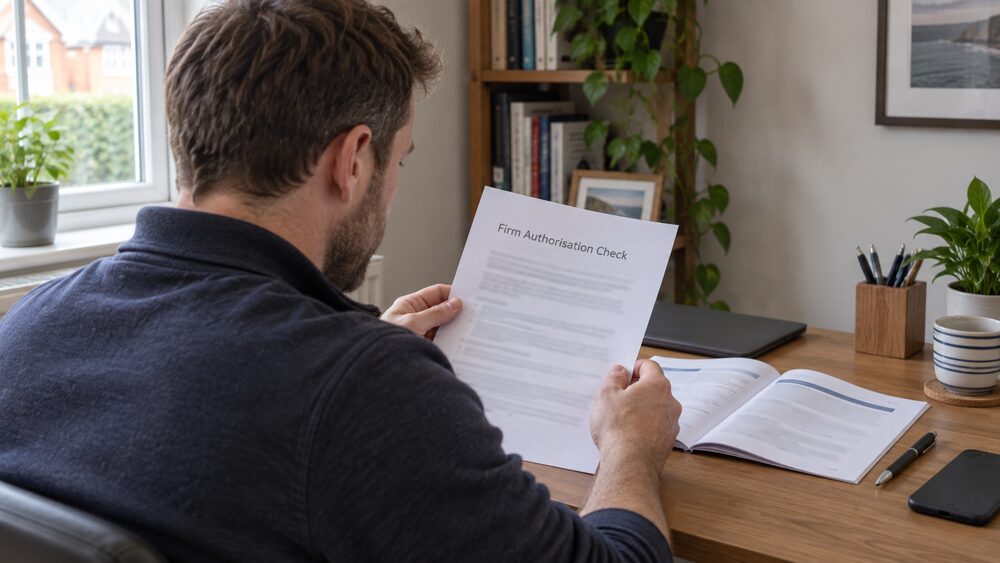
Buying insurance means handing money to a firm on a promise: that it will pay out if something goes wrong months or years later. Before that promise means anything, the firm selling it has to be real and allowed to sell it. In the UK, the Financial Conduct Authority (FCA) regulates financial services, and it keeps a public list, the Financial Services Register, of every firm it has authorised1. Checking that list takes a few minutes and is the single most useful step you can take before paying for a policy.
The check matters because almost every protection you have with insurance depends on it. The Financial Services Compensation Scheme (FSCS), which pays consumers when firms fail, states plainly that one of its conditions is that "the firm must have been authorised at the time you did business with it"2. The Financial Ombudsman Service, which settles disputes, tells consumers to use the FCA's Firm Checker to confirm a firm is authorised before complaining3. If the seller was never authorised, those safety nets may not be there at all.
This page explains how to check an insurer, broker or comparison site, what the register tells you, how to spot a clone firm or ghost broker, and what to do if you have already paid a firm that turns out to be fake.
Why checking authorisation matters before you buy insurance
Insurance is bought on trust. You pay a premium now for a payout that may only be tested years later, and the market includes firms you will never meet in person: online insurers, phone-based brokers, comparison sites passing you to a seller you have not heard of. The FCA regulates financial services in the UK, and authorisation is its stamp that a firm has been vetted, has met standards, and is subject to ongoing supervision1. A firm that is not authorised has passed none of those checks.
The practical reason to check is what authorisation unlocks. The FSCS, which compensates customers of failed firms, can only protect you if the FCA authorised the firm you dealt with7. Its guidance walks through the same sequence: first check your provider is authorised by the FCA, then find out whether the particular activity the firm carries out for you is regulated by the Prudential Regulation Authority (PRA) or the FCA8. Both steps are visible on the register.
Checking also protects you against outright fraud. Scammers advertise insurance that does not exist, or pose as real firms. The FCA is described by the Bank of England as the go-to contact if you want to check whether a firm is legitimate or report a possible scam9. A register search before you pay is the cheapest defence available: it costs nothing and takes less time than the phone call in which a seller pressures you to buy.
The Financial Services Register: what it shows
The Financial Services Register is the FCA's public record of firms and individuals it or the PRA have authorised. You can check it on the FCA's website at register.fca.org.uk to see whether the firm you are dealing with is authorised2. The FSCS's own protection checker draws its results from the same register, which you can search yourself to check if your firm is authorised10.
A register entry tells you several things, and each one matters:
- Status: whether the firm is currently authorised. The FSCS notes that if the register shows a firm's status as "authorised", it may be able to compensate you if the firm fails11.
- Permissions: the specific activities the firm is allowed to carry out. A firm can be authorised yet lack permission for the thing it is selling you, so the activity matters as much as the name8.
- Firm reference number (FRN): the firm's unique identifier. The FSCS suggests searching the register using your insurance provider's FRN12.
- Registered details: the firm's official name, address and contact details, which you can compare against what a seller has given you.
The register is also used to confirm a firm held a particular permission at a particular time, not just that it exists now. FSCS guidance on targeted support, for example, tells customers to check the Financial Services Register to confirm that a firm held the relevant permission when they received the support13. The same principle applies to insurance: what counts is the firm's status when you did business with it2.
One gap to know about: the FSCS protection checker does not include mutual insurers, which do not appear in the checker10. If your insurer is a mutual, the register is still the place to confirm its authorisation.
How to use the FCA Firm Checker
The FCA has launched a dedicated tool, the Firm Checker, to help consumers check whether financial services firms are authorised and have permission to sell products and services5. The Financial Ombudsman Service points consumers to the same tool, to confirm a firm is authorised and help avoid scams3. It is free, public, and covers insurers, brokers and other sellers alike.
The process is straightforward:
- Search the firm by name, or by its firm reference number if you have it. Searching by FRN avoids confusion between firms with similar names12.
- Check the status. The entry should show the firm as authorised. Firms whose status is "No longer authorised" or "Revoked" will not appear on the Firm Checker unless they get authorised again14.
- Check the permissions. The firm must hold permission covering the activity it carries out for you. The FCA's own worked example, for lending, shows the pattern: select the relevant activity area, then check the firm is "Authorised" and has the matching permission15. For insurance, look for permissions covering arranging or advising on insurance contracts.
- Check the contact details against what the seller has given you, as explained in the next section.
- If anything is unclear, call the FCA consumer helpline. You can use the online register or telephone the FCA consumer helpline1.
Treat the check as part of buying, not an afterthought. The ombudsman's guidance to use the Firm Checker applies before you commit money, whether the seller approached you or you found them through an advert or a comparison site3.
Match the contact details, not just the name
Finding a firm's name on the register is only half the check. The other half is confirming that the firm you are speaking to is that firm. The FCA warns consumers to check that the contact details match those listed on Firm Checker, to avoid scammers pretending to be a real firm3. A fraudster can copy a genuine insurer's name, logo and website design; what they cannot easily copy is the registered phone number and address on the FCA's own record.
MoneyHelper gives the same advice in its guidance on loan fee fraud, and the principle is identical for insurance: search the Firm Checker and use the contact details listed there, not the ones given to you16. So if a broker emails you a number to call, or a website lists a claims line, cross-check it against the register entry before you pay. If they differ, use the register's details and ask the firm to confirm the others.
This matters most when a seller has approached you first. Cold calls about insurance, pensions or investments are a common route in, and the rules on financial cold calling exist precisely because of that. If someone calls you out of the blue selling insurance, do not rely on the number they give you: look the firm up independently and call back on the registered number. If you are worried about a suspicious call, you can also call 159 to check whether you are being targeted by scammers17.
Clone firms, ghost brokers and other warning signs
A clone firm is a scam in which fraudsters borrow the identity of a real, authorised firm: the same or a similar name, a professional website, sometimes even the genuine firm's FCA reference number copied onto paperwork. The register entry looks real because it is real, which is why the contact details check in the previous section is the part that catches them. The FCA's warning is that scammers pretend to be a real firm, and the defence is to verify the details through Firm Checker rather than through the seller3.
In insurance, the equivalent scam is the ghost broker: someone selling policies that are either fake, cancelled, or taken out in your name with false details that invalidate them. The warning signs are the ones that appear across financial scams generally:
- Pressure to buy quickly, before you have had time to check anything.
- Contact details that do not match the register, or a firm that only communicates by phone or messaging app.
- Prices well below everything else on the market, which is the bait that draws people in.
- Payment to a personal account or an odd route, rather than to the firm named on the policy.
- A firm that cannot be found on the register at all, or whose entry shows it is no longer authorised14.
MoneyHelper's guidance on types of scam describes the same pattern of fake firms and cloned identities across financial products, and points to the FCA as the place to check and report16. The ombudsman's fraud and scams pages likewise direct people to the Firm Checker before dealing with any firm they are unsure about18. If a seller fails the contact details test, or cannot be found at all, do not pay, whatever the price.
Brokers and comparison sites need authorisation too
The check is not only for insurers. Most people buy insurance through an intermediary of some kind, and those firms are regulated in their own right. An insurance broker is a regulated financial adviser who specialises in general insurance: brokers help you decide what type of insurance and level of cover you need and recommend a suitable policy at a price you can afford19. Comparison sites sit in the same market, and like brokers they get paid commission by the insurance provider for selling their products19.
That means the register covers the middlemen as well as the insurers. The ombudsman's guidance on credit broking states the general rule: make sure the broker you use is on the FCA's Financial Services Register, which means they are authorised and regulated20. The same logic applies to a firm arranging or advising on insurance. Before dealing with a broker or comparison site, search for its name on the register or Firm Checker and check it holds permissions covering arranging or advising on insurance5.
The two routes differ in what they offer, and it helps to know which you are using. The policies offered on a comparison website will be fairly generic, so if you want cover that meets your individual needs, a broker's professional opinion can be valuable19. Brokers are paid by commission19. Using a regulated broker also brings protection with it: if you use a regulated broker, you are protected by the Financial Services Compensation Scheme19. A comparison site's own entry on the register tells you whether the site itself is authorised, separate from the insurers whose quotes it shows.
What authorisation gives you: fair sales and complaint handling
Authorisation is not just a badge. It puts the firm inside a framework of rules and redress that an unauthorised seller simply does not belong to, and that framework is what you are really checking for.
Fair sales. Authorised firms must hold permission for the activities they carry out, and the FCA supervises how they treat customers8. When a sale goes wrong, the question of what the firm was authorised to do becomes central. In mis-sold travel insurance complaints, for example, the ombudsman considers what would have happened if the sale had been done properly: where the customer would have bought a different policy that would have covered their claim, the ombudsman asks the insurer to pay the claim21. That kind of remedy depends on there being a regulated firm to pursue.
Complaint handling. A firm regulated by the FCA must make a final decision on a complaint within eight weeks6. If you are unhappy with the outcome, or the firm goes silent, you can take the complaint to the Financial Ombudsman Service, which handles complaints about insurance22. The ombudsman itself tells consumers to check the firm is regulated using the FCA's Firm Checker before complaining3. Some cases have their own routes: for a complaint about the sale of a group accident policy provided by your employer, you need to ask your employer to complain to the ombudsman about the sale23. And in some complaints the broker's role matters: the ombudsman asks whether the broker was acting as the insurer's agent in connection with the sale of the policy24.
Compensation if the firm fails. FSCS protection is tied to authorisation. Compulsory general insurance bought via a failed broker or financial adviser is 100% protected, while credit insurance is not eligible for FSCS protection12. The distinction shows why the check matters: the same failure can be covered or not covered depending on what was sold and by whom.
If the firm is not on the register or has disappeared
A firm that does not appear on the register at all, or whose entry shows it is no longer authorised, needs treating with caution. The FCA states that firms listed as "No longer authorised" or "Revoked" will not appear on the Firm Checker unless they get authorised again14. If a seller claims to be authorised but the tool finds nothing, that is a serious warning sign: either the firm is not authorised, or you are dealing with someone using its name.
If you have already paid and the firm has disappeared, the order of checks determines what happens next.
- Search the register for the firm's name and FRN. The FSCS suggests searching using the provider's firm reference number12.
- Check the status it held when you did business. FSCS protection requires that the firm was authorised at the time you did business with it2.
- Check whether the firm has gone out of business. The FSCS can only help once the firm has failed: its guidance states the adviser must have gone out of business, and must have been regulated by the FCA at the time it gave the advice25. The same conditions apply to its pension claims process26.
- Contact the FSCS if both conditions are met. If the register showed the firm as authorised and it has now failed, the FSCS may be able to compensate you11.
The hard case is the firm that was never authorised. The FSCS states plainly that it can only protect you if the FCA authorised your provider7. Where the seller was a fraudster rather than a failed regulated firm, the route is not compensation but your bank, the police and Action Fraud, covered in the final section.
Where the FCA can help and where it cannot
The FCA's role in this area has clear edges. It regulates financial services in the UK1, it keeps the register, and it is the go-to contact if you want to check whether a firm is legitimate or report a possible scam9. You can check the register online or telephone the FCA consumer helpline1, which is available on 0800 111 6768 and can also provide information in large print, Braille or audio format27.
What the FCA does not do is decide your dispute or restore your money. The FCA cannot pay compensation or order a firm to compensate you, even if you have received poor service28. That division of labour matters when choosing where to send a problem:
| What you want | Who handles it |
|---|---|
| Check a firm is authorised | FCA register and Firm Checker5 |
| Report a possible scam | The FCA9 |
| Complain about a sale, policy or claim | The firm first, then the Financial Ombudsman Service22 |
| Money back after a firm fails | The Financial Services Compensation Scheme11 |
| Money lost to a scammer | Your bank or card provider, and Action Fraud16 |
The ombudsman and the FSCS both depend on the firm having been authorised. The FSCS states that it can only protect you if the FCA has authorised your provider7, and the ombudsman can only look at complaints within its jurisdiction, which is why it tells people to check the firm's status on the Firm Checker first3. In some investigations the ombudsman also scrutinises the firm's own conduct: where fraud was a possibility on an insurance claim, it checks what further investigation was done before the insurer decided to pay out29. None of that machinery reaches an unauthorised seller, which is the whole case for the check.
Reporting a suspected scam and getting help
If a check has raised alarm bells, or money has already gone, there are several places to turn, and using them in the right order helps.
Report it to the FCA. The FCA is the go-to contact for checking whether a firm is legitimate and for reporting possible scams9. Reporting helps the FCA warn other consumers and take action against the firm.
Contact your bank immediately if you have paid. In scam cases, speed matters, and the banking and payments industry has been developing measures against authorised push payment scams, including a standardised approach to sharing data between banks and building societies to help identify scams before payments are made30. The ombudsman's fraud and scams guidance sets out the complaint routes when a payment has gone through18.
Report to Action Fraud. MoneyHelper's scam guidance directs victims of financial scams to report them, and describes the common types so you can recognise the pattern16.
Get free, independent advice. If you are unsure whether something is a scam, or what to do after paying a firm that has vanished, free help exists. MoneyHelper's guidance on types of scam is a starting point16, and the ombudsman's fraud and scams pages explain what it can and cannot look at18. For wider help when a dispute stalls, see free consumer advice, and for the general background on these schemes, see scams and fraud and consumer protection in UK financial services. If you need to put a complaint in writing, writing an effective complaint covers how to do it, and what to do if a company hasn't replied covers the eight-week rule in practice.
Sources30 cited
- Getting information and help with pensions nidirect, 2026-06-26
- FSCS podcast episode 46 transcript Financial Services Compensation Scheme, 2025
- Complaints we can help with: pensions and annuities Financial Ombudsman Service, 2026-09-26
- Protect your money Financial Services Compensation Scheme, 2026-09-25
- Check if a firm is authorised Financial Conduct Authority, 2026-09-27
- Research briefing CBP-8742 House of Commons Library, 2026-07-08
- Stolen pension: what we cover Financial Services Compensation Scheme, 2026-09-25
- Guide to investment protection Financial Services Compensation Scheme, 2026-09-25
- What is the Prudential Regulation Authority? Bank of England, 2026-02-11
- Can't find your firm? Financial Services Compensation Scheme, 2026-09-25
- Bad advice: mortgages Financial Services Compensation Scheme, 2026-09-25
- Flood insurance: what we cover Financial Services Compensation Scheme, 2026-09-25
- Targeted support: what we cover Financial Services Compensation Scheme, 2026-09-25
- How to check a firm or individual is authorised Financial Conduct Authority, 2023-03-20
- Buy now pay later Financial Conduct Authority, 2026-02-11
- Types of scam MoneyHelper, 2026-09-25
- Guidance on HMCTS-related suspicious phone calls, emails and text messages HM Courts and Tribunals Service, 2026-09-17
- Complaints we can help with: fraud and scams Financial Ombudsman Service, 2026-09-27
- When to use an insurance broker MoneyHelper, 2026-09-25
- Complaints we can help with: credit broking Financial Ombudsman Service, 2026-09-27
- Mis-sold travel insurance Financial Ombudsman Service, 2026-09-26
- Complaints we can help with: insurance Financial Ombudsman Service, 2026-09-26
- Personal accident insurance Financial Ombudsman Service, 2026-09-27
- Underinsurance in home insurance complaints Financial Ombudsman Service, 2026-09-26
- Defined benefit pension transfers Financial Services Compensation Scheme, 2026-09-26
- Defined benefit pension transfer claims process Financial Services Compensation Scheme, 2026-09-25
- Getting a bank account Citizens Advice, 2026-09-25
- Complain about a claims management company HM Government, 2026-09-26
- Fault claims and no claims bonuses Financial Ombudsman Service, 2026-09-16
- CP21/3: Authorised push payment scams call for views Payment Systems Regulator, 2026-09-26




 Citizens AdviceFree advice on money, consumer and legal problems in England and Wales
 MoneyHelperFree, impartial money and pensions guidance, set up by government
 Financial Ombudsman ServiceFree, independent help when a complaint about a firm is not put right
 GOV.UKOfficial information on tax, benefits and government services
 StepChangeFree debt advice and solutions from a charity