
Shared ownership is a part buy, part rent scheme. You buy a share of a home, usually between 25% and 75%, and pay rent to a housing association on the share you do not own1. Because the deposit is only needed on the share you buy, at least 5% of it, the upfront cost is far lower than buying outright3.
Whether it is cheaper than renting depends on the total you pay each month, not the deposit. That total is a mortgage payment on your share, rent on the rest, and usually a service charge4. Rent is commonly set at around 2.75% of the unpurchased share, though the lease sets the actual figure5. On a £300,000 home bought with a 40% share, the first year's rent was £4,950, or £413 a month, in the government's own worked example6.
So the honest answer is: sometimes. A small share with low rent can cost less per month than a private tenancy of the same size. A large share, or a home with high service charges, can cost more. What shared ownership reliably does is cut the deposit and give you a stake in the property, which renting does not.
What shared ownership is and what you get
You buy a share of a property on a leasehold basis and pay rent on the remaining share to the landlord, usually a housing association10. The lease is a legal contract that makes you the homeowner, and it sets out how long the lease runs, what the costs and fees are, and what your responsibilities are11. Shared owners own their homes and can properly be called homeowners11.
The share you can buy varies. Government evaluation work puts the range at between 10% and 75% of the home's value1. Consumer guidance describes the usual range as 25% to 75%2. Under the newer national model, you buy an initial percentage between 10% and 75% and pay a reduced rent on the rest3. In Wales, the scheme is a part buy, part rent arrangement where you buy an initial share of 25% to 75% with rent on the remaining share12. Northern Ireland runs its own scheme under the Co-Ownership name, where you buy a percentage share that suits your budget, between 50% and 90%13.
The point of the structure is that you build equity in the part you own while renting the rest. You can buy more shares later, a process called staircasing, and each time you do, your rent falls14. If you reach 100%, you pay no rent at all15.
The monthly costs, side by side
Renting privately means one payment to a landlord. Shared ownership means several payments, and they behave differently.
| Cost | Renting privately | Shared ownership |
|---|---|---|
| Deposit | Usually several weeks' rent | At least 5% of the share you buy3 |
| Monthly payment | Rent to landlord | Mortgage on your share plus rent on the rest10 |
| Service charge | Sometimes included in rent | Usually payable, set by the lease, not capped8 |
| Repairs inside the home | Landlord's responsibility | Yours, as the homeowner16 |
| Major structural works | Landlord's responsibility | Yours, under the lease16 |
| Rent rises | Set by the tenancy | Set by the lease, on the unpurchased share15 |
The rent you pay covers the landlord's cost of financing the share you have not bought16. That is why it falls as you buy more: the landlord is financing less. The greater the share you buy, the less rent you pay, and at 100% no rent is paid15.
Service charges are the part that catches people out. Increases to the service charge are not capped, even though rent increases are8. For flats, if the reserve fund does not cover a repair, the cost is divided between you and the other flat owners in the building17. Shared owners have the same rights over the common parts as any other leaseholder, but the same liabilities too16.
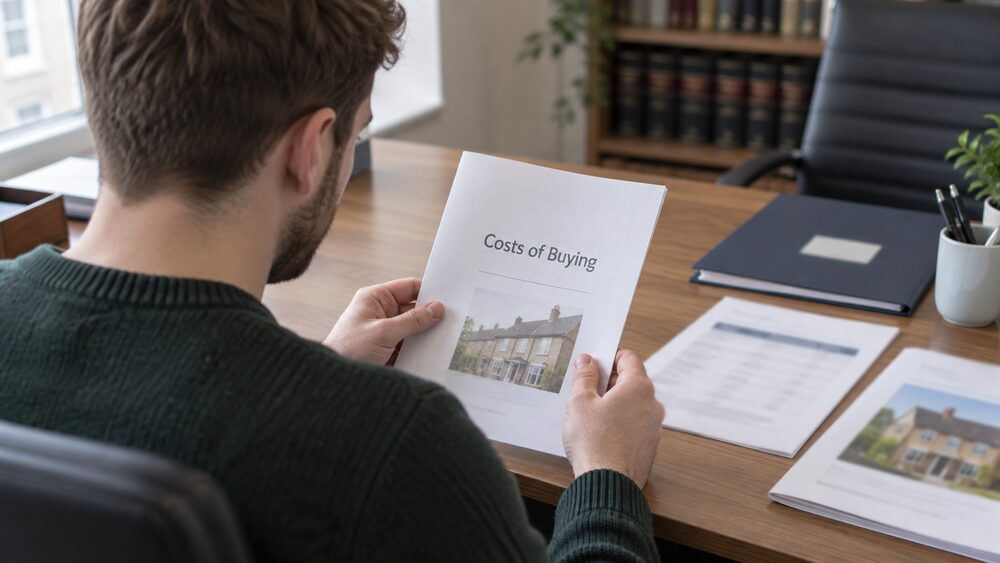
What it costs to buy in
The deposit is the headline advantage. Shared ownership homes can be bought with a deposit of at least 5% of your share of the property, plus a mortgage to cover the rest3. You only need a deposit for the part of the home you are buying, not the full price18.
There are other costs. Legal fees for a solicitor, survey costs to check the condition of the home, broker fees if you use one, and then service charges and rent on an ongoing basis18. Stamp Duty may apply, and there are two ways to pay it: on the whole home, which costs more now but means you will not pay again as you staircase, or just on your share18.
Eligibility and who the schemes are for
Shared ownership is aimed at first-time buyers and people who do not currently own a home19. In England outside London, the combined household income of applicants must be less than £80,000, and £90,000 in London7. There is a separate scheme for people aged 55 and over7.
There are also targeted routes. The Right to Shared Ownership lets eligible social housing tenants buy a percentage of their social or affordable rented home and pay a reduced rent on the rest to a housing association3. The HOLD scheme exists for people with a long-term disability, and lets you staircase in the same way14.
Availability is not universal. Not every home is offered through shared ownership, and what is available depends on what housing associations and developers are offering in your area18. The scheme name differs by nation: Help to Buy in England outside London, Share to Buy in London, Shared Ownership in Wales, and Co-Ownership in Northern Ireland18.
Where the rules differ across the UK
The legal definition of a shared ownership tenancy is not identical in each nation. In England and Wales it is a lease granted on payment of a premium calculated by reference to a percentage of the value of the accommodation or the cost of providing it. In Scotland it is an agreement under which the tenant of a jointly owned property is the tenant in respect of the landlord's interest, or has the right to purchase it19.
Scotland's scheme is described as part buy, part rent, with two payments each month: a mortgage on the share you own and a monthly occupancy charge to the housing association21. The housing association tells you how much the occupancy charge is, set case by case21.
Wales runs its own scheme with an initial share of 25% to 75% and rent on the remaining share12. Northern Ireland's Co-Ownership offers two products, each designed for a different stage of life and a different way of financing a move, with a buyer's share of between 50% and 90%13.
What happens if you fall behind
This is the part that matters most, and it is where shared ownership differs sharply from a private tenancy. The lease allows the landlord to seek possession for non-payment of rent. If a court orders possession, the shared owner loses their interest in the property and ownership returns in full to the landlord, and they also lose any capital payment made when the lease was granted9.
There is some protection in how the case is heard. The landlord may rely on Grounds 10 and 11, which are linked to non-payment of rent but allow the court to consider the surrounding circumstances in deciding whether to award possession9.
Help exists before it reaches that point. If you have a shared ownership tenancy, your Universal Credit housing costs payment can include an amount for your rent22. In Northern Ireland, Support for Mortgage Interest is available for shared ownership properties alongside help with rent23. Housing Benefit may help with rent and service charges whether or not you qualify for help with mortgage costs24. Shared ownership cases are treated as Social Rented Sector cases for benefit purposes, with housing costs based on the rent and any eligible service charges19.
How it compares with buying outright
The trade-off is straightforward. Buying outright means a deposit on the full price, which is why a mortgage covering the whole price exists as an alternative route for people with a small deposit. Shared ownership means a deposit on a fraction of the price, but rent on the rest for as long as you own less than 100%.
The costs converge over time. Research cited to the Commons housing committee found that the costs borne by shared owners reach around the same level as those for open market purchasers after 15 years8. That is the point at which the rent saved by staircasing offsets the higher initial costs.
Staircasing is not automatic and not everyone does it. Around 4,000 to 5,000 shared owners a year staircase to full ownership3. One estimate put the annual rate of reaching 100% ownership at around 3%, with rates as low as 0.7% in the North-East and higher in the South-East at 9.2% and London at 15.3%8. Of the roughly 400,000 shared ownership homes built, only around half remain categorised as shared ownership homes8.
There are limits on what you can do with the property. In most cases you cannot sub-let a spare room under a shared ownership scheme7. You cannot rent out the whole home or keep it empty; if you want to leave, you sell your share18. If you own less than 100%, you must tell the housing association that owns the rest when you want to sell18.
The lease, your rights and where protection stops
A shared ownership lease gives similar rights to an ordinary long residential lease, but there are differences26. You are responsible for all repairs and maintenance in your home, including major structural works and major repairs, because the lease makes you the homeowner16. You also agree to pay the full costs of repairs and maintenance16. The sharing of cost is stipulated in the lease, as with all leasehold properties16.
For new build shared ownership homes, the cost of repairs and maintenance is met by the landlord for the first 10 years after purchase, with some limits8. Housing associations also contribute up to £500 a year towards certain repairs and maintenance costs in the first 10 years of ownership, and that contribution can be rolled over for one year3.
On the mortgage side, the standard lease includes protection for the lender. The landlord agrees to compensate the lender for part of any loss if the sale proceeds of the leaseholder's share are insufficient on default, so mortgage indemnity insurance is not required, and the lender needs the landlord's consent to the mortgage terms27.
"the Landlord agrees that if the Leaseholder defaults the Landlord will compensate the Lender for some part of any loss"
Where protection stops is at the point of possession. The lease is not an assured shorthold tenancy, and the shared owner is the homeowner, which is why the consequences of default fall on them rather than on a landlord's insurance26.
Buying more shares and the newer model
Staircasing is the route from part ownership to full ownership. You can buy more shares in your home in future, and if you buy more shares you pay less rent14. After becoming a shared owner, you can buy more shares usually increasing to up to 100%3.
The newer national model changes some of the terms. It sets a 990-year lease as standard, applied to existing shared owners as well3. It allows staircasing in 1% increments per year for 10 years without undertaking a valuation, and reduces other staircasing transactions to a minimum of 5% rather than 10%3. For shares of more than 5%, the shared owner must pay for a valuation by a chartered surveyor, and may also be liable for an administration fee paid to the landlord of between £150 and £5008.
One limitation is worth knowing. Shared owners do not have the statutory right to lease extension in the way other leaseholders do, and must raise it informally with landlords8. The Leasehold and Freehold Reform Act 2024 provides that on the grant of an extended lease, only the rent payable in respect of the tenant's share becomes a peppercorn28.
Who provides shared ownership homes
Shared ownership accommodation is provided by housing associations19. Housing associations have built and sold 103,000 shared ownership homes in the last decade3.
Mortgages for shared ownership are offered by a range of lenders, including high street banks and building societies. Barclays, Lloyds, NatWest, Halifax and TSB all publish shared ownership mortgage information29. Smaller building societies also lend in this market, including Cambridge Building Society, Mansfield Building Society and Teachers Building Society, and The Mortgage Lender lists a shared ownership range7.
Lenders set their own criteria on the minimum and maximum share they will lend against. Cambridge Building Society, for example, offers shared ownership mortgages on properties in England and Wales with a minimum share of 25% and a maximum of 75%7. The rent on the unpurchased share is typically around 2.75%, though rental payments can be up to 3% of the total remaining share5.
Sources33 cited
- Evaluation of the Help to Buy scheme: findings report GOV.UK, 2026
- How much deposit do you need for a mortgage? Which?, 2026
- Shared ownership National Housing Federation, 2026
- Right to Shared Ownership GOV.UK, 2026
- Shared ownership mortgages Teachers Building Society, 2026
- The Right to Shared Ownership: a guide for tenants GOV.UK, 2025
- Shared ownership mortgages: everything you need to know Cambridge Building Society, 2026
- Shared ownership inquiry report House of Commons Levelling Up, Housing and Communities Committee, 2024
- Can shared owners lose all of their investment if they don't pay their rent? National Housing Federation, 2026
- Shared ownership mortgage Lloyds Bank, 2026
- Why is shared ownership considered ownership? National Housing Federation, 2026
- Help to Buy Home schemes Welsh Government, 2026
- What is Co-Ownership? Co-Ownership, 2026
- Home Ownership for people with a Long-term Disability (HOLD) GOV.UK, 2025
- How could anyone ever buy the place outright? National Housing Federation, 2026
- Why are shared owners responsible for major structural works? National Housing Federation, 2026
- Repairs and home improvements GOV.UK, 2026
- Shared ownership mortgage guide NatWest, 2026
- Shared ownership guidance legislation.gov.uk, 2025
- Housing Benefit regulations legislation.gov.uk, 2006
- Shared ownership: how it works mygov.scot, 2026
- Can I get Universal Credit housing costs element? Turn2us, 2026
- Universal Credit payments: housing nidirect, 2026
- Shared ownership Entitledto, 2026
- Debt solutions if you own your home StepChange, 2026
- Is a shared ownership lease just another form of renting? National Housing Federation, 2026
- Key information for shared owners of flats in England GOV.UK, 2015
- Leasehold and Freehold Reform Act 2024 legislation.gov.uk, 2024
- Shared ownership mortgages Barclays, 2026
- Government housing schemes Halifax, 2026
- Affordable housing mortgages TSB, 2026
- Shared ownership Mansfield Building Society, 2026
- Our mortgages The Mortgage Lender, 2026



 MoneyHelperFree, impartial money and pensions guidance, set up by government
 Citizens AdviceFree advice on money, consumer and legal problems in England and Wales
 ShelterFree housing advice from a charity
 GOV.UKOfficial information on tax, benefits and government services
 Financial Ombudsman ServiceFree, independent help when a complaint about a firm is not put right