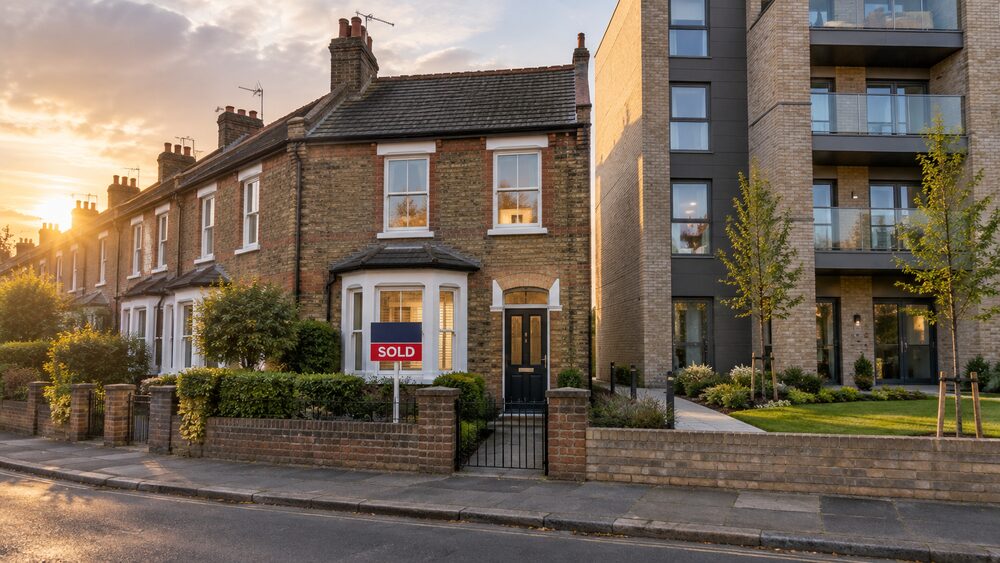
If you have a small deposit, two routes get you into a home. A 95% mortgage is a loan for 95% of a property's price, where you put down a 5% deposit to cover the rest1. Shared ownership means you buy a share of a property, usually between 25% and 75%, and pay rent to a landlord on the share you do not own2.
The two are not the same kind of decision. A 95% mortgage buys you the whole home and leaves you with very little equity, which is what makes it risky if prices fall. Shared ownership buys you part of the home and leaves you with a landlord, a rent bill and a service charge alongside the mortgage. Which one fits depends on your income, where you live, and whether you can find a shared ownership home in your area at all.
This page sets out what each route offers, what it costs, who qualifies, how you get in and out, and what protects you when something goes wrong.
What each route actually buys you
A 95% mortgage is a standard mortgage with a high loan-to-value. You own the whole property from completion, you are responsible for all of it, and your deposit is 5% of the full price. It is theoretically available to both first-time buyers and home movers, though lenders apply their own affordability rules on top1. The majority of 95% deals launched so far allow borrowing of up to four-and-a-half times your household income4.
Shared ownership is a part-buy, part-rent arrangement. You buy a share of the property and pay rent to a landlord, usually a housing association, on the remaining portion6. The scheme allows you to buy between 10% and 75% of a home and pay rent on the rest7. Under the newer model, you buy an initial percentage between 10% and 75% and pay a reduced rent on the remainder to a housing association3. Some schemes start at 25%, and some homes let you start with just 10%8.
The practical difference is what you are buying. With a 95% mortgage you are buying a whole home with borrowed money. With shared ownership you are buying a slice of a home and renting the rest, which means two monthly payments instead of one and a landlord with a say in what you can do with the property.
Fees, charges and eligibility
The costs differ in kind, not just in size. With a 95% mortgage you pay a deposit of 5% of the full price, plus the usual buying costs. With shared ownership you pay a deposit on your share only, which is why the upfront figure is smaller.
Shared ownership homes can be purchased with a deposit of at least 5% of your share of the property and a mortgage to cover the rest3. Official guidance for the Right to Shared Ownership scheme puts the usual deposit at between 5% and 10% of the share you are buying9. Lenders typically ask for at least 5% to 10% of the property price on a shared ownership mortgage7.
On top of the mortgage, shared owners pay rent, a service charge and, in some cases, a monthly management fee. Each month you will usually pay your mortgage payment, your rent and a service charge for things like cleaning shared areas8. The rent is charged on the share you do not own, and the greater the share you buy, the less rent you pay; at 100% you pay no rent at all8.
Eligibility is where the two routes diverge most. Shared ownership is aimed at first-time buyers and those who do not currently own a home10. In England outside London, the combined household income of applicants must be less than £80,0005. There is a different scheme for people aged 55 and over5. A 95% mortgage has no equivalent income cap, but the lender's affordability check does the same job.
Fixed or tracker, and what the rate depends on
Neither route is a single product. A 95% mortgage can be fixed or variable, and so can a shared ownership mortgage. What changes between them is how much you borrow relative to what you own, and that affects the rate you are offered.
A 95% mortgage carries higher interest rates than a lower loan-to-value deal, and it can be difficult to remortgage to a better rate when your deal ends, because it can take a while to build enough equity to qualify1. That is the trade-off: you get in sooner, and you pay more for the privilege until your equity grows.
Shared ownership mortgages are also priced for the risk. Lenders offer them on properties in England and Wales with a minimum share of 25% ownership and a maximum of 75%5. Some lenders will consider 100% of benefit income when assessing affordability on a shared ownership mortgage11.
The rate you pay is not the only cost. Early repayment charges apply on some shared ownership deals, and they can be steep in the early years. One five-year fixed shared ownership mortgage charges 5% of the outstanding balance in year one, falling to 2% in year four and 1% in year five, with 5% of any excess overpayment in year one12. Another shared ownership deal charges interest calculated daily13.
If you are weighing up whether to fix or track, the same questions apply as on any mortgage: how long you expect to stay, whether you can absorb a payment rise, and what the exit charge would be if you moved.
How you get in: buying, applying and switching
The process for a 95% mortgage is the standard home-buying process. You find a property, apply to a lender, and the lender checks your income and outgoings against its affordability rules. The deposit is 5% of the price, and the loan covers the rest1.
Shared ownership works differently because you are buying a share from a housing association or developer, not from a seller on the open market. Shared ownership accommodation is provided by housing associations10. You apply through the scheme or the landlord, and the size of the share is usually between 25% and 75%10.
Once you own a share, you can buy more of it over time. This is called staircasing, and the scheme offers you the opportunity to increase your share and eventually own the property in full14. Under the new model you can staircase in 1% increments per year for 10 years without undertaking a valuation, and other staircasing transactions have a minimum of 5% rather than 10%3. You can usually increase your ownership up to 100%3. Around 4,000 to 5,000 shared owners a year staircase to full ownership3.
If you want to staircase, you will need the permission of the company that owns the rest of the home8. When you staircase, the extra share you buy will need to be valued at that time5.
Switching between the two routes is not straightforward. If you buy with a 95% mortgage and later want shared ownership, you would generally need to sell and start again. If you own a share and want to move to a full mortgage, staircasing to 100% is the route, and it depends on your income and the lender's rules at the time.
Service and complaints
The service you get depends on which side of the arrangement you are dealing with. On a 95% mortgage, your relationship is with the lender, and complaints go through the lender's process and then to the Financial Ombudsman Service if they are not resolved.
On shared ownership, you have two relationships: the lender for the mortgage, and the housing association for the rent, the service charge and the upkeep of the building. Shared owners have the same benefits and rights in relation to the common parts as any other leaseholder15. That matters when something goes wrong with the building rather than the mortgage.
Complaints data gives a sense of where disputes arise. Help to Buy and shared equity loans had 110 complaints opened in 2025/26, with 64% upheld16. In the first quarter of 2025/26, Help to Buy and shared equity loans had 38 complaints with 62% upheld, while buy-to-let mortgage complaints had 157 complaints with 23% upheld17. For context, mortgages made up 10.5% of complaints by product in 2009/1018, and 19.5% of banking and credit complaints in 2013/1419.
If you fall behind on payments, lenders are expected to offer support. In 2021, 88% of mortgage firms offered support and forbearance before missed payments, alongside 86% for motor finance and 90% for personal loan firms20.
Selling up and moving on
Selling a shared ownership home is not the same as selling a home you own outright. If you own less than 100%, you will need to tell the company that owns the rest when you want to sell8. You can sell at any time, but the landlord's involvement is part of the process.
You cannot rent out a shared ownership home or keep it empty; you will need to sell your share if you want to leave8. In most cases you also cannot sub-let a spare room under a shared ownership scheme5. There is a limited exemption under the Renters' Rights Act rules, which ban re-letting for 12 months after certain evictions but exempt shared owners who give written notice to the tenant and meet other conditions.
With a 95% mortgage, selling is the standard process, but the maths can work against you if prices have fallen. A 95% mortgage leaves little equity, so a fall in value can put you in negative equity, where you owe more than the home is worth1. That is the risk that sits behind the low deposit.
Protection for your money
The protections differ because the products differ. A 95% mortgage is a regulated mortgage, and the lender is subject to the Financial Conduct Authority's rules. The Mortgage Charter, which applies to 97% of the mortgage market, allows customers who are up to date with payments and not seeking to borrow more or change repayment type or term to switch to a new deal without an affordability check22.
Shared ownership sits across two regulatory worlds. The mortgage is regulated; the rent and the landlord relationship are housing matters. Shared ownership schemes are treated as Social Rented Sector cases for benefit purposes, and housing costs are based on the rent and any eligible service charges10. The size criteria is not applicable to shared ownership cases, which means the removal of the spare room subsidy does not apply10. Any mortgage in shared ownership cases is subject to Support for Mortgage Interest rules10.
If you are buying with a mortgage, the lender's affordability rules apply to both routes. The FCA's rules on mortgages apply where the lender has a first charge over the property and at least 40% of the property is occupied by you or your immediate family23. That is the boundary between a regulated residential mortgage and a business or investment loan.
Where protection stops is at the edges. A 95% mortgage does not protect you from falling prices, and shared ownership does not protect you from rent rises or service charge increases. Neither route removes the need for a deposit, legal fees, survey costs or the other costs of buying.
Where to get free help
If you are weighing up either route, free and impartial help is available. Citizens Advice provides guidance on buying and selling a home24. StepChange offers a mortgage jargon buster for people trying to understand the terms14. Scope has advice on mortgages for disabled buyers25.
If you are already struggling with payments, the picture is different. The Scottish Government's Mortgage to Rent scheme is for people at risk of losing their home, and eligibility includes holding 25 per cent or more equity in your home21. The FCA's borrowers in financial difficulty project sets out how firms should support customers20.
For complaints, the Financial Ombudsman Service is the route if a lender or landlord does not resolve your issue. Complaints about Help to Buy and shared equity loans are upheld at a high rate, which suggests the ombudsman is willing to find in the consumer's favour when the evidence supports it16.
Sources25 cited
- 95% mortgages Which?, 2026-04-02
- Buying a house or flat in London Which?, 2026-06-19
- Shared ownership National Housing Federation, 2026-09-26
- 95% mortgage guarantee scheme launches today Which?, 2021-04-19
- Shared ownership mortgages: everything you need to know Cambridge Building Society, 2026-09-25
- Shared ownership mortgage Lloyds Bank, 2026-09-27
- Shared ownership mortgages Experian, 2026
- Shared ownership guide NatWest, 2026-09-25
- Right to Shared Ownership GOV.UK, 2026-09-26
- Help to buy a home mygov.scot, 2026-06-24
- Together Shared Ownership mortgage Together Money, 2026-09-26
- Shared Ownership 5 Year Fixed Rate Mortgage Cambridge Building Society, 2026-09-26
- Shared Ownership 2 Year Discount 95% LTV Chorley Building Society, 2026-09-26
- Mortgage jargon buster StepChange, 2026-09-25
- Why are shared ownership customers responsible for paying for major structural works? National Housing Federation, 2026-09-26
- Quarterly complaints data Q1 2025/26 Financial Ombudsman Service, 2025
- Annual complaints data and insight 2024/25 Financial Ombudsman Service, 2024
- Financial Ombudsman Service annual review 2009/10 Financial Ombudsman Service, 2009
- Financial Ombudsman Service annual review 2013/14 Financial Ombudsman Service, 2013
- Borrowers in financial difficulty project Financial Conduct Authority, 2021-07
- Mortgage to Rent scheme Scottish Government, 2010-06-23
- Mortgage Charter HM Treasury, 2023-06
- Mortgages and Home Finance: Conduct of Business sourcebook legislation.gov.uk, 2022-07-21
- Buying a home Citizens Advice, 2026-09-25
- Mortgages Scope, 2026-04-01




 MoneyHelperFree, impartial money and pensions guidance, set up by government
 Citizens AdviceFree advice on money, consumer and legal problems in England and Wales
 ShelterFree housing advice from a charity
 GOV.UKOfficial information on tax, benefits and government services
 Financial Ombudsman ServiceFree, independent help when a complaint about a firm is not put right