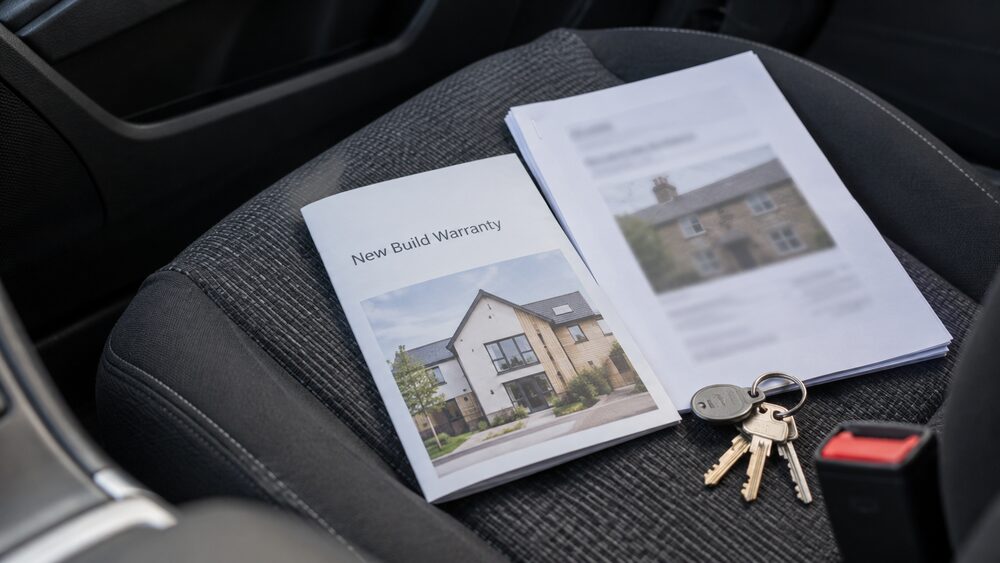
Buying a new build and buying an older home are two different processes, not two versions of the same one. With a new build, the builder usually makes the offer to you rather than the other way round, and most properties are sold at a fixed price, often before the home has been built, which is what buying off-plan means1. With an older home, you make the offer, you commission a survey, and you take on whatever condition the property is in.
The price you pay reflects that difference. In England, the average new build price was £398,000 in May 2026, up 7.7% on the year, against an average of £392,000 in March 2026 and £393,000 in February 20262. The Office for National Statistics did not publish new build and existing resold property averages in its July 2026 release because there were not enough new build transactions for a reliable result2.
What follows is how the two routes differ on price and valuation, mortgages and deadlines, government schemes, off-plan buying, warranties and repairs, surveys, and insurance.
What changes between buying a new build and an older home
The mechanics of the transaction differ from the first step. In Scotland, buying a newly built or converted home means the builder makes an offer to sell to you, and once you accept it, it becomes a legally binding contract10. That is the reverse of the older-home route, where you note interest, may face a closing date, and make the offer yourself.
New build homes in Scotland can be bought completed, currently being built, or yet to be built, which is off-plan11. The same three stages exist across the UK, and the earlier you buy, the more of the process you are committing to before you can see the finished home.
There is also a tax difference in how part exchange works. Where a building company buys your old home and sells you a new one, relief can apply if you lived in the property as your main or only home at some time in the two years before the purchase, you buy a new home from the building company, and you intend to live in it as your main or only home; it does not apply to house swaps12. In Scotland, part exchange relief applies where you sell your existing home to the house building company in total or partial consideration for the new home13.
For an older home, the condition of the property is part of the purchase. In Scotland, the Home Report is the starting point, and you will need to pay for any repairs it flags14. Elsewhere, the survey you commission does that job.
| New build | Older home | |
|---|---|---|
| Who makes the offer | The builder, in Scotland a binding contract once accepted10 | You, sometimes against a closing date |
| When you can see it | Completed, being built, or off-plan11 | As it stands |
| Condition | Covered by a warranty for structural problems8 | As described by your survey |
| Repairs after moving in | Developer fixes snags; warranty covers structural problems15 | Yours from completion |
Prices and valuations: why new builds can cost more
New build prices are tracked separately from existing homes, and the gap between them is the new build premium. An official evaluation of the Help to Buy scheme found a premium of 5% for non-Help to Buy new builds and 6% for Help to Buy new builds, an additional Help to Buy price premium of around 1%, during the period of the scheme5. That is a historical finding from the scheme's evaluation, not a current market rate.
The published averages move month to month. England's average new build price was £393,000 in February 2026, £392,000 in March 2026, and £398,000 in May 20264. The Office for National Statistics publishes a separate new build and existing resold property dataset as a CSV file16.
Valuation matters on both routes. When you port a mortgage to a new property, you will usually have to pay a valuation fee so your lender can check that the new property is worth roughly what you are planning to pay for it17. That check is what stands between an agreed price and a mortgage offer, and it applies whether the home is new or old.
Building your own home can cost less than buying a house already built by a developer, according to official guidance for Northern Ireland18. That is a third route, separate from both, and it comes with its own funding and warranty arrangements.
Mortgages for new builds: deposits, lenders and offer deadlines
The deposit question is about the lender and the deal, not the age of the property. What changes with a new build is timing. Because the home may not exist yet, the gap between your mortgage offer and completion can be long, and offers do not last indefinitely.
Homes England, for its Help to Build equity loan, will only allow more time if the build has been delayed due to circumstances beyond your control, for example import delays, staff shortages, or weather19. That is a useful guide to how lenders and scheme administrators treat delay generally: it has to be outside your control and evidenced.
Lenders also look at your wider finances. A pattern of regular buy now pay later use may be fed into the affordability calculation or lead to delays through further questions20. Lenders consider your age at application and the age you will be at the end of the mortgage, and many have an upper age cap beyond which they will not lend21.
If your existing mortgage is portable, moving it to a new home still usually involves a valuation fee, and you may have to pay certain fees such as a valuation survey fee even when you are not borrowing extra17. Where a fixed rate is ending, your lender will talk to you about a new deal about 3 to 6 months before the end of the one you have now22.
Your First Home equity loan scheme for first-time buyers
The Your First Home scheme was announced on 26 September 2026 for first-time buyers in England buying a new-build property from a developer signed up to the scheme6. It pairs a 2.5% minimum deposit with 20% government-backed equity loans, leaving a 77.5% mortgage6. The scheme will be confirmed at the Budget and is expected to open for registration by the end of 20266.
Because it is not yet open, the practical detail is still to be settled. What is clear is the shape: it is for new builds only, from participating developers, and it is an equity loan rather than a grant, so the government's share is repayable.
Other schemes show how the new build and older home split works elsewhere in the UK. In Scotland, the New Supply Shared Equity scheme is for buying a brand new house that is being built, while the Open Market Shared Equity scheme is for buying an existing home that is on sale12. The First Homes Fund in Scotland cannot be used together with other schemes that help you buy a home, though a Help to Buy ISA or Lifetime ISA can be used for the deposit23.
The First Homes scheme in England is for new builds and caps the price at £250,000 after the discount, or £420,000 if the property is in London24. You can usually only sell such a property to someone who is eligible to buy a First Home25.
Buying off-plan, reservation fees and completion delays
Buying off-plan means committing to a home that has not been built. In Wales, you are able to reserve a new home off plan at any time, but you cannot exchange contracts in excess of six months before the legal completion of the property sale26. That six-month rule is a concrete limit on how far ahead a purchase can be locked in.
The builder's offer comes with a list of conditions, and in Scotland accepting it creates a legally binding contract1. That is the point at which delay becomes expensive rather than inconvenient.
Delays are common enough to be written into scheme rules. Homes England will only allow more time on a Help to Build equity loan where the delay is due to circumstances beyond your control, such as import delays, staff shortages or weather19. Where a sale is delayed, the buyer and seller may agree alternative arrangements: under exchange with delayed completion and lease options contracts, the buyer may take over paying your mortgage and make payments either directly to you or to your mortgage lender, and may also take over buildings insurance costs and agree to pay for repairs27.
Warranties, snagging and repairs: who fixes what
A new build comes with two layers of protection that an older home does not. The first is the developer's obligation to fix snags, the defects you find after moving in: the developer is responsible for fixing snags15. The second is the building warranty, which covers major problems with newly built or converted homes28.
The warranty period is usually long. The building warranty will usually cover the cost of structural repairs in the first 10 or 12 years for new-build homes8. In Scotland, new build homes usually come with a 10-year warranty for structural problems11. For Help to Buy - Wales, your home builders must give you a new home warranty before you complete the purchase29.
Shared ownership new builds have their own arrangement: under the new national model for shared ownership, the cost of repairs and maintenance is met by the landlord for the first 10 years after purchase of a new property, with some limits30.
An older home has no such cover. You buy the property in the condition the survey describes, and repairs are yours from completion. In Scotland, the Home Report flags repairs and you will need to pay for any repairs it flags14.
Surveys and the condition of older homes
On an older home, the survey is the main protection against buying a problem. Homebuyer surveys at Level 2 RICS are a mid-level survey popular with most people buying a conventional property in reasonable condition31. A full structural survey is likely to be of use if you want to know about possible future expense, you want to negotiate a lower purchase price, or you want to decide whether to go ahead with the purchase32.
Whether to survey a new build is your decision. More in-depth reports are generally optional, so it is up to you whether to get them carried out32. The warranty covers structural defects, but it does not tell you about the plot, the drainage, or how the home was finished.
The condition of the wider housing stock is worth knowing. In the English Housing Survey 2024 to 2025, 1% of vacant owner occupied dwellings were awaiting another tenant or owner33. Survey data on material deprivation is not directly comparable between the National Survey for Wales and the Family Resources Survey, so figures from the two should not be set against each other34.
Home insurance and flood cover for new and older homes
Home insurance splits into cover for the building itself and cover for the contents inside your home28. You insure the building for the amount it would cost to completely rebuild your home, which is usually less than the sale price35. Only 45% of homeowners in a Which? survey said they had checked or updated their rebuild cost within the past two years, and even among homeowners who said they knew their rebuild cost, only 55% were confident the figure was accurate, while nearly one in five had never checked or updated it36.
Timing differs between the two routes. If you are buying a new-build property, the insurance does not need to come into effect until the day of completion1. For an older home, check your contract with your conveyancer.
Flood cover is a standard feature of home insurance31. But if you live in a high-risk flood area or your home has flooded in the past, the quotes you are offered by some insurance companies may exclude flood cover or add a high excess31. Flood Re is a re-insurance scheme in which insurers can pool the costs associated with higher-risk properties by paying a levy into a non-profit-making fund, and it is a commitment by the industry to offer insurance in high risk areas at affordable prices37. It generally excludes properties built since 20099, and properties built from 2009 are among those outside Flood Re criteria38.
You do not deal with Flood Re directly: insurers decide whether an eligible property is included37. All insurers pay into Flood Re through an industry levy, and if an insurer considers a customer to be particularly high risk, that customer's flood cover can be ceded to Flood Re31. Flood Re is a time limited scheme38, and its strategy is that premiums and payments should encourage householders to make their properties more flood resilient37.
The effect on price is measurable. A home in a high-flood-risk area with a flood claim typically sees a jump of about another 50%, meaning these homes typically see prices that are 100% to 120% higher than low-risk, no-claim properties38. Before Flood Re, just over half of these flood-claim homes would have paid thousands of pounds, while the remainder would have been unable to obtain insurance altogether38. Since its introduction, 93% of households at risk of flooding are claimed to be able to access multiple insurance quotes39.
If your home is flooded, check whether your insurance covers repair costs, replacing your belongings, another place to stay, and legal cover and legal advice40. In Northern Ireland, the process for making an insurance claim after a flood follows the same principle of checking your policy cover first41.
Where to get help
If a dispute arises over a valuation or survey, the Financial Ombudsman Service handles complaints about valuations and surveys32. It also handles complaints about building warranties28 and about how home insurance claims are settled28. Complaints about a new build itself are a separate route, and the developer and warranty provider are the first points of contact.
For free, impartial guidance on buying a home, Citizens Advice covers buying and selling, including problems with delayed completion27. Shelter Scotland covers finding properties and what happens after you buy in Scotland11. MoneyHelper provides free guidance across money topics.
Sources41 cited
- How to buy a house Which?, 2026-05-29
- UK House Price Index for July 2026 GOV.UK, 2026
- UK House Price Index for May 2026 GOV.UK, 2026
- UK House Price Index for April 2026 GOV.UK, 2026
- Evaluation of the Help to Buy scheme GOV.UK, 2026-09-16
- New first-time buyer scheme to be confirmed at Budget GOV.UK, 2026-09-26
- Your First Home scheme HomeOwners Alliance, 2026-09-26
- Shared ownership: repairs and home improvements GOV.UK, 2026-09-28
- Affordable insurance for flood risk properties: Flood Re House of Commons Library, 2026-09-26
- Buy a newly built home mygov.scot, 2020-08-12
- Finding properties Shelter Scotland, 2024-07-25
- Help to Buy: buy a home mygov.scot, 2026-06-24
- Hundreds of households benefit from extension to three key schemes Welsh Government, 2026-07-28
- First Homes Fund: eligibility Scottish Government, 2026-06-24
- After you buy Shelter Scotland, 2024-07-25
- UK House Price Index data downloads GOV.UK, 2026-08-19
- Porting a mortgage Which?, 2026-06-08
- Raising money to build your own home nidirect, 2024-09-02
- Apply for a Help to Build equity loan GOV.UK, 2026-09-27
- 7 mistakes to avoid with your mortgage application Which?, 2026-06-05
- Retirement interest-only mortgages explained Which?, 2026-04-02
- Mortgage term ending StepChange, 2026-09-25
- First Homes Fund: before you apply mygov.scot, 2026-08-31
- How the First Homes scheme works GOV.UK, 2026-09-28
- Selling a First Homes property GOV.UK, 2026-09-28
- Help to Buy - Wales: frequently asked questions Welsh Government, 2021-06-29
- Problems with selling your home: delayed completion and lease options contracts Citizens Advice, 2026-09-26
- Building warranties Financial Ombudsman Service, 2026-09-26
- Help to Buy - Wales buyers guide phase 3 extension Welsh Government, 2024-09
- New national model for shared ownership House of Commons Library, 2026-07-08
- Home insurance and flooding Which?, 2026-09-17
- Valuations and surveys Financial Ombudsman Service, 2026-09-26
- English Housing Survey 2024 to 2025 GOV.UK, 2024
- Poverty and deprivation: National Survey for Wales Welsh Government, 2024-02-15
- Shopping around for insurance Independent Age, 2026-09-26
- Could you be underinsured? Why your rebuild cost matters Which?, 2026-05-22
- Flood Re House of Commons Library, 2026-09-14
- Flood insurance: a Wales perspective Welsh Government, 2025-11
- Insurance and Flood Re: a Wales perspective Welsh Government, 2025-03-17
- Housing help if your home is flooded Shelter England, 2025-10-27
- After a flood: making an insurance claim nidirect, 2024-08-29






 MoneyHelperFree, impartial money and pensions guidance, set up by government
 Citizens AdviceFree advice on money, consumer and legal problems in England and Wales
 ShelterFree housing advice from a charity
 GOV.UKOfficial information on tax, benefits and government services
 Financial Ombudsman ServiceFree, independent help when a complaint about a firm is not put right