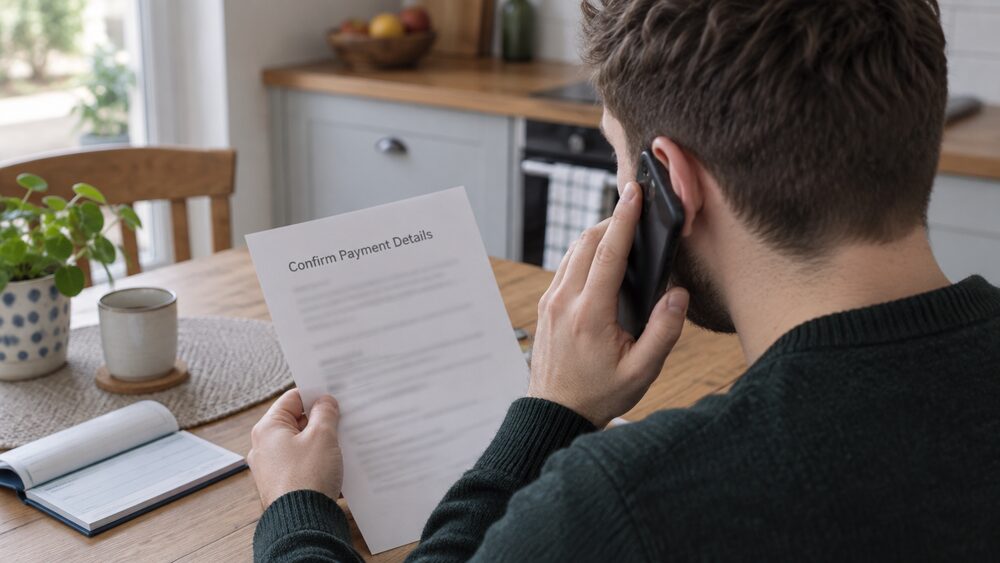
Buying a home involves some of the largest payments most people ever make, and criminals know it. In a conveyancing fraud, a fraudster intercepts or imitates messages between you and your solicitor or conveyancer, then tricks you into sending your deposit, or the balance of the purchase price, to an account they control. The National Crime Agency warns that Payment Diversion Fraud, the technique behind these scams, is on the rise, and that investment fraud losses alone run at more than £100,000 every hour1. The scam is often called "Friday afternoon fraud" because it tends to strike on the day of completion, when buyers are under pressure and large sums are moving.
The good news is that there are firm rules forcing banks to refund many victims of this kind of scam, and a further safety net, the Solicitors Regulation Authority (SRA) Compensation Fund, where a solicitor's own dishonesty is to blame. This page explains how the fraud works, how to check payment details before sending money, what to do if money has already gone, where reimbursement stops, and how the SRA fund operates. HM Land Registry, which maintains the register of ownership in England and Wales, stopped 97 registered title fraud attempts on properties valued at a total of £58 million between April 2023 and March 2024, so the threat is real but also actively fought2.
How criminals intercept a deposit or completion payment
The fraud usually begins with an email that looks like it comes from your conveyancer. Sometimes the criminal has hacked the solicitor's or estate agent's email account and watched the purchase progress, so their message arrives at exactly the right moment: the deposit is due, or completion is tomorrow. Sometimes they spoof the address, so a reply goes to the fraudster without you noticing. The message typically says the firm's bank details have changed, or gives "new" account details for the deposit, and asks you to send the money urgently.
Once the payment leaves your account it is moved on quickly, often through several accounts, which is why speed matters so much both for the fraudster and for you. The National Crime Agency notes that solicitors and conveyancers themselves are targets and should protect against the risk of Payment Diversion Fraud, so a compromised firm is not evidence that you were careless1. First-time buyers, who accounted for 52.8% of all mortgage sales in 2025, are a large share of the market and many are making these payments for the first time8.
A related scam targets the property itself rather than the payment. HM Land Registry stopped 97 registered title fraud attempts in a single year, on properties valued at £58 million in total, where criminals tried to change the register or impersonate an owner2. You can sign up to the free HM Land Registry Property Alert service to monitor a property you own and receive warnings if someone tries to change its register entries2.
Checking payment details before you send money
The single most effective defence is never to take bank details from an email alone. Your conveyancer's bank details are normally given once, at the start, in a letter or secure portal. Treat any later change of details, however plausible, as a warning sign. Confirmation of Payee, the name-checking service used by UK banks, helps reduce misdirected payments and certain types of authorised push payment fraud by checking whether a payee's account details match those held by their payment service provider9, and the Payment Systems Regulator has been expanding the firms required to use it10. But it is a check at the point of payment, not a substitute for verifying details at the source.
In practice this means: phone your conveyancer on a number you already have, from your engagement letter or found independently, never a number printed in the suspicious email. Ask them to confirm the account details verbally, using details you were given at the outset. Read the Confirmation of Payee result at your bank carefully: if the name does not match, stop. Some buyers send a small test payment first and confirm by phone that it arrived before sending the balance. Keep a record of every call and message, because if a dispute or claim follows, that record is your evidence.
If money has already gone: what to do straight away
Speed is the most important factor. Contact your bank immediately, by phone if possible, and ask it to attempt a recall of the payment and to freeze anything that can be frozen. Report the fraud as a crime: the official route is to report it online to Report Fraud or by phoning 0300 123 2040, and you can also call police on the non-emergency number 1016. MoneyHelper, the government-backed money guidance service, advises checking your account transactions and reporting any you do not recognise quickly, because you will usually get a refund if it is fraud11.
Then protect the rest of your identity. The Information Commissioner's Office advises anyone whose details may have been compromised to regularly check credit card and bank statements for suspicious activity and to monitor their credit report12. A fraudster who has your conveyancing file may know your address, your mortgage details and your moving date, which is useful material for follow-up scams. Tell your conveyancer, your mortgage lender and, if contracts have exchanged, the seller's side what has happened, so nobody proceeds on the assumption the money has arrived.
Reimbursement for scam payments: up to £85,000 per claim
Since 7 October 2024, payment firms have been required by the Payment Systems Regulator to reimburse victims of authorised push payment (APP) scams, the category that covers a deposit sent to a fraudster's account5. When the rules were designed, the regulator set the maximum reimbursement level at £415,000 per claim, applying to all consumers13. The reimbursement dashboard now published by the regulator refers to a maximum cap of £85,000, and to a £100 excess that the victim bears3. Documents in this area disagree on the cap: some material refers to £85,000 and some to £120,000, and the position has not been formally resolved, so check the current rules with your bank or the regulator before relying on a figure.
Two further points shape what you get back. First, the excess: the first £100 of the loss is not reimbursed, so a small scam payment may return very little3. Second, the deadline: sending payment firms can deny APP scam claims submitted more than 13 months after the final payment in the claim4. Where more than one payment was made to the fraudster, the clock runs from the last one. For a house purchase, where losses can be enormous, the cap matters: a diverted deposit above the cap is not fully covered by the bank rules, which is why the other routes on this page, the ombudsman and the SRA fund, matter too.
Where scam reimbursement stops
The mandatory reimbursement rules have exclusions, and a bank may refuse or reduce a payout if one applies. The exclusions include international payments, card payments, cryptocurrency transfers, payments to accounts the consumer controls, civil disputes, payments sent or received by credit unions, municipal banks and national savings banks, first-party fraud, gross negligence, payments made before 7 October 2024, and claims made more than 13 months after the last payment5.
Two of these deserve explanation in a conveyancing context. First-party fraud means a consumer who is themselves party to the fraud or dishonesty giving rise to the claim is ineligible for reimbursement14. Gross negligence is the exclusion most often argued about: a bank may claim a customer ignored clear warnings, though the regulator has tightened how firms may use this. Civil disputes are also outside the rules: the reimbursement requirement does not apply where a customer has paid a legitimate supplier for goods or services but has not received them, found them defective, or is otherwise dissatisfied15. If your conveyancer genuinely received the money and then failed to do the work, that may be a professional negligence or regulatory matter rather than a scam reimbursement claim, which leads to the later sections of this page.
Complaining to your bank and the Financial Ombudsman Service
If the bank refuses to reimburse you, or offers less than you think is right, you have a free route of escalation. The standard process is to complain to the company involved first; if it does not send a final response within eight weeks, or you are unhappy with its response, you can take the complaint to the Financial Ombudsman Service7. The ombudsman is independent and free to use, and its decisions can require the bank to put things right.
Importantly, the ombudsman's reach is wider than the reimbursement rules. It states that it can still help where those rules do not apply, for example certain other types of payment, and it may also tell the firm to pay you compensation for any distress or inconvenience you have suffered16. Its published guidance indicates awards for distress and inconvenience of up to £1,50017. One practical note on timing: the ombudsman has reported that complaints take over three weeks longer, on average, to reach a first assessment in cases where key information arrives late or has to be chased, so send everything you have, in one go, when you submit18.
When the law firm is at fault
Sometimes the loss is not a scammer outside the firm but dishonesty inside it: a solicitor who takes client money, or fails to account for it. This is where the SRA Compensation Fund comes in. The scale of the problem is not trivial: in the nine months to November 2019, the SRA took action against eight law firms over property and investment schemes in which people lost around £50 million, fining the firms almost £160,000, striking off two solicitors and suspending five19. The fund exists to restore money lost because of a solicitor's dishonesty or failure to account, where it cannot be recovered from the firm itself, and it is a fund of last resort: it pays where the money cannot be got back any other way20.
Who can claim matters. The fund is aimed at consumers, and private individuals do not have to prove hardship to be considered, in contrast to some other discretionary funds. The fund is discretionary: the SRA decides each case on its facts, and a payment is never guaranteed. Your own conduct is relevant: a claimant who was party to the dishonesty, or who ignored clear warnings, can expect a payment to be reduced or refused, mirroring the way the bank reimbursement rules treat first-party fraud and gross negligence14.
Since 8 April 2026, the SRA assesses all compensation fund applications by category rather than in order of receipt, a change made after a significant increase in applications following a large intervention21. Emergency payments are dealt with first, and commercial transactions last, with caseworker allocation times ranging from as soon as possible for emergencies to nine months for commercial transactions22. For a home buyer, that means a case about a lost deposit or a purchase that cannot complete is prioritised over a firm's commercial clients. Emergency payments exist precisely for situations where someone could lose their deposit or their home, so tell the SRA if completion is imminent21.
Licensed conveyancers are regulated separately by the Council for Licensed Conveyancers (CLC), which runs its own compensation arrangements. In July 2025 the CLC completed an initial review of claims from over 300 individuals relating to more than 50 developments, and began requesting conveyancing files from the practices involved23. If your conveyancer was a CLC-regulated firm rather than a solicitor, the CLC is the corresponding route.
Stamp Duty, mortgage money and Land Registry fees caught up in a fraud
A house purchase involves a chain of payments beyond the deposit, and a fraud or a failed firm can entangle all of them. As part of buying a house or flat you may need to pay a solicitor, an independent surveyor, a mortgage arrangement fee, a Land Registry fee and Stamp Duty24. If your conveyancer received money for tax or registration and it was stolen or misapplied, the position differs for each item.
For Stamp Duty Land Tax, HMRC treats the tax as the buyer's liability even where the conveyancer held the money, and there is a formal route to apply for a refund of Stamp Duty Land Tax where tax was not paid or was overpaid25. Note the practical rule on who gets money back: refunds can only be paid to the purchasers, unless a letter signed by the purchasers confirms who is to be repaid25. Mortgage money is lent for a specific purchase and, if the purchase fails because the money was diverted, the lender's position is set out in the mortgage offer; the costs of buying a house and exchange of contracts and completion pages cover how these payments normally flow. If your conveyancer has failed to pay property tax, see what to do if your conveyancer fails to pay property tax.
Registration is the final step that proves you own the property, and the land registration page explains how it works in each nation. HM Land Registry's own fraud-fighting record, 97 stopped title fraud attempts on properties valued at £58 million in one year, shows why registering promptly and signing up to Property Alert matter2.
Does insurance cover a lost deposit?
In almost all cases, no. Standard home insurance is built for the building and its contents: most home insurance policies cover subsidence, heave and landslip, not money lost to a scam17. A diverted deposit is not damage to the property, and the insurer of your buildings or contents policy has no obligation to refund a payment you were tricked into making.
That does not leave you without any insurance-related route. If you hold any policy you think might respond, complain to the insurer first and then to the Financial Ombudsman Service if you are refused7. But the realistic routes for a conveyancing fraud loss are the bank reimbursement rules, the ombudsman, and, where a solicitor was dishonest, the SRA Compensation Fund. The general scams and fraud guide covers the wider protections available across UK financial services.
Protecting your deposit through the whole purchase
The risk is not confined to one moment. Payments happen at every stage, from the first conveyancer invoice to the completion balance, and the pressure rises as the purchase nears exchange and completion, which is exactly when fraudsters strike.
The habits that protect you are simple and cost nothing. Keep the original letter containing your conveyancer's bank details and compare every payment request against it. Phone the firm on a known number before the deposit and again before the completion payment, using the flow above. Read the Confirmation of Payee result every time9. Report anything suspicious immediately, because quick reporting is what usually secures a refund of fraudulent transactions11. Monitor your statements and credit report if your details were compromised12. If the worst happens, move fast: bank first, then Report Fraud on 0300 123 20406, then the complaint routes, and, where a solicitor was at fault, the SRA Compensation Fund, whose emergency payments are prioritised for buyers about to lose a deposit21. The conveyancing page explains the legal work itself, and complaining when buying a home goes wrong covers the wider complaint routes.
Sources25 cited
- Fraud and economic crime, National Crime Agency National Crime Agency
- Property Alert: protect your property from fraud, HM Land Registry GOV.UK
- APP scams reimbursement dashboard Payment Systems Regulator, 2026-07-30
- APP scams reimbursement consolidated policy statement PS25/5, May 2025 Payment Systems Regulator, 2025-05
- What to do if you're the victim of a bank transfer APP scam, Which? Which?, 2026-05-12
- Computer software service fraud: follow calls, nidirect nidirect, 2026-07-27
- Ongoing financial advice services: how the Financial Ombudsman can help Financial Ombudsman Service, 2026-09-26
- Mortgage statistics UK: 2025, ONS Office for National Statistics, 2025
- Confirmation of Payee: ending dual running, consultation paper CP21/11 Payment Systems Regulator
- Specific Direction 17: Confirmation of Payee, removing the expiry date and expanding the scope of directed firms Payment Systems Regulator
- How to open, switch or close your bank account, MoneyHelper MoneyHelper, 2026-09-25
- Identity theft, Information Commissioner's Office Information Commissioner's Office, 2026-09-25
- APP scams policy statement PS23/4, December 2023 Payment Systems Regulator, 2023-12
- APP scams: policy clarifications Payment Systems Regulator, 2026-09-26
- APP fraud reimbursement policy statement PS23/3, June 2023 Payment Systems Regulator, 2023-06
- Scams where you've been tricked into making a payment, Financial Ombudsman Service Financial Ombudsman Service, 2026-09-27
- Subsidence and types of ground movement, Financial Ombudsman Service Financial Ombudsman Service, 2026-09-26
- Modernising the Redress System: policy statement Financial Ombudsman Service, 2026-08
- Property schemes: fraud and dishonesty, Solicitors Regulation Authority Solicitors Regulation Authority, 2019-11
- SRA Compensation Fund Solicitors Regulation Authority, 2026-04-08
- Compensation Fund claims process Solicitors Regulation Authority, 2026-04-08
- Compensation Fund resources Solicitors Regulation Authority, 2026-04-08
- Compensation, Council for Licensed Conveyancers Council for Licensed Conveyancers, 2025-07-14
- Buying a home: things to consider, nidirect nidirect, 2026-02-25
- Apply for a refund of Stamp Duty Land Tax, HMRC GOV.UK, 2026-06-26





 MoneyHelperFree, impartial money and pensions guidance, set up by government
 Citizens AdviceFree advice on money, consumer and legal problems in England and Wales
 ShelterFree housing advice from a charity
 GOV.UKOfficial information on tax, benefits and government services
 Financial Ombudsman ServiceFree, independent help when a complaint about a firm is not put right