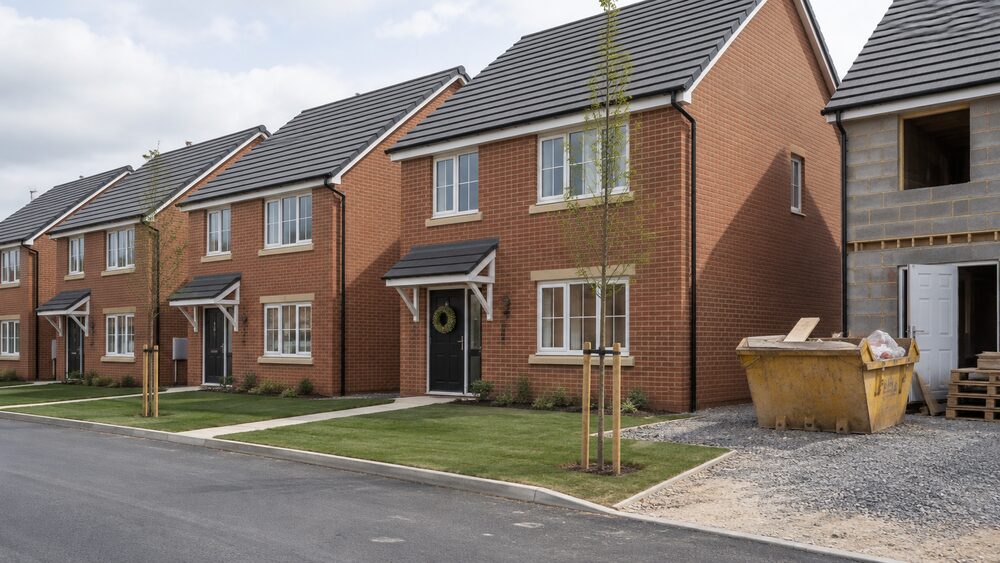
Buying a new build home works differently from buying an older property. Most new builds are sold at a fixed price, often before the home has been built, which is known as buying off-plan. Instead of you making an offer, the builder makes an offer to sell the property to you, and that offer comes with a list of conditions you must agree to1. In Scotland, most builders use a standard form of offer setting out those conditions2.
New builds also tend to cost more than comparable older homes. The government's evaluation of the Help to Buy scheme found a new build premium of 5% for non-Help to Buy new builds, and 6% for Help to Buy new builds, meaning an additional premium of around 1% on homes bought through the scheme3. What a buyer gets in return is a home with consumer protection attached: most new builds in the UK are covered by a consumer code, a structural warranty, and access to a free ombudsman for disputes with the developer4.
Which consumer code protects a new build home
A new home built by a developer registered with LABC Warranty, and covered by a New Homes Warranty, will be covered by one of two consumer protection codes4. The codes are separate from the warranty itself: the warranty covers faults in the building, while the code covers how the sale was conducted and how you are treated afterwards.
The Consumer Code for Home Builders (CCHB) has operated since 2010 and applies to most new-build homes in the UK. It is accredited under a government-approved consumer protection scheme, and complaints about possible breaches of the Code are handled through an independent contact centre supported by government funding4. That independence matters: the body reviewing your complaint is not the developer and is not the warranty insurer.
Alongside the codes sits the New Homes Ombudsman. The scheme's policy statement is clear about who it exists for:
"The Ombudsman will support people who have been able to purchase a new build home."
In practice this means the Ombudsman handles disputes between buyers and the developer they purchased from. It does not step into every property dispute, and later sections of this page set out where its role stops and where other routes, such as the Financial Ombudsman Service for warranty insurers, take over.
New Homes Quality Code or Consumer Code for New Homes: how each one works
The two codes now operating are the New Homes Quality Code (NHQC) and the Consumer Code for New Homes. The NHQC is managed by the New Homes Quality Board, an organisation that operates independently from warranty providers. Developers register with the Board and, once they activate their registration, they are required to follow the Code's rules and standards4.
The separation from warranty providers is deliberate. Historically, consumer codes for new homes were run by the same bodies that provided the warranties, which meant the organisation judging a complaint about a sale could have a commercial link to the developer or insurer. The New Homes Quality Board's independence from warranty providers is designed to remove that conflict4.
The Code's requirements span the whole purchase. Documents describing the Code refer to its coverage of legal documents, information, inspection and completion, and of after-sales service, complaints and the New Homes Ombudsman Service, in Part 2 and Part 3 of the Code, though the documents differ on exactly how these sections are divided4. In substance, the Code reaches from the moment information is first given to a buyer, through the reservation and completion, to the developer's obligations after keys are handed over.
The Consumer Code for New Homes is currently published in more than one version: documents in circulation refer to both Version 5 and Version 4, and the two disagree on which is current4. For a buyer, the practical point is to ask which version of which code applies to your purchase, and to get that in writing, because the complaints route and the standards the developer must meet are set by the code in force for your home.
What the developer must tell you before you reserve
Both codes carry guidance instructing developers to offer reliable information before, during and after purchase, to treat buyers fairly, to maintain high standards of customer service through staff training, and to ensure buyers have access to free, independent help if a dispute arises4. Before you reserve, that means you are entitled to clear information about the property, the price, the timetable and what happens if things change.
Some disclosures are required by other rules too. If the home has a Green Deal loan attached to it, the seller must tell the buyer that there is a Green Deal loan and that they are responsible for it, and must show the Energy Performance Certificate before they move in8. A Green Deal charge stays with the property, so this is something to check specifically on a new build with energy-efficiency measures installed.
Where a government scheme is involved, there are extra requirements. Under Help to Buy Wales, your home builders must give you a new home warranty before you complete the purchase9. The same requirement appears in the scheme's earlier buyer guidance10. In Scotland, buyers using the Help to Buy scheme are given an 'After Sales' brochure by the agent who deals with post-sales work in their area11.
The offer document itself is where the conditions live. The builder's offer to sell comes with a list of conditions1, and in Scotland most builders use a standard form of offer laying out the conditions you must agree to2. Read these before paying anything, because the conditions set out what the builder must do, what you must do, and what happens if either side changes or pulls out of the deal.
Reserving: why the usual 14-day cooling-off right does not apply
Many consumers assume that any purchase at a distance or away from a trader's premises can be cancelled within 14 days. That right exists in law for some contracts: the Digital Markets, Competition and Consumers Act 2024 provides for a 14-day period beginning with the day after a relevant renewal of a subscription contract occurs12. But house purchases sit outside this framework.
The Consumer Contracts (Information, Cancellation and Additional Charges) Regulations 2013 exclude contracts for the creation of immovable property or of rights in immovable property, the rental of residential accommodation, and the construction of new buildings7. In plain terms, buying or reserving a new home is not the kind of contract that carries a statutory 14-day cancellation right.
This is why the reservation document matters so much on a new build. Any right to cancel, any deadline, and any treatment of the reservation fee come from the conditions the builder has set out in its offer, not from general consumer law. Some developers voluntarily allow a short period in which a reservation can be cancelled, but that is a term of the contract, not a statutory right, and it varies between developers. Ask for the cancellation terms in writing before paying a fee, and have your solicitor review them.
Choosing your own solicitor and advisers
The legal work on a new build is the same in kind as on any purchase, but the timetable is often tighter and the builder's conditions add extra documents to check. Official guidance for buyers of new homes sets out where the process starts when something is wrong: if you have serious problems with a new home, for example if you discover a defect, the guidance is to speak to your solicitor first13.
Under Scotland's shared equity schemes the position is explicit. When you are ready to buy through the Open Market Shared Equity scheme, you need a solicitor to act on your behalf to assist with buying the home, and the Scottish Government has its own solicitor who will handle the work involving its equity share14. So even where a public body holds a stake in the property, your legal representation is separate and yours to choose.
The one-off costs of buying are yours to arrange as well. Guidance for buyers in Northern Ireland lists the payments you may need to make: a solicitor, an independent surveyor, a mortgage arrangement fee, a Land Registry fee, and Stamp Duty15. On a Help to Buy equity loan valuation, you choose the surveyor and arrange and pay for the report yourself16.
A developer may recommend a solicitor, a mortgage broker or both, often with an incentive such as a contribution to legal fees. Nothing obliges you to accept. The builder's offer carries the conditions of the sale1, but the code requires access to free, independent help if a dispute arises4, and independence is easiest to establish at the start. An adviser chosen by the developer is paid through a transaction in which the developer has an interest, and a buyer who wants advice untied to the sale can appoint their own solicitor and broker, and their own surveyor.
Part exchange, incentives and assisted-move offers
Developers commonly offer incentives to buyers who need to sell an existing home: part exchange, where the developer buys your current home, and assisted-move or assisted-purchase schemes, where the developer helps with the sale. These offers change what a scheme permits. The First Homes Fund in Scotland excludes purchasers who are using part exchange, though it does allow builder incentives and assisted purchase17.
Incentives also interact with government schemes. The New Supply Shared Equity scheme in Scotland helps buyers take a 60-80% share of the cost of a brand new house that is being built18, and the scheme exists to help people buy a new-build home from a council or housing association19. An evaluation of the First Home Fund gave an indicative estimate that nearly four in ten (37.5%) of new build properties purchased through the FHF may have been eligible for Help to Buy21. The wider family of Scottish low-cost initiatives includes the New Supply Shared Equity scheme alongside other routes22.
In Wales, Help to Buy works as an equity mortgage: the scheme's own worked example uses an equity mortgage percentage of 20%10, and the same warranty requirement applies as for any scheme purchase22. A new scheme for England was announced on 26 September 2026: Your First Home would give first-time buyers a 20% government-backed equity loan on new-build homes bought from a developer signed up to the scheme, with a 2.5% minimum deposit and a 77.5% mortgage, to be confirmed at the Budget and open for registration by the end of 202623.
The new build premium is the backdrop to all incentives. The evaluation found a premium of 5% for non-Help to Buy new builds and 6% for Help to Buy new builds3. An incentive that reduces your costs may still leave you paying a price that reflects the premium, so the value of an incentive is worth weighing against the price being asked for the home itself.
Pre-completion inspection and moving in
Before completion, the checks on a new build differ from an older property in one useful way: there is no existing owner's occupation to inspect around, but there may be no finished building either. Where a scheme is involved, the warranty must be in place before you complete: under Help to Buy Wales, your home builders must give you a new home warranty before you complete the purchase9.
Insurance timing also differs. If you are buying a new-build property, the insurance does not need to come into effect until the day of completion1. On an older home, buildings insurance is often needed from exchange of contracts, so this is a genuine difference in the new build process and one worth confirming with your insurer and your lender.
The pre-completion stage is also when the developer's code obligations bite: the codes require reliable information and fair treatment through the purchase and beyond4, and the offer conditions govern what must be finished by the completion date1. A snagging inspection at this point, before completion where possible, gives you a written record to hand over on day one.
Snags and defects: who puts them right
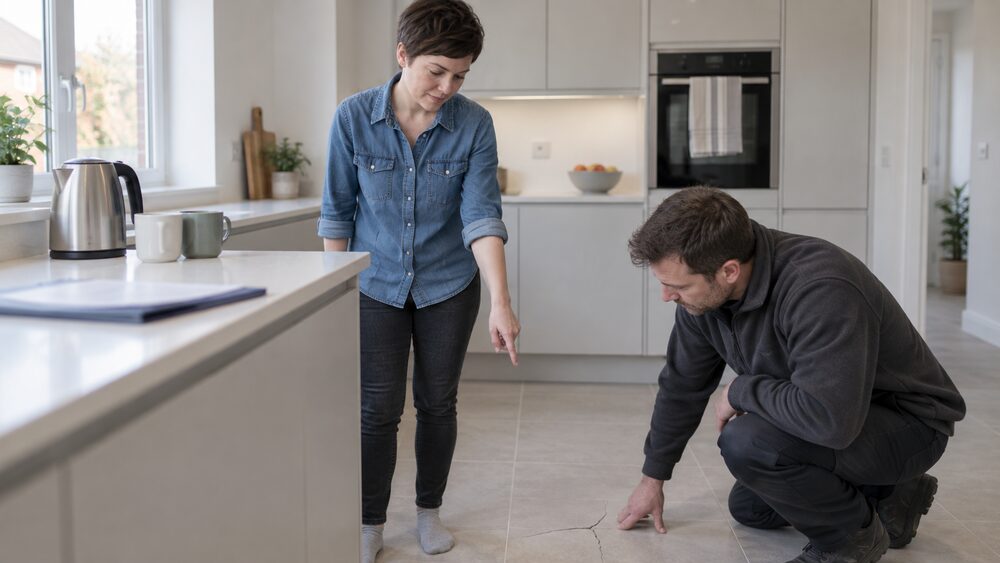
Snags, the small defects and unfinished items common in new homes, are the developer's responsibility to put right, and the consumer codes are the mechanism that enforces this. The codes require developers to maintain high standards of customer service and to provide access to free, independent help if a dispute arises4. In Scotland, buyers using Help to Buy are given an 'After Sales' brochure by the post-sales agent for their area, which sets out the route for reporting problems11.
For serious problems, the starting point is your own solicitor. Official guidance says that if you have serious problems with a new home, for example if you discover a defect, the first step it sets out is speaking to your solicitor13. A solicitor can advise on what the builder's offer and the code require, and on deadlines that may apply to claims.
The warranty covers a different layer of the problem. Building warranties cover major problems with newly built or converted homes6. In years 3 to 10, you are covered for structural problems where the builder has not complied with technical requirements, described as a breach of technical requirements6. So the division of labour is: snags and service issues go to the developer under the code; major and structural defects go to the warranty insurer; and a dispute about how the developer handled either can go to the code body or the New Homes Ombudsman.
What happens if the builder fails before completion
Buying off-plan means paying, or committing to pay, for something that does not yet exist. The protection against the builder failing is the warranty. Building warranties cover you if the builder is insolvent or commits fraud and does not complete the build: the insurer should refund your money, part-refund it, or arrange for the building to be finished6.
This is why the warranty documents matter as much as the consumer code. Confirm before exchange that a warranty is in place and registered for your plot, and keep the policy documents with your purchase papers. Where a government scheme is involved, the requirement is explicit: home builders must give you a new home warranty before you complete the purchase9.
If the worst happens, the claim is against the warranty insurer, not the failed builder. The Financial Ombudsman Service can look at complaints about building warranties, and its data shows these are not rare: 109 new complaints about Building Guarantees were opened in Q3 2025/2624. If the insurer does not respond or you disagree with its decision, the complaint route in the next section applies.
How to complain about a new build developer
The first stop is always the developer. Complaints about the sale process that have not been addressed by the builder or developer should be taken to the relevant consumer code, and information about the code should be available through the builder or developer, or in the welcome pack supplied when the home was bought4. Complaints about possible breaches of the Consumer Code for Home Builders are handled through an independent contact centre supported by government funding4.
If the developer does not resolve the matter, the New Homes Ombudsman is the escalation route for disputes with the developer the home was purchased from, and the service will be free to consumers5. Where a government scheme is involved, there are parallel routes: you can complain to Help to Buy Wales over the phone or in writing, about the scheme or about someone who works for it, and someone else can complain on your behalf25.
For warranty disputes, the Financial Ombudsman Service applies its standard process: complain to the company involved first, and if it does not send a final response within eight weeks, or you are unhappy with its response, you can bring the complaint to the Ombudsman using its complaint form26. If the ombudsman cannot help, it can provide details of other ombudsman schemes covering complaints such as energy and housing27.
Where the codes do not apply
The consumer codes and the ombudsman have boundaries, and a buyer who assumes universal protection can be caught out. The most important boundary is contractual: the Consumer Contracts Regulations exclude contracts for the creation of immovable property or rights in it, rental of residential accommodation, and construction of new buildings7, so the statutory cancellation and information rights that apply to ordinary consumer purchases do not reach the house purchase itself.
The New Homes Ombudsman only covers people who purchased a new build home and are in dispute with the developer they purchased from5. A second-hand buyer of the same home years later has no route to the Ombudsman, however bad the original build. Their protection is the warranty, which runs with the building, and the courts.
Other protections have their own edges. The Mortgage Charter's commitments do not apply to Buy to Let mortgages28, and the Pre-Action Protocol for possession claims excludes Buy To Let mortgages too29. The FCA's affordability rules do not apply to a replacement contract with no additional borrowing beyond financing a product or arrangement fee, or to a variation, provided there is no material change to the affordability terms30. First-time buyer relief from Land and Buildings Transaction Tax cannot be claimed where evidence clearly shows another dwelling will continue to be the buyer's main residence, or that the new dwelling was acquired for another purpose such as with a buy-to-let mortgage31, and the relief's provisions do not apply in relation to a spouse or civil partner of the purchaser if the two are not living together on the effective date of the other land transaction32.
For shared owners, the repairs allowance has its own limit: if the new owner buys a 100% share, they do not get the repairs allowance33. And in Scotland, Help to Buy assistance is not provided to help you pay a deposit to a lender34.
Where the complaint is about a financial product rather than the building, the Financial Ombudsman Service is the route. It can look at complaints about financial difficulties affecting your ability to repay your mortgage, including complaints about advice from a financial business, mortgage arrears and charges, and repossession before possession takes place or after it has happened35. It can help even after a house has been repossessed36. And where a credit broker receives a complaint in relation to the subject matter of its scheme, it must forward the complaint to the lender and inform the consumer that it has been forwarded37, so a complaint about a broker recommended by the developer still reaches the right firm.
Sources37 cited
- How to buy a house Which?, 2026-05-29
- Buying a newly built home mygov.scot, 2020-08-12
- Evaluation of the Help to Buy scheme: evaluation findings report GOV.UK, 2026-09-16
- Consumer code protection for homebuyers LABC Warranty, 2026
- New Homes Ombudsman: summary integrated impact assessment Welsh Government, 2022-01-19
- Building warranties Financial Ombudsman Service, 2026-09-26
- The Consumer Contracts (Information, Cancellation and Additional Charges) Regulations 2013 legislation.gov.uk, 2013-12-11
- Green Deal GOV.UK, 2026-09-26
- Help to Buy Wales buyers guide phase 3 extension Welsh Government, 2024-09
- Help to Buy Wales post-completions guide Welsh Government, 2024-07
- Help to Buy: after you buy mygov.scot, 2022-04-08
- Digital Markets, Competition and Consumers Act 2024, Part 4 legislation.gov.uk, 2024-05-24
- New Supply Shared Equity scheme: how it works mygov.scot, 2026-07-28
- Open Market Shared Equity scheme: how to apply mygov.scot, 2026-03-17
- Buying a home: things to consider nidirect, 2026-02-25
- How to get a valuation of your Help to Buy home GOV.UK, 2025-08-18
- First Homes Fund: how to apply, eligibility gov.scot, 2026-06-24
- Help to buy a home mygov.scot, 2026-06-24
- New Supply Shared Equity scheme for older people mygov.scot, 2022-04-08
- Low cost initiative for first-time buyers gov.scot, 2026-09-26
- First Home Fund evaluation synthesis gov.scot, 2021-02-24
- Help to Buy Wales buyers guide Welsh Government, 2021-01
- New first-time buyer scheme to be confirmed at Budget GOV.UK, 2026-09-26
- Quarterly complaints data Q3 2025/26 Financial Ombudsman Service, 2025
- Help to Buy Wales: complaints Welsh Government, 2026
- Ongoing financial advice services Financial Ombudsman Service, 2026-09-26
- How to complain: consumer video transcript Financial Ombudsman Service, 2026-09-26
- Mortgage Charter 2026 GOV.UK, 2026-03-26
- Pre-Action Protocol for Possession Claims Ministry of Justice, 2017-01-30
- MCOB 11.6.3R FCA Handbook, 2026-06-26
- LBTT first-time buyer relief Revenue Scotland, 2025-11-19
- Finance Act 2003, Schedule 4ZA legislation.gov.uk, 2026
- Shared ownership scheme: repairs and home improvements GOV.UK, 2026-09-28
- Help to Buy information for buyers leaflet gov.scot, 2016-02
- Financial difficulties with mortgages Financial Ombudsman Service, 2026-09-26
- Interest-only mortgages Financial Ombudsman Service, 2026-09-26
- CONRED 6.1.9: credit broker complaints FCA Handbook, 2026-03-31





 MoneyHelperFree, impartial money and pensions guidance, set up by government
 Citizens AdviceFree advice on money, consumer and legal problems in England and Wales
 ShelterFree housing advice from a charity
 GOV.UKOfficial information on tax, benefits and government services
 Financial Ombudsman ServiceFree, independent help when a complaint about a firm is not put right