
For most jobs, poor credit will never come up. Employers do not routinely see your credit report, and a job application does not leave a mark on your file. Where it does matter is narrower than people fear: bad credit might affect your ability to get some jobs, for example in legal or financial services1. Some debt solutions can affect jobs that handle other people's money, like jobs in law or financial services2.
For most jobs, poor credit will never come up. Employers do not routinely see your credit report, and a job application does not leave a mark on your file. Where it does matter is narrower than people fear: bad credit might affect your ability to get some jobs, for example in legal or financial services1. Some debt solutions can affect jobs that handle other people's money, like jobs in law or financial services2.
The bigger practical effect of a poor credit record is on borrowing, renting and household bills rather than on employment. A bad credit rating will make it more expensive and harder to borrow money, and it can also affect your ability to rent a home, get a mobile phone contract or anything else that requires a credit check3. Failing to pay debts, whether secured or unsecured, can affect your credit rating3.
If you are job hunting and worried about your record, the useful things to know are what an employer can actually see, what stays on your file and for how long, and how quickly steady payments can turn things around. Six to 12 months of paying on time is the timescale for someone who has never officially borrowed before to improve their credit score4.
Bad credit can affect some jobs, mainly in legal and financial services
The employment effect is real but narrow. Guidance from high street banks states plainly that bad credit might affect your ability to get some jobs, for example in legal or financial services1. Debt charity StepChange goes further on the debt side: some jobs may be affected by going bankrupt or having a debt solution, and some debt solutions can affect jobs that handle other people's money, like jobs in law or financial services2.
That second point is the one people miss. It is not only a poor repayment record that can matter. Entering a formal debt solution, such as bankruptcy or an individual voluntary arrangement, can restrict certain roles, particularly where the job involves handling clients' money or regulated financial activity. If you work in, or are applying for, a role in law, accountancy or financial services, the type of debt solution you choose can be as relevant as the arrears themselves.
A county court judgment can also reach beyond credit. Having a CCJ can affect your credit rating and may make it harder for you to obtain credit in the future, and the consequences listed include your credit score, borrowing, renting and employment opportunities7. In Scotland the equivalent is a decree, and the same broad principle applies: it is a public record of a debt you have not paid9.
For everyone else, the picture is calmer. Most employers never ask, and the sectors where screening is standard are a small share of the job market. If you are applying outside law, financial services and roles that handle other people's money, your credit file is unlikely to be part of the process at all.
What an employer or lender sees: no single credit score
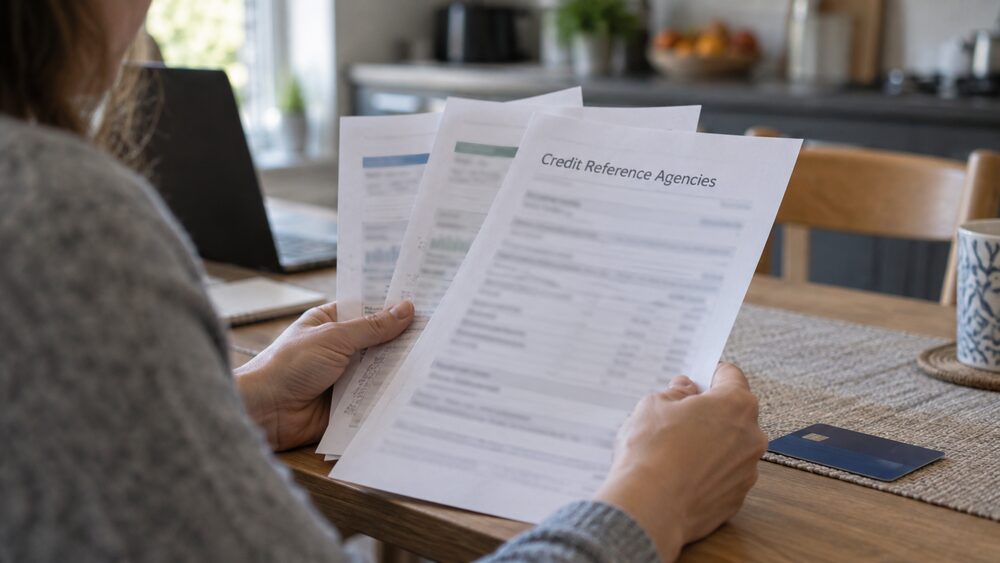
There is no such thing as a universal credit score10. Each lender has its own system, and the three credit reference agencies each produce their own version. That matters for a job application because there is no single number an employer could look up even if it wanted to.
What exists instead is your credit report: a record of accounts, payments, searches and public information. Employers who screen do so through a formal process, usually as part of recruitment checks for a specific role, and you would be asked to consent. Companies cannot see if your report has been checked by an employer, so your credit score will not be affected by a job application11.
It is worth separating the two kinds of check that do exist:
- Soft searches are used for eligibility checks and quotes. They will not affect your credit score, as lenders cannot see them12. A mortgage agreement in principle uses a soft credit check, which does not affect your credit rating or ability to borrow from lenders in the future13.
- Hard searches happen when you actually apply for credit. A hard credit check will be visible to anyone checking your credit report, and can impact your credit score for at least 12 months12.
What counts against you and for how long: missed payments stay for six years
The six year figure runs through almost everything on a credit file. Late payments stay on your credit history for six years, as do missed payments and defaults5. Some information stays on your credit file for six years, like missed payments, defaults and court judgments14.
The same period applies across the different kinds of problem:
| What it is | How long it stays | Source |
|---|---|---|
| Late or missed payments | Six years | 5 |
| Defaults | Six years | 5 |
| County court judgments | Six years | 14 |
| Bankruptcy | Six years on your credit file | 15 |
| Minimal asset process bankruptcy (Scotland) | Six years | 16 |
| Missed mortgage repayment | Six years | 17 |
A missed mortgage repayment leaves a mark on your credit report and impacts your credit score, and that mark remains for six years17. A default notice negatively impacts your credit rating for six years and would be quite damaging for future financing plans18. Bankruptcy has a big impact on your credit score and stays on your credit file for six years, and you may find it hard to get credit for up to six years15.
There is one piece of good news inside that window. If you pay a CCJ within a month, it can be kept off your file, and paying a judgment later still helps: satisfying it makes it easier to apply for credit in the six years before the CCJ drops off your credit file7. Getting a debt written off is likely to have a negative impact on your ability to get credit in the future for up to six years13.
Characteristics that cannot be used against you
Credit scoring is bound by rules about what it may consider. Credit scores cannot be based on characteristics such as religion, race, political beliefs, sexual orientation, disability or criminal record20. Those factors are off limits in the scoring itself, whatever a lender's own criteria may say about affordability.
Some things people assume will hurt them do not, on their own:
- A partner's poor credit. Your partner's poor credit does not always affect you, even if you are married or in a civil partnership. It only counts if you have a joint account, loan or credit card with them22. Where you do hold joint borrowing, they can affect your score if they have a bad credit history22.
- Negative equity. Negative equity will not necessarily impact your credit score, unless you default on your payments or need to move house and cannot make up the shortfall23.
- Losing your job. Losing your job will not, in itself, impact your credit score, but lost income may lead to financial behaviour that can lower it11.
- Refinancing debt. Refinancing can have less impact on your credit rating because there is not an ongoing record of making reduced payments24.
The distinction that matters is between your circumstances and your behaviour. Being made redundant, being in negative equity or having a partner with debts are circumstances. Missing payments, going over an overdraft limit or defaulting are behaviour, and those are what the file records.
Does checking my own credit score harm it?
No. You can check your own credit score without hurting it, and you can check it as often as you like without doing any harm25. Viewing your score will not affect it26.
What does move a score is repeated applications. Multiple hard searches, particularly within a short period, can lower your credit score10. Every time you make a credit application, it gets recorded on your credit history, and unsuccessful applications can bring down your score27. Current accounts with overdrafts appear on your credit report, and successive applications in a short space of time could negatively affect your score28.
That is why eligibility checkers exist. A soft search will not affect your credit score, as lenders cannot see it12. Post Office states that its small loan eligibility check is fast and will not affect your credit score, and the same for its self-employed loan check29. Using these before a full application keeps the hard searches down.
Does not being on the electoral roll affect my credit file?
Yes, and it is one of the few things that affects every score the same way. Certain things will have a negative impact on your score regardless of the agency, for example, not being on the electoral roll or making a late payment10. Because the three agencies all treat it the same, an out of date registration is a problem you cannot shop around.
There are three credit reference agencies in the UK who store information about your credit history: Equifax, Experian and TransUnion32. There are three credit reference agencies, Experian, Equifax and TransUnion, and lenders may use any of them33. Checking with all of them means you do not miss anything32.
Other things that count against you, and where they come from:
- Overdrafts. Your credit rating can be affected if you often go over your overdraft limit or owe too much on your overdraft34.
- Reduced payments. Your credit file will be affected any time you pay less than what you agreed to when you took out the debt35.
- Late payments and the electoral roll. Certain things have a negative impact on your score regardless of the agency, for example not being on the electoral roll or making a late payment33.
Cards aimed at people with a poor credit history tend to have a low limit of around £200 and often have a high interest rate, so they are a tool for rebuilding rather than a source of cheap borrowing36.
Improving your credit record: 6 to 12 months of steady payments
The timescale is more encouraging than the six year retention periods suggest. It takes six to 12 months of paying on time for someone who has never officially borrowed before to improve their credit score4. The same six to 12 month figure applies to credit builder card users working on their score4.
A debt consolidation loan may help you repair your credit file over time, if you keep up with payments37. The condition is doing the work: the improvement comes from the record of payments, not from the loan itself.
If you are new to the UK, an overseas record will not transfer. While you may have a good credit history overseas, this will not help you in the UK and you will have to build your UK credit history from scratch38. The same works in reverse: credit scores from one country do not usually count in another22.
Moving abroad for work does not clear a UK debt. Moving to another country makes it harder for the people you owe to find you, but it does not stop them trying9. If you are leaving the country with unpaid debts, the file and the obligation both travel less well than the debt collectors do.
Where to get free help
If debt is the reason your credit record is causing worry, free and impartial advice is available. StepChange offers debt advice, and its guidance covers how debt interacts with work and education2. Citizens Advice explains how lenders decide whether to give you credit33. National Debtline publishes guides on writing off debt13.
For the employment question specifically, the practical steps are to check your report with all three agencies, correct anything wrong, keep your electoral registration current at your address, and avoid a cluster of credit applications. If a role you are applying for involves a credit or financial screening, ask the employer what the check covers and when it happens, so you know what is being looked at and can respond to anything inaccurate before a decision is made.
Sources38 cited
- What affects your credit score Lloyds Bank, 2026-09-27
- Debt and my career StepChange, 2026-09-25
- What do I need to know about debt Bank of England, 2025-08-19
- How to improve your credit score Which?, 2025-10-24
- Getting a mortgage with late payments and defaults Which?, 2025-08-20
- Reduced income guide StepChange, 2026-09-25
- How long does a CCJ last StepChange, 2026-09-25
- Not paying or ignoring a CCJ StepChange, 2026-09-25
- County court judgments Shelter Cymru, 2026-08-30
- How to check your credit score for free Which?, 2025-10-24
- Employment and your credit report Experian, 2026
- What is a hard or soft credit check Halifax, 2026-09-27
- Can I avoid my debts StepChange, 2026-09-25
- How does debt affect a credit file StepChange, 2026-09-25
- How does bankruptcy affect my credit score Accountant in Bankruptcy, 2026-07-15
- Minimal assets process StepChange, 2026-09-25
- How do mortgage payments work Which?, 2026-06-19
- Car finance Advice NI, 2026-09-26
- Bankruptcy and your assets StepChange, 2026-09-25
- Understanding your credit information Equifax, 2026
- Understanding credit information Experian, 2026
- How to rent with a poor credit history Shelter England, 2026-05-01
- Negative equity Which?, 2025-12-10
- Negotiating with my creditors StepChange, 2026-09-25
- Credit score StepChange, 2026-09-25
- What is credit Experian, 2026
- Bad credit mortgages Which?, 2025-10-08
- How to open a bank account online Which?, 2026-04-23
- Small loans Post Office, 2026
- Self-employed loans Post Office, 2026
- How to check your credit score for free Which?, 2025-10-24
- Will I be blacklisted Mental Health and Money Advice, 2025-09-08
- How lenders decide whether to give you credit Citizens Advice, 2026-09-25
- Overdrafts: things to consider StepChange, 2026-09-25
- Arranging payment with creditors StepChange, 2026-09-25
- Credit card debt StepChange, 2026-09-25
- Debt consolidation and debt management StepChange, 2026-09-25
- New to the UK Experian, 2026






 MoneyHelperFree, impartial money and pensions guidance, set up by government
 Financial Ombudsman ServiceFree, independent help when a complaint about a firm is not put right
 Citizens AdviceFree advice on money, consumer and legal problems in England and Wales
 StepChangeFree debt advice and solutions from a charity
 GOV.UKOfficial information on tax, benefits and government services