
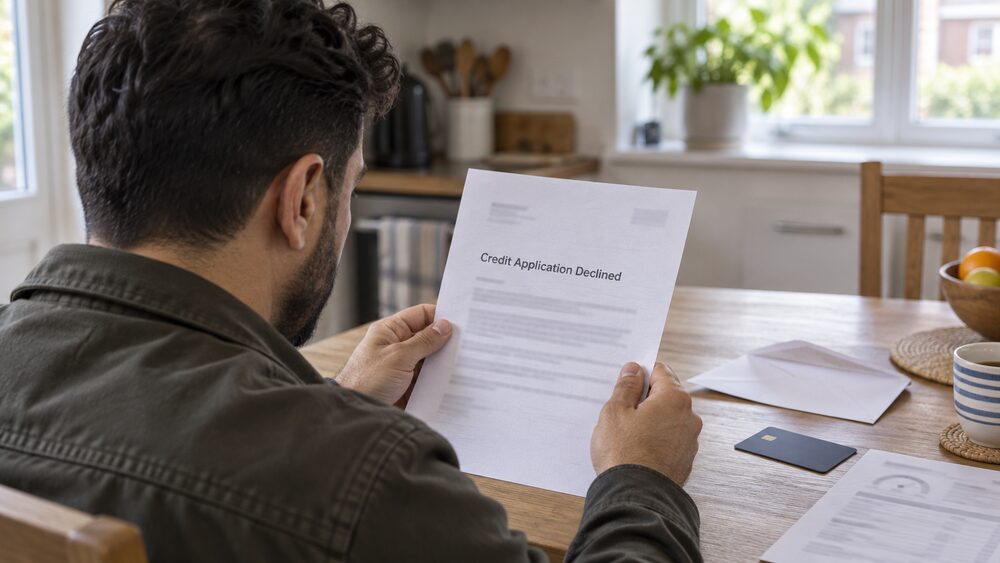
If a lender turns you down, the refusal itself does not go on your credit file. What does go on your file is the search the lender carried out when you applied. That search is visible to other lenders, and a cluster of them in a short period can make lenders more cautious about saying yes.
If a lender turns you down, the refusal itself does not go on your credit file. What does go on your file is the search the lender carried out when you applied. That search is visible to other lenders, and a cluster of them in a short period can make lenders more cautious about saying yes.
The final decision, accept or decline, is not recorded with the credit reference agencies1. One major lender states plainly that the fact you have been declined, and the reason for the decision, will not be reported to the agencies2. So there is no "declined" stamp sitting on your file for the next lender to read.
What other lenders can see is the footprint: a record that a company searched your credit file on a particular date. That is why the practical question is not "does a refusal show up" but "how many searches are on my file, and what do they look like to the next lender".
A declined application is not recorded, but the search is
When you apply for credit, the lender runs a search on your credit file. That search is registered, even though the outcome is not1. The Information Commissioner's Office, which regulates how your data is used, says searches on your credit file should not have a negative impact on your credit history7. In other words, a search is a record of activity, not a black mark in itself.
The distinction matters because it explains what a future lender actually sees. They see that you applied somewhere, on a date, and that the lender looked at your file. They do not see whether you were accepted or turned down. One provider confirms that the record of the search is kept on your credit file and may be seen by other organisations3.
There is a related point about joint applications. If you apply for credit jointly with someone, your credit files become linked or associated, and lenders can look at the other person's credit history even if you apply in your name only8. That link is separate from any individual refusal, but it affects what a lender sees when they assess you.
Poor credit history: a common reason mortgages are turned down
When a mortgage application is rejected, poor credit history is one of the reasons lenders give9. But it is not the only one. Lenders also turn people down because their identity or address could not be confirmed, because they have insufficient credit history, because of late or missed payments, defaults or county court judgments, because of an IVA or debt management plan, because of multiple applications in a short space of time, because of a mistake on the form, because of a financial association with someone with a bad credit history, because they are not the lender's target customer, or because of employment history or information missing from the credit report10.
For self-employed applicants, a rejected mortgage application will be recorded on your credit file and can damage your credit score11. That is the search being recorded, not the refusal.
A bad credit history does not close the door permanently. Some high street banks may refuse to give you a mortgage outright, but building societies and specialist lenders can be more flexible13. You may have to pay more in interest and fees14. Common reasons for declined applications include issues with your credit history, affordability concerns based on your income and outgoings, problems with the property valuation, or not meeting the lender's specific criteria15.
One sign worth knowing: if you are refused financial services, credit cards or a loan despite having a good credit rating, that can be a sign of identity theft16.
Why applying again quickly can make things worse
Each application leaves a search. Apply several times in a short period and the searches stack up. One source describes this as the rejection spiral: any failed application reduces your credit rating, and getting a lot of rejections in a short period can hurt17. The advice is not to apply for a lot of credit cards in a short space of time17.
Applying too often in a short space of time can lower your credit score, which may make it harder to get credit18. Multiple applications in a short period can negatively impact your credit score, which may further discourage lenders from approving you19. Each time you apply for credit, a hard search is recorded on your credit report, which can temporarily lower your credit score, so it helps to space applications out over several months and make as few as possible20.
Some lenders warn against applying at all if your file shows recent problems.
How long a hard search stays on your credit file
The length of time a search stays on your file depends on the credit reference agency and the type of application. One source says credit report searches by a creditor stay for one or two years depending on the agency4. Guidance on declined remortgage applications says the hard search will only stay on your credit file for 12 months22. A policy statement on joint loan applications says hard searches will normally stay on the respective credit files for two years, creating a clear trail of when an application was made23.
For comparison, a default stays much longer. A default stays on your credit file for six years5, and the account stays on your file for six years from the date it was defaulted24. A default makes it harder to borrow more money because it stays on your credit file for six years25. So a search is a short-term footprint; a default is a long-term one.
Checking your file and finding out why you were refused
The first step after a refusal is to ask the lender for a reason and get a copy of your credit report to check it for accuracy10. If a lender refuses you credit after checking your credit reference file, they must tell you why credit has been refused and give you the details of the credit reference agency they used26. Under the Consumer Credit Act 1974, section 157, where a creditor decides not to proceed with a prospective regulated agreement on the basis of information from a credit reference agency, the creditor must inform the debtor that the decision was reached on that basis and provide the agency's name, address and telephone number27.
For basic bank accounts, the rules are similar. The Payment Accounts Regulations require that where an application is refused, the institution must, without delay, inform the customer in writing and free of charge of the reason for the refusal if it may lawfully do so28. Banks can refuse an application based on credit history29, and if you cannot open a basic bank account, the bank should tell you why you have been turned down30.
If a creditor refuses to write off a debt, you can ask them to explain why if they have not given any reasons31. If you gave wrong information to a lender, that can lead to your affordability complaint being refused32.
Can I use a soft search eligibility checker before applying?
Yes, and it is one of the most useful tools for avoiding unnecessary searches. When you apply for a credit card it leaves a mark on your credit file, so if you apply and are rejected, it will show29. Providers offer a soft search eligibility check which does not impact your credit score29. Checking your eligibility for a credit card before you apply involves a soft credit search, which will not affect your credit score33. Many credit card providers offer soft credit searches, helping you to find cards you are eligible to apply for without impacting your credit score34.
A quotation search is another type of search that does not record on your credit profile or affect your credit score1. Asking for information, such as requesting your credit agreement, will not affect your credit file32.
How soon can I apply again after being declined?
There is no single rule, but the guidance points to a gap of months rather than days. One provider suggests waiting at least six months before trying again6. Another says that if you are declined, to limit any further impact, you may want to wait at least six months before applying again6.
Some lenders set their own shorter windows. Credit union loans may allow reapplication after at least three months: the Starter Loan, Premium Loan and Aspire Loan all state that if your application is declined, you can apply again after at least three months35.
The right gap depends on why you were declined and what has changed since. If the reason was a mistake on your file, correcting it first makes sense. If it was affordability, your circumstances need to have changed. If it was a thin credit file, building some history first helps.
Where to get help
If you are struggling with debt, free and impartial help is available. StepChange, National Debtline and Citizens Advice all offer free debt advice. MoneyHelper, the government-backed service, provides guidance on basic bank accounts and borrowing38.
If you have a complaint about how a lender handled your application or a refusal, you can complain to the lender first. If you are not satisfied, the Financial Ombudsman Service can look at complaints about financial businesses. The ombudsman's payday lending report sets out how it approaches affordability complaints5.
For problems with your credit file itself, such as wrong information or a search you do not recognise, you can raise a dispute with the credit reference agency. If you are refused credit and think the decision was based on inaccurate information, you have the right to see and correct your file.
Sources38 cited
- Ways to borrow TSB, 2026
- Declined for lending HSBC, 2026-09-07
- Credit scoring first direct, 2026
- Will I be blacklisted? Mental Health and Money Advice, 2025-09-08
- Payday lending report Financial Ombudsman Service, 2026-09-27
- Declined applications Lloyds Bank, 2026-09-27
- Credit and your data rights Information Commissioner's Office, 2026-09-25
- How joint debts affect me StepChange, 2026-09-25
- Mortgage broking application rejected complaints Resolver, 2026-09-26
- Refused credit Experian, 2026
- Self-employed mortgage squeeze Which?, 2025-12-18
- Mortgages for self-employed buyers Which?, 2025-12-18
- Bad credit mortgages Which?, 2025-10-08
- Mortgage term ending StepChange, 2026-09-25
- Getting a mortgage Co-ownership, 2026-09-26
- Identity theft Information Commissioner's Office, 2026-09-25
- Credit cards and bad credit scores StepChange, 2026-09-25
- Home improvements loans guide Experian, 2026
- How to apply for a credit card Lloyds Bank, 2026-09-27
- Credit builder cards Experian, 2026
- Standard Loan British Airways Credit Union, 2026
- Remortgaging and declined applications Creditfix, 2026
- From Control to Financial Freedom UK Finance, 2024-05
- Full and final settlement offers National Debtline, 2026-09-25
- Glossary StepChange, 2026-09-25
- How lenders decide whether to give you credit Citizens Advice, 2026-09-25
- Consumer Credit Act 1974, section 157 legislation.gov.uk, 2026
- Basic bank accounts: July 2023 to June 2024 HM Treasury, 2025-11-05
- Should I get a credit card? Which?, 2026-09-18
- Basic bank accounts Advice NI, 2026
- Debt write-offs Advice NI, 2026
- Irresponsible lending and affordability checks StepChange, 2026-09-25
- Credit builder credit cards HSBC, 2026
- Using credit cards to build your credit score Halifax, 2026-09-27
- Starter Loan The Money Coop, 2026-06-18
- Premium Loan The Money Coop, 2026-06-18
- Aspire Loan The Money Coop, 2026-06-18
- Basic bank accounts MoneyHelper, 2026-09-25










 MoneyHelperFree, impartial money and pensions guidance, set up by government
 Financial Ombudsman ServiceFree, independent help when a complaint about a firm is not put right
 Citizens AdviceFree advice on money, consumer and legal problems in England and Wales
 StepChangeFree debt advice and solutions from a charity
 GOV.UKOfficial information on tax, benefits and government services