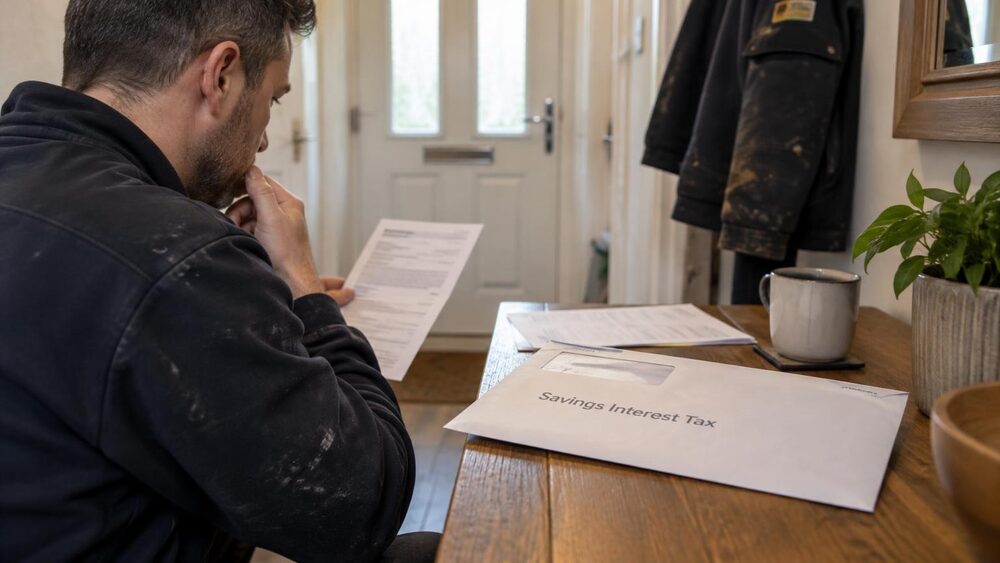
AJ Bell expects the number of savers paying tax on their savings interest to rise from 1.8 million to 2.7 million in 2023-24, according to figures reported by Which? on 17 August 20231. The comparison site said the 1.8 million savers who exceeded their personal savings allowance last year generated £3.4bn for the Treasury1.
The personal savings allowance lets basic rate taxpayers earn up to £1,000 of savings interest a tax year without paying tax, or £500 for higher rate taxpayers; additional rate taxpayers get no allowance1. Which? calculated the balances at which savers would exceed those limits, based on the top one-year account at the time of writing, which paid 6.1% (Beehive Money, Nottingham Building Society)1.
| Taxpayer | Personal savings allowance | Balance at which the allowance is exceeded, at 6.1% |
|---|---|---|
| Basic rate | £1,000 | £16,394 |
| Higher rate | £500 | £8,197 |
| Additional rate | None | Any interest |
Source: Which?, 17 August 20231
Which? also noted that the best one-year fixed cash Isa at the time of writing paid 5.77% (UBL UK, United National Bank), and that up to £20,000 can be deposited into Isas per tax year1. On its figures, a full £20,000 Isa allowance would earn £1,154 in interest, while the top savings account would earn £1,220 after tax for a basic rate taxpayer, £66 more than the Isa; higher rate payers would earn £932 after tax1.
The allowance is withdrawn in stages as income rises. Which? reported that earning even a pound more than £50,270 halves the personal savings allowance, and that it is lost entirely above £125,1401. It added that a projected 5.6 million people will pay the higher rate of income tax in 2023-24, up 41% compared with 2020-211. Savers with income below £17,570 may be able to use the starting rate for savings, which allows up to £5,000 of savings interest tax free1.
"It predicts this will balloon to 2.7m savers in 2023-24 as rising interest rates and a frozen allowance push more of us over the threshold."
Which? singled out holders of long-term fixed-rate accounts such as five-year bonds, which in some cases pay all their interest in one go: all the interest is treated as earned in the year it was paid, rather than spread across the years of the account1. On payment, it said any tax due is usually collected automatically through PAYE using information from banks and building societies, or declared on a self-assessment return1.
Why it matters for households
The change affects savers whose interest exceeds their allowance in 2023-24, and the effect depends on the rate they are on. A higher rate taxpayer reaches the £500 limit at a much smaller balance than a basic rate taxpayer, and additional rate taxpayers have no allowance at all1. Because the allowance is tied to income thresholds rather than to interest rates, a pay rise that takes someone above £50,270 cuts their allowance to £500, and above £125,140 it disappears1. For anyone with a fixed-term bond that pays interest at maturity, the whole amount can fall into a single tax year, which can push a saver over the limit in that year even if the interest built up over several1. Tax on savings interest is normally taken through PAYE rather than a separate bill, so the deduction may appear in a payslip or pension payment rather than as a demand1. The starting rate for savings can apply to those with income below £17,5701.
What happens next
The 2.7 million figure is a projection for the 2023-24 tax year, which ends on 5 April 20241. No further dates have been reported.

 MoneyHelperFree, impartial money and pensions guidance, set up by government
 FSCSProtects your money if a bank, insurer or investment firm fails
 Financial Ombudsman ServiceFree, independent help when a complaint about a firm is not put right
 Citizens AdviceFree advice on money, consumer and legal problems in England and Wales
 GOV.UKOfficial information on tax, benefits and government services