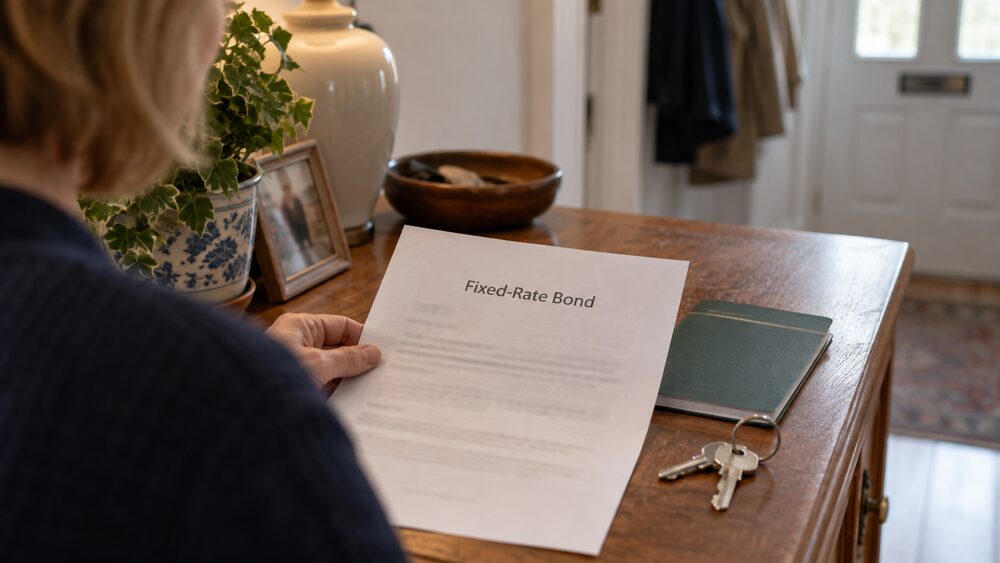
A fixed-rate bond pays a set rate of interest for a set period, and in exchange your money is tied up. Most providers state plainly that you cannot make withdrawals or close the bond before it matures, and some terms go further: you may not withdraw funds or close the bond before the maturity date for any reason, except on the death of a sole account holder1.
A fixed-rate bond pays a set rate of interest for a set period, and in exchange your money is tied up. Most providers state plainly that you cannot make withdrawals or close the bond before it matures, and some terms go further: you may not withdraw funds or close the bond before the maturity date for any reason, except on the death of a sole account holder1.
Where early access is allowed, it is usually a penalty rather than a flat refusal. Penalties on fixed-rate cash ISAs typically range between 90 and 365 days of interest3, and one provider's fixed-rate cash ISA charges 180 days of interest4.
The practical point is that a fixed-rate bond is not a place for money you might need. Terms run from six months to five years1, and the accounts are built around a single lump sum left alone until maturity5.
Most fixed-rate bonds lock your money in for the whole term
A fixed-rate bond is a savings account where you agree to lock your money away for a set period in return for a guaranteed interest rate7. The term is fixed from the day you open it, and the rate does not move during that time. MoneyHelper describes these products as usually requiring you to tie up your money for between six months and five years1, while one provider puts typical terms at between one year and five years8 and an independent guide describes fixed-term bonds as usually running between one and five years9.
The lock-in is the product, not a side effect. Providers describe fixed-rate bonds as accounts that do not allow you to take money out, and that require a full lump sum deposit at opening, accessible only when the bond matures5. One building society says its fixed-rate bonds lock your money away for a period of time with a fixed interest rate10, and another says simply that your money is locked away for the agreed term11.
That structure is why the rate is usually higher than an easy access account paying a variable rate. It also means the account is unsuitable for an emergency fund. Independent guidance on emergency savings notes that fixed-term bonds guarantee the same returns for a set period, usually between one and five years9, which is the trade a saver is making.
If you want a fixed rate but need to be able to reach the money, the alternatives are a notice account, where you give notice and lose interest if you take the money out immediately12, or a limited access account, which permits a set number of withdrawals. Both are covered in types of savings account.
Can I close a fixed-rate bond before it matures?
For most fixed-rate bonds, no. The wording across providers is consistent and blunt. One building society's two, three and five year fixed rate bonds all state that you cannot make withdrawals or close the bond before it matures13, and the same wording appears on its five year bond product page16. Another provider's three year fixed rate bond says early closure or withdrawals are not permitted until the end of the term, when the account matures17, and its terms repeat that early closure or withdrawals are not permitted until the end of the term18.
Some terms are drafted to close off argument entirely. One provider's bond terms state that you may not withdraw funds from or close your bond before the maturity date for any reason, except death of a sole account holder2. Another says that for fixed rate bonds you cannot close your account before maturity19.
A minority of providers leave a door open, but on their terms rather than yours. One bank's savings direct fixed rate bond permits withdrawals and closures before maturity only in exceptional circumstances and at the discretion of the bank, following receipt of a written signed request20. That is a discretionary process, not a right, and it depends on the provider agreeing.
Can I take out part of my money from a fixed-rate bond?
Usually not, and partial access is rarer than full early closure. Providers describe fixed-rate bonds as accounts where you cannot take money out or close the account before the bond ends21. One provider's five year and three year bond accounts both state that you cannot make withdrawals from a fixed rate bond before the end of the fixed term22, and another's five year fixed rate bond says you cannot take money out or cancel it, so you will not be able to access your money until the end of the term24.
The exception that proves the pattern is a fixed-rate saver that allows the full amount to be withdrawn before the term ends, but not part of it4. That is the opposite of what most people want when they ask about partial access: it means closing the account entirely rather than dipping in.
Where partial access does exist, it tends to sit in fixed-rate cash ISAs rather than bonds. One fixed-rate ISA states that early withdrawals are not allowed during the fixed rate term, but that you can close your account25. Another provider's fixed-rate cash ISA allows early access subject to an interest rate penalty set out in the product terms26. If you need to be able to take some money out and leave the rest, a limited access account is the structure designed for it.
Early withdrawal: losing interest and other penalties
Where a provider does allow early access, the cost is normally taken as lost interest rather than a separate fee. Most fixed-rate bonds have no upfront fees, but some charge penalties for early withdrawals6. In practice that means the penalty is expressed as a number of days of interest.
The range across the market is wide. Penalties on fixed-rate cash ISAs typically range between 90 and 365 days of interest for early closure or withdrawal3, and an earlier independent guide gives the same 90 to 365 day range for fixed-term savings accounts that allow earlier access27. One provider's fixed-rate cash ISA charges 180 days of interest4. A building society describes the trade as agreeing to lock your money away for a fixed amount of time or pay a sizeable penalty28.
The consequence is not always a penalty. Some providers describe early withdrawal as leading to withdrawal fees or lower interest rates29, and others as losing some or all of the interest earned, or even paying a charge7. One provider's cash ISA says withdrawing early usually means losing some interest30, and another says the rate is locked for a set term and early withdrawal may incur a penalty31.
National Savings and Investments applies a different model on its older fixed interest savings certificates. Certificates starting their term on or before 22 July 2023 can be cashed in early, but a penalty is deducted from the payment equivalent to 90 days' interest on the amount cashed in32. Those certificates are no longer on sale, and are covered in closed NS&I products.
"Certificates starting their term on or before 22 July 2023 can be cashed in early but a penalty is deducted from your payment equivalent to 90 days' interest on the amount cashed in."
Where limited access is allowed
Limited access is the exception, and it is worth knowing which shapes it takes, because the marketing language around fixed-rate accounts does not always make it obvious.
The first shape is a fixed-rate account that permits early closure with a penalty. Fixed-rate cash ISAs are the most common example: one provider applies an interest rate penalty as set out in the product terms26, another charges 180 days of interest4, and independent guidance notes that fixed-rate accounts may charge an interest penalty if you withdraw money or close the account before the fixed period ends34.
The second shape is a fixed-rate account that permits full early closure but not partial withdrawal, such as the fixed-rate saver that allows the full amount out before the term ends but not part of it4.
The third shape is a fixed-rate account that permits closure but not withdrawal, which is a distinction that matters. One fixed-rate ISA states that early withdrawals are not allowed during the fixed rate term, but that you can close your account25. Closing means the whole balance goes, and the account ends.
The fourth shape is discretionary access. One bank considers early closure only in exceptional circumstances, at its discretion, on a written signed request20, and one building society says that in exceptional circumstances it would close the account and return the money including interest35.
Against all of that, the standard position remains no access at all. One building society's one year and two year fixed rate bonds both state that no withdrawals or early access are allowed36, and providers across the market describe early withdrawals as usually prohibited, and where available typically restricted or penalised38.
What happens if I need the money urgently during the fixed term?
For most fixed-rate bonds there is no mechanism to reach the money, which is why the emergency fund question matters before you open one rather than after. Independent guidance on emergency savings puts the focus on holding enough aside in an accessible account precisely because fixed-term money is not reachable9.
Where providers do respond to urgent need, it is usually tied to a defined event rather than general hardship. One provider's bond terms allow withdrawal or closure before the maturity date only on the death of a sole account holder2. One building society says that in exceptional circumstances, including the death of the account owner, it would close the account and return the money including interest35. One bank considers early closure in exceptional circumstances at its discretion, on a written signed request20.
If you are already inside a fixed term and need money, the options are limited to what your own product terms allow. Reading the terms you agreed to is the starting point, because the penalty, the notice requirement and whether the provider will consider a request at all are set out there. If the provider refuses and you believe the terms have been applied wrongly, the Financial Ombudsman Service can look at complaints about how a savings account has been run.
What happens to my money when a fixed-rate bond matures
Maturity is the point at which the lock-in ends and the decisions open up. When a savings bond reaches the end of its term and matures, you can reinvest the money into a new bond or cash it in and close the account completely39. One provider sets out three routes: withdraw the money and move it to another account, reinvest in another fixed rate bond, or allow it to roll over into a new bond if the provider offers that6.
Doing nothing is also a choice, and it has a consequence. One building society says that if you do not want to invest your money in a new product, it will automatically mature into an instant access account35. Another sets out the same three options, adding that if you do nothing it will transfer the balance into an instant access account or the nearest equivalent40. One provider's maturity account pays a lower interest rate but allows withdrawals at any time41.
Some providers roll the balance into a new fixed bond instead. One provider's one year and two year fixed rate bonds state that if no instruction is received, the balance is transferred to an instant access account at maturity42. Another's five year fixed rate bond allows withdrawals only at the end of the fixed term, and if maturity falls on a non-working day the funds are available the next working day44.
The practical risk at maturity is a quiet drop in rate. A maturity account paying a lower rate is the default outcome for savers who do not respond, which is why the maturity letter matters. The options and timings are set out in more detail in what happens when a fixed-rate savings account matures.
Where protection applies, and where it stops
Money in a fixed-rate bond held with a UK bank or building society is covered by the Financial Services Compensation Scheme in the same way as any other deposit, up to the scheme limit per person per firm. That protection covers the firm failing, not the terms of the product: it does not give you a route to your money early, and it does not override a penalty in the product terms.
The distinction matters when a provider stops serving customers or closes a brand. If a firm fails, the scheme responds; if a product simply does not allow early access, the scheme has nothing to do with it. How FSCS protection works for savings sets out the limits and how they apply across brands sharing a licence.
Complaints about how a fixed-rate bond has been administered, including a disputed early closure decision or a maturity instruction that was not followed, go to the provider first and then to the Financial Ombudsman Service if they are not resolved. Free, impartial guidance on savings products and on what to do when money is tied up is available from MoneyHelper.
Sources44 cited
- Cash savings bonds MoneyHelper, 2026-09-25
- Savings terms and conditions Hampshire Trust Bank, 2026
- Will fixing your ISA beat the tax-free allowance cut? Which?, 2026-06-21
- What is an ISA? Metro Bank, 2026-09-25
- Opening a savings account Raisin UK, 2026-09-28
- What is a fixed rate bond Post Office, 2026-08-28
- Different types of savings account Yorkshire Building Society, 2026-09-26
- Savings accounts Raisin UK, 2026-09
- April price rises: how much more will you need in emergency savings? Which?, 2025-03-12
- Fixed rate bond Leek Building Society, 2026-09-25
- Fixed rate bonds Hodge Bank, 2026-09-23
- Savings terms HSBC UK, 2026
- Maturity 2 year fixed rate bond Principality Building Society, 2026-09-25
- Maturity 3 year fixed rate bond Principality Building Society, 2026-09-25
- Maturity 5 year fixed rate bond Principality Building Society, 2026-09-17
- 5 year fixed rate bond Principality Building Society, 2026-09-25
- 3 year fixed rate bond GB Bank, 2026-09-17
- Terms and conditions for saving GB Bank, 2025-12-12
- Can I close my account Secure Trust Bank, 2026
- Savings direct fixed rate bond AIB (GB), 2026
- Help me choose a savings account Yorkshire Building Society, 2026-09-26
- Personal 5 year bond account (Issue 16) Oxbury Bank, 2026-09-25
- Personal 3 year bond account (Issue 26) Oxbury Bank, 2026-09-25
- 5 year fixed rate bond (Issue 9) Monmouthshire Building Society, 2026-09-18
- Fixed rate ISA Issue 13 Melton Building Society, 2026-06-01
- Complete guide to ISAs Newcastle Building Society, 2026-03-13
- Trapped in a fixed-term account Which?, 2022-11-14
- ISAs or bonds? Furness Building Society, 2026-09-26
- What is a savings bond? HSBC UK, 2026
- ISAs Monmouthshire Building Society, 2026-09-25
- Transferring a cash ISA in Tandem Bank, 2026
- Fixed rate savings certificates NS&I, 2025-09-01
- Make a withdrawal from savings NS&I, 2024-05-15
- Why can't I transfer my ISA? Which?, 2025-07-07
- Frequently asked questions about bonds Bath Building Society, 2026-07-03
- 1 year fixed rate bond (Issue 9) Harpenden Building Society, 2026-08-13
- 2 year fixed rate bond (Issue 14) Harpenden Building Society, 2026-09-09
- Fixed rate bonds Raisin UK, 2026-09
- Fixed rate bonds Leeds Building Society, 2026-09-26
- Fixed term bonds Principality Building Society, 2026-09-26
- Fixed rate bond maturity options Nationwide Building Society, 2026
- 1 year fixed rate bond (Issue 77) Monmouthshire Building Society, 2026-09-02
- 2 year fixed rate bond (Issue 55) Monmouthshire Building Society, 2026-09-02
- 5 year fixed rate bond Issue 57 Shawbrook Bank, 2026-09-26












 MoneyHelperFree, impartial money and pensions guidance, set up by government
 FSCSProtects your money if a bank, insurer or investment firm fails
 Financial Ombudsman ServiceFree, independent help when a complaint about a firm is not put right
 Citizens AdviceFree advice on money, consumer and legal problems in England and Wales
 GOV.UKOfficial information on tax, benefits and government services