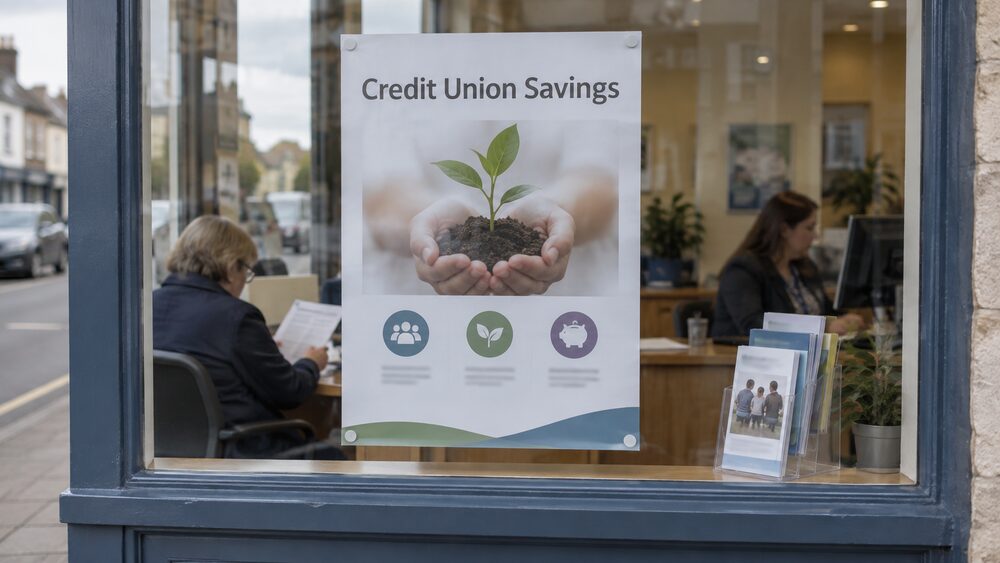
A credit union savings account and a bank savings account do much the same job: they hold your money, they pay something for it, and both are covered by the Financial Services Compensation Scheme up to £120,000 per eligible person, per firm1. The differences are in how you get in, how you are paid, and what the organisation is for.
A credit union is a not-for-profit financial provider owned by its members, and all credit unions offer savings accounts and loans1. A bank is a company answerable to shareholders. That single difference shapes everything else: who can join, what the account pays, and what happens to any surplus.
The practical points are these. You can only join a credit union if you share a common bond with its other members, such as living or working in a certain area1. Your return is usually a dividend that depends on how the union has performed, not a rate set in advance5. And credit unions vary enormously in size and services, so what one offers is no guide to what another does3.
How credit union savings differ from bank savings accounts
Every credit union offers savings accounts and loans, and nothing else is guaranteed1. Beyond that, services vary by branch: savings accounts, loans, foreign exchange, prepaid debit cards and, at some, current accounts11. The larger credit unions add Christmas savings accounts, cash Child Trust Funds, ISAs, budgeting accounts, current accounts and debt management3.
A credit union is a not-for-profit financial provider that helps people access banking products, and it is run by members to benefit communities rather than to make a profit1. Members' savings are used to fund loans to other credit-worthy members of the same union12. That is the model in one sentence: the money you save is lent to the person next to you in the same bond, not to an anonymous borrower elsewhere.
There are limits to what a credit union can do. A credit union is not a bank and cannot offer overdrafts, mortgages, electronic banking services and payment methods or business loans in the same way as a bank13. If you need an overdraft as part of your everyday banking, a credit union current account usually will not provide one1.
For a saver, the practical consequences are these. Your money is doing something specific and local, which some people value. In exchange, you may have fewer ways to reach it, fewer products alongside it, and a return that is decided after the year rather than published before it.
Who can join a credit union: the common bond
All credit unions in the UK may only accept members who have a common bond14. That is the rule that decides whether a particular credit union is open to you at all.
The bond can take several forms. Members might live or work in the same area, work for the same employer, belong to the same trade union, or belong to the same church or other association15. In practice this typically means a credit union is either based in its local community or draws its members from one sector, such as the police16. The legal framing is the same: all members must live in the same area, or work for the same employer, or be a member of a trade union or other special interest group4.
There is a family route in. As long as one member of a family meets the common bond requirements and has joined the credit union, the other family members living at the same address can usually join too3. Anyone in the house of a person with a common bond can usually join15.
To become a member, you need to visit or call your chosen credit union to confirm what information you need to join1. There is no single national application, because each union sets its own bond and its own paperwork.
Dividends or interest: how each one pays savers
A bank savings account pays interest at a rate the bank sets and publishes. A credit union savings account either pays interest or a share of any profits1. Where it pays a share of profits, the profit made by the credit union is shared evenly among savings accounts, and this is called the dividend, with some kept back to improve services3.
The dividend is not a rate agreed in advance. Returns depend on how well the union performed, and are usually paid as an annual dividend6. A credit union may describe the possibility of earning a dividend when the credit union does well19.
That is the trade-off in plain terms. A bank account with a fixed rate tells you what you will get. A credit union dividend tells you what the union can afford after the year is out, which could be more or less than a bank would have paid, and is not guaranteed.
If you are comparing returns, the same discipline applies as anywhere else: check what the account actually pays and how the rate is set. Our guide to AER, gross and fixed or variable rates explains how to read a quoted rate, and compound interest explains how the timing of a dividend or interest payment changes what you end up with.
Access to your money and saving small amounts
Access is where credit unions and banks diverge most in day-to-day use. Credit unions may have their own limits as to how much you can save20, and some will ask you to build savings first before you borrow15.
Ways to pay in are broad. Members can pay in directly by payroll deduction or through benefit direct accounts, through retail payment networks such as PayPoint and PayZone, by standing order or Direct Debit, or in cash at local offices and collection points3. One credit union's instant access savings account lets you have your wages or benefits paid in, transfer savings to your bank account using its app, and access the account online, on the phone or in a branch19.
Getting money out works differently from a bank. Options include cashing a cheque at a local Post Office, cash from a local credit union office, payment directly into a bank account, or a debit card at a cash machine if the credit union operates a current account5. Credit union current accounts can be used at a local Post Office for both withdrawals and deposits21.
Credit unions are built for small, regular amounts. One published a news article showing how small daily and weekly amounts add up over a year, encouraging regular saving22. If you are saving a few pounds a week rather than a lump sum, that rhythm suits the model.
Christmas savers, junior and school savings schemes
Credit unions run dedicated Christmas and holiday savings accounts, which lock money away for a season rather than leaving it available all year23. These sit alongside the ordinary savings account and are a common reason people join. Our guide to Christmas savings clubs and accounts covers how these schemes work more generally.
Children's saving is a long-standing part of the model. Credit unions run school savings schemes, and one announced new post boxes for its School Savings Scheme24. Another introduced a new online joining form for junior accounts, making it quicker to open an account for a child25. One young savers scheme credits a £25 bonus to accounts that deposited monthly from January to June 2027 and held £25 on 30 June 2027, paid on 1 July 202726.
For comparison, children's bank accounts can be opened for kids as young as six27. So a child can save with a bank from that age, and a credit union junior account is an alternative route, usually reached through a family member's membership or a school scheme. Our guide to children's savings accounts sets out the wider options.
Saving to borrow: loans for members
The savings and the borrowing are connected. Members' savings are used to fund loans to other credit-worthy members12, and you need to be a member of a credit union to get a loan from it, with some asking you to build up savings first28. Usually, in order to borrow, you must already have a savings account with the credit union6.
How much you can borrow is tied to what you have saved. If you are a member of a credit union, you can usually borrow at least two or three times the amount you have in savings, depending upon the loan policy of your credit union9. You usually need a history of saving with a credit union before you can borrow long-term loans and mortgages29.
Some credit unions lend as soon as you become a member, while others lend only after you have saved for a set period, and affordability is checked against the money you have left after paying bills5. Credit unions are described as an alternative borrowing option to payday loans15, and can be a more affordable alternative to banks or expensive payday loans, sometimes offering cheaper loan rates28.
That is not the whole picture. Credit union loans are often more expensive than personal loans from a bank or building society30. So the comparison depends on what you are comparing against: against a payday loan, a credit union is usually cheaper; against a mainstream personal loan, it may not be. Our guide to loans covers how personal loan pricing works.
FSCS protection: up to £120,000 per person at both
This is the part that surprises people most often, in a good way. Just like most banks, up to £120,000 per person is protected in a credit union account1. FSCS can pay back any money you hold with a failed credit union, up to its compensation limit of £120,000 per person2.
The scheme is automatic. Deposits are automatically compensated up to £120,000 per eligible person, per bank, building society or credit union7. The limit is £120,000 per person or company, per authorised firm31, and £120,000, or £240,000 for joint accounts, per authorised firm8.
The limit applies per banking licence, not per brand. FSCS protection for banks, building societies and credit unions is up to £120,000 per person per banking licence32. That matters if a credit union shares a licence with another firm, because your balances with both count together towards the same £120,000. Our guide to how FSCS protection works for savings explains how to check which firms share a licence.
The limit rose recently. It protects up to £120,000 of savings per individual, per financial institution, and before 1 December 2025 it was £85,00033. Some older guidance still quotes the previous figure: one credit union site states that all deposits are protected up to the value of £85,000 per person3. The current limit is £120,000.
Help to Save and other government schemes
Help to Save is a government savings scheme for people getting Universal Credit35. If you get Working Tax Credit or Universal Credit, you may be able to open a Help to Save account37, and you can apply online38. The scheme pays 50p for every £1 saved over 4 years to people entitled to Working Tax Credit or receiving Universal Credit39.
The scheme is changing. The government has confirmed that the reformed Help to Save scheme will be delivered through a multi-provider model17, which will enable financial institutions to offer Help to Save accounts directly to eligible customers30. National Savings and Investments administers Help-to-Save accounts for the government32.
Eligibility is set to widen. From 2028 the scheme will be opened up to parents and carers on Universal Credit40, and from April 2028 the earning criteria will be removed so that anyone on Universal Credit, including people not working, will be eligible, with the government estimating an additional 1.5 million households become eligible41. The expansion will include all Universal Credit claimants who receive the child element, the caring element or both42.
Our guide to Help to Save covers the bonus, the limits and how withdrawals work. If you are weighing it against another government-backed account, Help to Save or Lifetime ISA compares the two.
Where to get free help
MoneyHelper, the government-backed money guidance service, publishes information on credit union current accounts and on choosing an account for your Universal Credit payment1. The finder at findyourcreditunion.co.uk lists credit unions by area and type3.
For debt problems rather than saving, free and impartial help is available from StepChange and Business Debtline, both of which publish guidance on credit unions as a borrowing option15. If you are struggling with bills, emergency funding and grants are covered by Turn2us and Shelter43.
Sources43 cited
- Credit union current accounts MoneyHelper, 2026
- Deposit protection for credit unions Financial Services Compensation Scheme, 2026
- About credit unions Find Your Credit Union, 2026
- Credit unions: explanatory memorandum legislation.gov.uk, 2006
- Credit unions Building Societies Association, 2026
- Emergency funding StepChange, 2026
- Check your money is protected Financial Services Compensation Scheme, 2026
- Cash savings bonds MoneyHelper, 2026
- Budgeting, saving and borrowing Business Debtline, 2026
- Debt consolidation Business Debtline, 2026
- Ways to bank Consumer Council for Northern Ireland, 2026
- About credit unions Association of British Credit Unions, 2026
- Credit unions and mutual banks Northern Ireland Assembly, 2025
- Credit unions House of Commons Library, 2026
- Credit unions StepChange, 2026
- Financial top tips for service personnel GOV.UK, 2012
- Tax-free savings newsletter 22 GOV.UK, 2026
- Choosing a bank account for your Universal Credit payment MoneyHelper, 2026
- Savings Unify Credit Union, 2026
- Savings accounts Consumer Council for Northern Ireland, 2026
- Credit unions and the Post Office University of Bristol, 2012
- Where does £2 a day really go? Gateway Credit Union, 2026
- Urgent gambling help Credit Union, 2026
- Savings Carnglen Credit Union, 2026
- Junior savers Harp & Crown Credit Union, 2026
- Young savers Darlington Credit Union, 2027
- How to open a bank account online Which?, 2026
- Personal loan debt StepChange, 2026
- Credit unions Experian, 2026
- Help to Save: explanatory memorandum legislation.gov.uk, 2025
- FSCS protected leaflet Financial Services Compensation Scheme, 2026
- Banking licences Financial Services Compensation Scheme, 2026
- Are my savings safe? Which?, 2025
- What to do if your bank goes out of business Which?, 2025
- What is the Help to Save scheme? Turn2us, 2026
- Who can use the Help to Save scheme? Turn2us, 2026
- How do I apply to the Help to Save scheme? Turn2us, 2026
- Annual savings statistics 2025 GOV.UK, 2025
- Tax update 2026 GOV.UK, 2026
- Help to Save expansion The Guardian, 2026
- Universal Credit and Help to Save The Mirror, 2026
- Help to Save Low Incomes Tax Reform Group, 2026
- Emergency grants, loans and money help Shelter, 2026






 MoneyHelperFree, impartial money and pensions guidance, set up by government
 FSCSProtects your money if a bank, insurer or investment firm fails
 Financial Ombudsman ServiceFree, independent help when a complaint about a firm is not put right
 Citizens AdviceFree advice on money, consumer and legal problems in England and Wales
 GOV.UKOfficial information on tax, benefits and government services