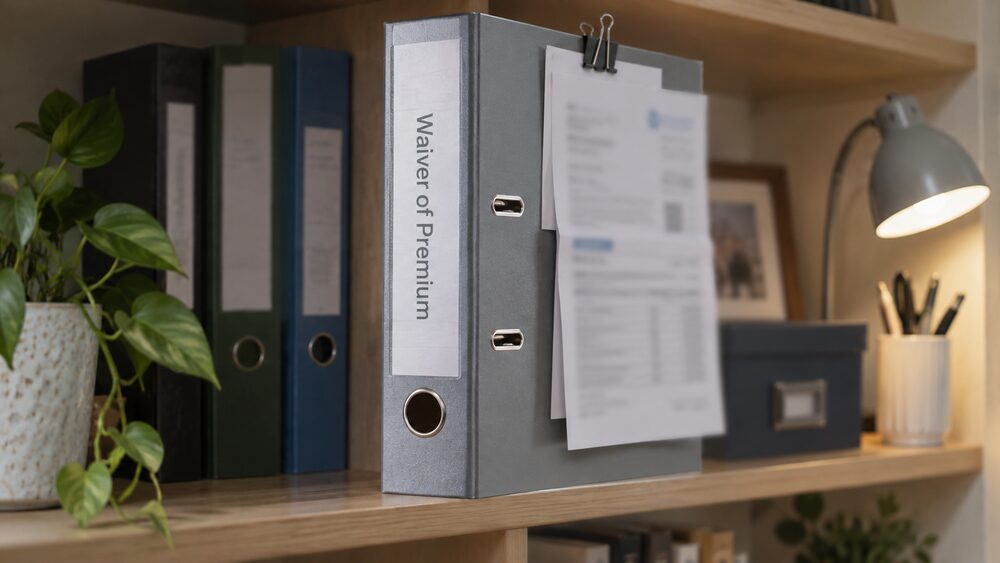
Waiver of premium is a feature on a protection policy that lets you temporarily stop paying premiums if you are sick or injured and unable to work. In most cases a waiting period applies first, and the insurer pays the premiums for you once that period has passed1. It usually costs extra on top of the policy it protects2.
Waiver of premium is a feature on a protection policy that lets you temporarily stop paying premiums if you are sick or injured and unable to work. In most cases a waiting period applies first, and the insurer pays the premiums for you once that period has passed1. It usually costs extra on top of the policy it protects2.
The waiting period is the part people most often get caught out by. On income protection, you choose a set deferred period, usually of four, 13, 26 or 52 weeks, and longer periods usually mean lower premiums3. Royal London's Waiver of Premium (Sickness) benefit offers a slightly wider set of choices: 4, 8, 13, 26 or 52 weeks4. Premiums are still due during that period, so the gap between stopping work and the waiver starting is money you have to find yourself.
Waiver of premium is not the same thing as income protection. Income protection replaces part of your earnings; waiver of premium keeps an existing policy, such as life cover or a pension plan, in force by covering its premiums while you cannot work2. The two are often confused because both hinge on the same question: what counts as being unable to work.
Waiver of premium keeps your cover going when you can't pay
The benefit exists to solve a specific problem: a policy only pays out if it is still running, and a long illness is exactly when premiums are hardest to keep up. Waiver of premium lets you temporarily stop paying premiums if you are sick or injured and unable to work, with a waiting or deferred period usually applying first1.
Canada Life's Flexible Life Plan describes the same idea in its own terms: it will waive all or part of your premiums due if for any reason you are unable to work for a period of six months, with nothing to pay until you return to work, and the benefit only valid if you are unable to work before the age of 658. That six-month figure is that provider's own term, not a market standard, and it shows how much the detail varies between policies.
The practical point is that waiver protects the policy, not your income. If you have life cover and stop paying because you cannot work, the cover lapses and there is nothing for your family to claim. Waiver of premium is the mechanism that prevents that, provided the incapacity meets the policy's definition and the deferred period has been served.
The waiting period: deferred periods of 4, 13, 26 or 52 weeks
The deferred period is the amount of time you have to have been off work before the policy will start paying you benefit, and it is agreed when you take out the policy9. On income protection, Phoenix describes it as a set deferred period, usually of four, 13, 26 or 52 weeks, with longer periods usually meaning lower premiums3.
Royal London's Waiver of Premium (Sickness) benefit sets out its choices as 4, 8, 13, 26 or 52 weeks4. The extra eight-week option is worth noting because it shows the menu is not identical across the market.
| Deferred period | What it means in practice |
|---|---|
| 4 weeks | Shortest common option; premiums are higher because the insurer expects to pay sooner3 |
| 8 weeks | Offered on some waiver benefits, including Royal London's4 |
| 13 weeks | Roughly three months, a common middle choice3 |
| 26 weeks | Roughly six months, matching Canada Life's six-month waiver term8 |
| 52 weeks | A full year; the longest common option and usually the cheapest premium3 |
Choosing a longer wait before payments begin can reduce premiums, which is why it matters if you can afford to rely on savings or employer sick pay for a period10. The trade-off is that you carry the cost of the waiting period yourself, and premiums are still payable during it.
How waiver works during an income protection claim
Once a claim is running, the mechanics are straightforward. During the period of any claim, where the insurer is paying money to you, the monthly premium to the policy does not have to be paid3. You will normally be paid monthly in arrears, starting in the month after the deferred period has expired3.
Income protection benefits are tax-free, and the amount you get when you claim is limited to between 50% and 75% of your earnings before you were unable to work3. You cannot insure yourself for an amount higher than your earnings when you take the policy out3. State benefits you might be able to claim, such as Statutory Sick Pay, Universal Credit or Employment Support Allowance, will also be considered3.
Payments stop when you recover and go back to work, when you start a new job that pays less or return to the old one part time, when the policy term ends, or on death3. Most policies also end at a certain age, such as your selected retirement age, with an upper age limit of 653.
If you can only go back to work in a reduced role and with a reduced income, a rehabilitation benefit may pay some level of income, usually for up to six months after you return to work and as part of the full sum assured on your policy3.
What counts as being unable to work
The definition of incapacity decides whether a claim is paid, and it is set out in the policy. The most common definitions mean you would not be able to work in your current occupation, work in any occupation you are trained for or have experience in, work in any occupation at all, or carry out various daily activities such as dressing, washing, eating, climbing stairs, shopping or cooking3.
That range matters because the wider the definition, the harder it is to meet. A policy that pays only if you cannot do any occupation at all is a much higher bar than one that pays if you cannot do your own job. Our page on own occupation, suited occupation and other income protection definitions sets out how these tests differ.
Income protection will not normally pay out if you are unemployed when you become unable to work, but if it does, it will be based on your ability to perform certain activities of daily living3. That is the same kind of test that applies to waiver of premium, which is why unemployment at the point of illness is a common reason a claim fails.
There are also exclusions. You will not receive benefits for accidents or illnesses caused by drug or alcohol abuse, criminal acts, intentional self-harm, wars, or pregnancy unless your policy includes it3. Your policy may only be valid while you are resident in the UK, EU or Western Europe, the USA or other developed countries3.
Is waiver of premium the same as income protection?
No, and the difference decides what you are buying. Income protection is designed to replace some of your income if you cannot work because of illness or injury3. Waiver of premium is a feature on a personal pension plan or life insurance plan that guarantees your contributions will be paid for a period of time, usually by the insurer, if you are ill or lose your job2.
So income protection pays you; waiver of premium pays the policy. Some policies carry both, and the waiver may be built into an income protection plan so that premiums stop during a claim3. Others sell waiver as a separate add-on to life cover or a pension, which is where the extra cost comes in2.
If what you want is money to live on, income protection is the product. If what you want is to stop a life or pension policy collapsing during a long illness, waiver of premium is the feature. Our guide to how income protection insurance works covers the income side in more detail.
Do I have to pay premiums during the waiting period?
Yes. The deferred period is time you have to have been off work before the policy starts paying, and nothing in the terms suspends premiums during it. The waiver of premiums applies during the period of a claim, where the insurer is paying money to you3. Before that point, the premiums are yours to pay.
This is the single most important practical consequence of choosing a long deferred period. A 52-week wait lowers the premium, but it also means a year of premiums falling due while you are not earning, on top of a year without a payout. That is why the choice is usually made alongside a plan for how the waiting period will be funded, whether from savings or employer sick pay10.
If premiums are not paid, the cover does not survive. With income protection, if you stop paying premiums, you lose your cover3. With over 50s life insurance, you must pay the premium until you die, and if you stop paying, your entire policy is cancelled and you get nothing back11.
Is there a grace period if I miss a premium payment?
Some policies build in a short window before cancellation. MetLife's MultiProtect terms state that if you miss a premium payment, you have 30 days from your chosen payment date to make the payment or your policy will be cancelled6. The EverydayProtect terms use the same 30-day window from your chosen payment date7.
That is a provider's own term rather than a market-wide rule, so the length of any grace period depends on your policy wording. It is worth checking before relying on it, because a missed payment that runs past the window ends the cover, and with it any waiver benefit attached to it.
What happens if I claim again for the same illness within six months?
A second claim for the same condition, or one directly related to it, within six months of an earlier claim ending is called a linked claim. It will not involve an additional deferred period3. In other words, you do not have to serve the waiting period a second time for a linked condition.
That matters for anyone whose illness recurs. Without the linked claim rule, a relapse shortly after returning to work would mean starting the deferred period again from scratch, with premiums due throughout. The rule exists to stop that happening where the two claims are connected.
The six-month window is the boundary. A claim for the same condition made more than six months after the earlier claim ended is not a linked claim, and the deferred period applies again as normal.
Can I get waiver of premium if I'm unemployed when I fall ill?
This is where many claims fail. Income protection will not normally pay out if you are unemployed when you become unable to work, and if it does pay, it is based on your ability to perform certain activities of daily living rather than your occupation3. Waiver of premium is tied to the same incapacity test, so being out of work at the point of illness is a common obstacle.
The activities of daily living test is a higher bar than an occupation test. It looks at whether you can dress, wash, eat, climb stairs, shop or cook, rather than whether you can do your job3. Someone who is unemployed and falls ill may therefore find the claim assessed on a much stricter basis than an employed claimant would face.
If you are between jobs, the practical position is that cover taken out while employed may not respond to a claim made while unemployed. Our page on when income protection will not pay out covers the other common reasons a claim is declined.
Where to get help
If a claim is declined or a waiver is refused, the insurer should explain its decision and you can complain. If the complaint is not resolved to your satisfaction, the Financial Ombudsman Service can look at it independently. The ombudsman will generally allow a 28-day grace period to pay compensation from the point when the financial business is informed of the consumer's acceptance of the decision12.
Free, impartial guidance on protection insurance and on what to do if you cannot work is available from MoneyHelper and from Citizens Advice. If money is already tight, a debt advice charity can help you work out which payments to prioritise before cover lapses.
Sources12 cited
- Term assurance product guide Phoenix Life, 2026
- Financial jargon checker Age UK, 2026-08-26
- Income protection product guide Phoenix Life, 2026
- Income protection Royal London, 2026-09-26
- Critical illness cover Royal London, 2026-09-26
- MultiProtect terms and conditions MetLife, 2026
- EverydayProtect terms and conditions MetLife, 2026
- Flexible Life Plan Canada Life, 2026-09-26
- Income protection insurance complaints Financial Ombudsman Service, 2026-09-26
- The overlooked insurance that could pay if you're signed off work Which?, 2026-04-04
- Over 50s life insurance Which?, 2025-12-03
- Guidance on our new interest awards Financial Ombudsman Service, 2026-09-26










 MoneyHelperFree, impartial money and pensions guidance, set up by government
 Financial Ombudsman ServiceFree, independent help when a complaint about a firm is not put right
 FSCSProtects your money if a bank, insurer or investment firm fails
 Citizens AdviceFree advice on money, consumer and legal problems in England and Wales
 Turn2usFree benefits calculator and grants search from a charity