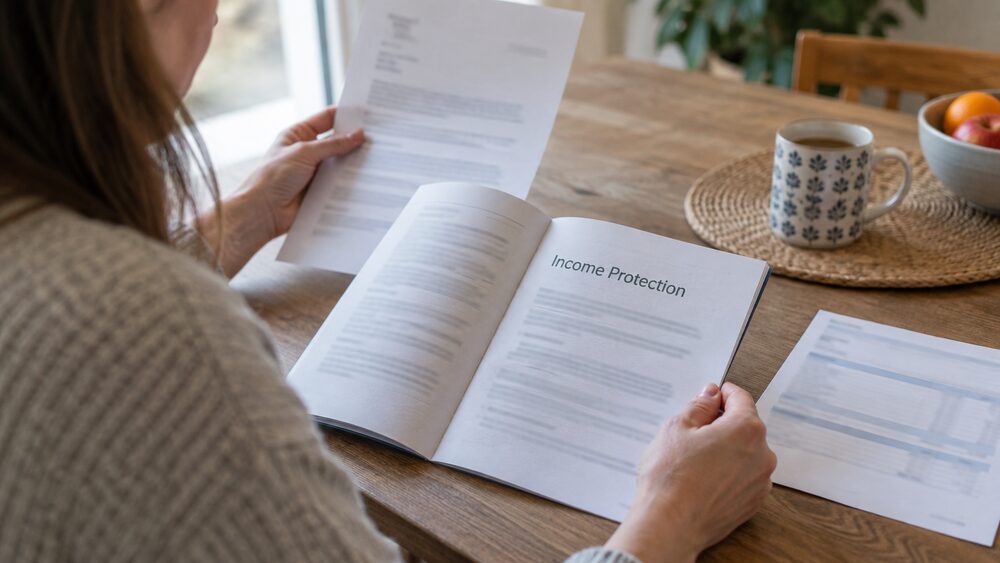
If you are off work because of illness, Statutory Sick Pay is paid by your employer for up to 28 weeks if you are too ill to work1. Many workplace sick pay schemes are more generous than that, but some end after six months2. After that, the money has to come from somewhere: savings, a partner's income, benefits, or an insurance policy.
Income protection is the insurance built for exactly this gap. It replaces lost income if you are unable to work due to illness or injury, paying a regular tax-free monthly income while you are unable to work3. It is not a replacement for sick pay or savings; it is what picks up when they run out.
So the honest answer to whether you need it is: it depends on how long your sick pay lasts, how long your savings would actually stretch, and whether your employer already provides cover through a group scheme. This page sets out how each of those pieces fits together, and how the waiting period on a policy is matched to what you already have.
What income protection does that sick pay and savings do not
Sick pay and savings both have a floor and a ceiling. Statutory Sick Pay is payable from the first full day of sickness and can be paid up to a maximum of 28 weeks6. It is treated as earned income, so you pay income tax and Class 1 National Insurance contributions on it1. Employer schemes vary enormously: occupational sick pay is usually inclusive of Statutory Sick Pay, meaning the employer tops up rather than adds to it7.
Income protection works differently. It pays a percentage of your income each month while you cannot work8, and it covers a wide range of conditions, essentially any illness or disability that leaves you unable to work for a period of time, including physical conditions such as cancer or a heart attack and mental health conditions including stress9. Some policies pay out until you can go back to work or reach retirement10.
The key difference is duration and trigger. Sick pay is time-limited and tied to your job. Savings are finite and have no trigger at all: you spend them whether you are ill, redundant or simply overspending. Income protection is triggered by illness or injury and, depending on the policy, can run for years.
There is also a tax point worth knowing. Income protection payouts are tax-free, whereas Statutory Sick Pay is taxable4. And most disability and sickness benefits are not affected by any other income or savings you have, with Universal Credit the exception11.
Statutory sick pay and employer sick pay: how long they last
The statutory floor is clear. Statutory Sick Pay is payable from the first full day of sickness, up to a maximum of 28 weeks6. You are usually entitled to it if you have been sick for at least one full working day1, and you will get it for all the days you are off sick that you would normally work, including the first three days12.
Claiming it has a process. You will generally need to tell your employer within 7 days of becoming ill, though some employers have a shorter deadline, and after the first week you usually have to send a doctor's certificate or fit note to your employer13. If you are eligible, Statutory Sick Pay is payable during any time you have to stay in hospital14.
Employer sick pay sits on top of that, and it is where the variation bites. Occupational sick pay is usually inclusive of Statutory Sick Pay, so the employer's scheme is your minimum entitlement when you are unable to work, not an extra layer7. If you are not entitled to anything under your firm's scheme, your employer should still pay you Statutory Sick Pay if you are eligible7. Some employer schemes can end after six months2.
Group income protection through work may reduce the cover you need
Group income protection is an insurance policy offered by employers to provide employees with a regular income if they are unable to work due to long-term illness or injury16. It is not universal, and it is not a legal requirement, so the only way to know is to ask.
If you have it, it changes the arithmetic. If you receive sick pay or have access to group income protection through work, you may not need as much individual cover9. That is the single most useful thing to establish before you buy anything: what your employer already pays for, for how long, and at what percentage of salary.
Group schemes are also tied to the job. Because the employer arranges the policy, it is a workplace benefit rather than something you own. The facts here do not set out what happens to a group scheme when you leave, so treat continuity as something to check rather than assume. If you want cover that follows you between jobs, that is what an individual policy is for.
There is one more interaction to check. If you have an income protection plan, also called permanent health insurance, income from your pension could reduce payments from the plan, so it is worth checking with your HR or pensions department17.
How long your savings would actually last
Savings are the most flexible buffer you have, and the least structured. There is no rule about how long they should last, because it depends entirely on your outgoings and what else is still coming in.
What the facts do show is the shape of the gap. Statutory Sick Pay runs to a maximum of 28 weeks6. Some employer schemes end after six months2. Income protection policies typically have a deferred period, the waiting time before payments start, generally ranging from one to 12 months after you were taken ill, with longer waiting periods often reducing the cost3. A common range is four weeks to 26 weeks, depending upon your sick pay5.
So the question to ask is not "do I have savings?" but "how many months of essential outgoings would my savings cover, and does that outlast my sick pay?" If your sick pay runs for six months and your savings cover three, there is a three-month hole. If your savings cover twelve months, the hole is smaller but the risk has not gone away: a long illness can outlast almost any savings pot, and spending savings on living costs leaves nothing for anything else.
Matching the deferred period to your sick pay and savings
The deferred period is the mechanism that stops you paying for cover you do not need yet. It is the waiting time between becoming unable to work and the policy starting to pay, and it is normally set to line up with your sick pay.
The ranges in the facts show how this works in practice. Deferred periods generally range from one to 12 months after you were taken ill, with longer waiting periods often costing less3. A typical range is four weeks to 26 weeks, depending upon your sick pay5. Payments usually start after any sick pay ends or other insurance stops covering you18.
That last point matters for how the two interact. Income protection policies commonly only pay out when other policies stop protecting you, such as company sick pay, and they will allow you to claim as many times as you need to4. So the policy and your sick pay are designed to dovetail, not to run side by side.
The practical effect is that a longer deferred period lowers the premium, because the insurer is on the hook for less time. If your employer pays six months of full sick pay, a policy with a six-month deferred period is doing the job that a one-month deferred period would do at a higher price. If your employer pays nothing beyond Statutory Sick Pay, a shorter deferred period is the one that matches your reality.
Choosing a smaller policy to cut the cost
Cost is driven by a defined set of factors: your age, your health, your job, hobbies and lifestyle, the waiting period, and whether you might be prepared to do other kinds of work than your own19. Several of those are within your control when you design the policy.
The waiting period is the most obvious lever, and it is the one that connects directly to your sick pay and savings. A longer deferred period means a lower premium, because you are carrying more of the early risk yourself3. The other lever is the definition of incapacity. Some policies will only pay out if you cannot do your specific job, while others may consider whether you could do a different type of work9. Cover if you cannot do your own job or occupation is one option; cover based on your job or a similar one you are qualified or have experience for is another20.
There is a trade-off to be honest about. A policy that only pays if you cannot do your own job is a stronger promise, and it costs more. A policy that pays only if you cannot do any similar work is cheaper and harder to claim on. Neither is wrong; they are different products.
Who still needs cover: the self-employed and those without workplace benefits
The people with the least sick pay are often the ones with the most to lose. Self-employed people do not usually qualify for Statutory Sick Pay, because they do not have an employer to pay it, so they cannot claim Income Support on that basis, though they may qualify for Employment and Support Allowance21. Self-employed people are not covered by occupational sick pay schemes either7.
That does not leave them without options. Self-employed people will not get sick pay, but they can still apply for other benefits such as Universal Credit or Employment and Support Allowance if they cannot work or their income decreases22. And income protection is available for the self-employed and small business owners23, with self-employed individuals able to take out income protection insurance3.
The same logic applies to anyone without workplace benefits: those on short contracts, the recently self-employed, and anyone whose employer offers nothing beyond the statutory minimum. For these groups, the gap between what sick pay provides and what life costs is widest, and it opens soonest.
Does income protection pay out if I am made redundant?
No, and this is the most common misunderstanding about the product. Basic income protection policies typically do not cover redundancy3. Income protection does not cover redundancy because it is designed to provide an income if you cannot work due to illness or injury16.
If redundancy is the risk you want to cover, the product is different. Mortgage payment protection insurance keeps up repayments if you are unable to work because of illness, accident or being made redundant24. It is designed for mortgage-related needs during illness, injury and, unlike typical basic income protection policies, redundancy3. If you have lost your job or you are too ill to work, it is worth checking whether you already have mortgage protection insurance covering your payments25.
There is one useful overlap. Where a redundancy payout has a mortgage-funded element, that element will not be considered as income if you need to claim benefits26. And if you are on sick leave and receiving sick pay when you are made redundant, your redundancy pay will be based on your normal pay27.
Where to get independent help before you buy
Income protection can be bought from an independent financial adviser, who may charge, or directly from an insurance company19. Before committing, it is worth knowing what the state would provide anyway, because that changes how much cover makes sense.
Most disability and sickness benefits are not affected by any other income or savings you have, with Universal Credit the exception11. Personal Independence Payment has two parts, a daily living part and a mobility part, and you may qualify if you have a disability or health condition and need help with everyday tasks or getting around28. If you have cancer, there is help with health costs including prescriptions, dental treatment and eye treatment15.
For free, independent guidance, several organisations can help. Independent Age offers a free, confidential benefits check30. Macmillan and Turn2us both provide benefits and financial support guidance15. If debt is part of the picture, StepChange offers free debt advice31. And always get free, independent help before you pay a commercial service32.
Sources33 cited
- Statutory Sick Pay explained Which?, 2026-04-14
- Critical illness insurance explained Which?, 2026-08-24
- 9 myths about income protection busted Which?, 2025-05-27
- Personal accident insurance Financial Ombudsman Service, 2026-09-27
- Finding the right insurance cover Mental Health and Money Advice, 2023-09-05
- Guidance on social security abroad (NI38) GOV.UK, 2026-07-07
- Occupational sick pay Entitledto, 2026-09-26
- Protection insurance and cancer Macmillan Cancer Support, 2023-09-01
- The overlooked insurance that could pay if you're signed off work Which?, 2026-04-04
- What is mortgage protection insurance? Which?, 2026-05-11
- Life insurance and tax Halifax, 2026-09-27
- Can I get Statutory Sick Pay? Turn2us, 2026-04-01
- How do I claim Statutory Sick Pay? Turn2us, 2025-06-05
- SR1 form Marie Curie, 2024-04-06
- Benefits and financial support Macmillan Cancer Support, 2025-06-01
- Income protection Cavendish Online, 2026-09-26
- Mortgage arrears or payment difficulties nidirect, 2025-11-07
- What is income protection insurance? Aviva, 2022-09-07
- Income protection insurance Citizens Advice, 2026-09-26
- What happens to your pension when you die Marie Curie, 2024-03-31
- Work hours and sick pay Entitledto, 2026-09-26
- Self-employment and benefits FAQ Turn2us, 2026-04
- Redundancy insurance Which?, 2025-11-19
- Dealing with mortgage arrears Shelter Cymru, 2026-08-28
- Dealing with loan sharks nidirect, 2026-09-23
- How to calculate your redundancy pay Which?, 2026-04-06
- What insurance might I need if I have a mental health condition? Mental Health and Money Advice, 2023-09-05
- Non-work income overview: Universal Credit Entitledto, 2026-09-26
- Adult disability payment Marie Curie, 2026-08-12
- Universal Credit Marie Curie, 2026-08-12
- Your financial situation and health StepChange, 2026-09-25
- Helping someone to claim benefits Independent Age, 2026-09-26
- Early advice Shelter England, 2026-01-20


 MoneyHelperFree, impartial money and pensions guidance, set up by government
 Financial Ombudsman ServiceFree, independent help when a complaint about a firm is not put right
 FSCSProtects your money if a bank, insurer or investment firm fails
 Citizens AdviceFree advice on money, consumer and legal problems in England and Wales
 Turn2usFree benefits calculator and grants search from a charity