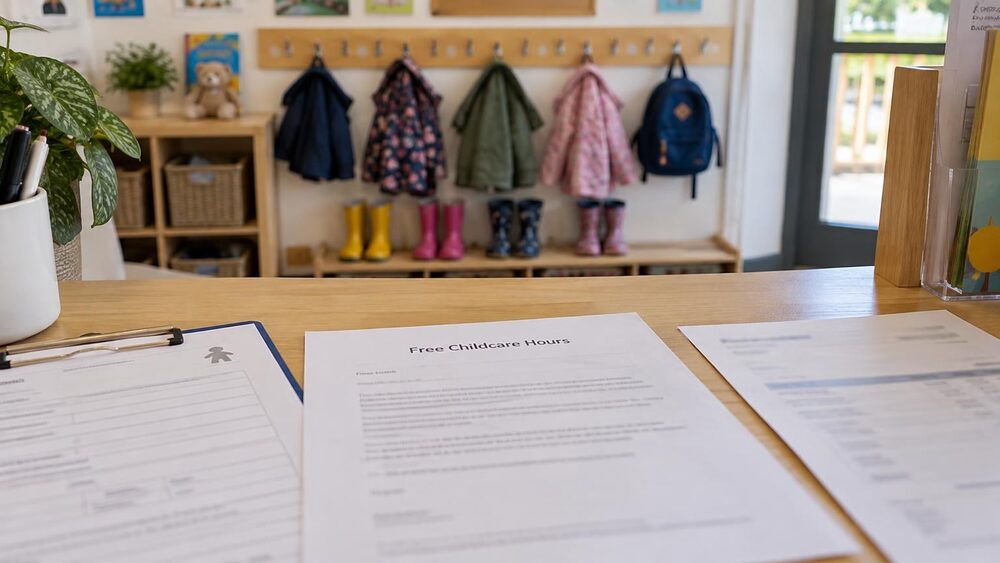
Eligible working parents in England can access 30 hours of free childcare a week for children aged from nine months up to school age from September 2025, according to Which?1. The Joseph Rowntree Foundation (JRF) states that "since September 2025, eligible working parents can receive up to 30 hours of free childcare per week (for 38 weeks of the year) for children aged from 9 months up to school age"2. The expansion follows earlier stages: 15 hours for working parents of two-year-olds from April 2024, and 15 hours for children aged nine months up to three years from September 20243.
Applications for the expanded scheme opened on 12 May 2025, with a deadline of 31 August 2025 to receive the free childcare from September1. Once approved, parents receive an eligibility code to give to their childcare provider, who is then reimbursed for the funded hours1. To qualify, neither parent can earn more than £100,000 a year, and parents must use a registered childcare provider1.
The entitlement sits alongside tax-free childcare, a separate scheme in which the government adds £2 for every £8 a parent contributes, up to £500 every three months or £2,000 a year per child, or £4,000 a year for a disabled child1. Tax-free childcare can be used for children up to age 11, or 16 if the child has a disability1. Eligibility requires earning at least the minimum wage for the equivalent of 16 hours a week, and both partners in a couple must meet this and earn under £100,000 a year1. It cannot be used alongside Universal Credit or childcare vouchers, with exceptions1.
HMRC figures cited by Which? show around 826,000 families used tax-free childcare for 1.08 million children in the 2024-25 tax year, up from 740,000 families for 966,000 children the year before1. Government spending on the scheme was £55.3m in March 2025, £7m below its peak of £62.3m in July 20241. Only about half of all tax-free childcare accounts were used each month, with usage falling from 54.8% in October 2024 to 49.2% in March 20251. HMRC attributes this partly to the free childcare application being combined with the tax-free childcare application, meaning accounts are opened automatically but often left unused1.
The JRF report notes that changes to childcare support have reduced costs for many working families with younger children, but that many remain below the Minimum Income Standard. A lone parent with two children working full-time on the National Living Wage reaches 67% of MIS, while a couple with two children where both work full-time reaches 80%2.
Why it matters for households
The change affects working parents in England with children aged from nine months to school age who meet the earnings rules, from September 20252. Families previously receiving 15 hours for younger children can now receive 30 hours a week for 38 weeks of the year2. The hours follow the school year and do not cover holiday periods, though some providers allow hours to be stretched across more weeks, resulting in fewer hours each week1.
Parents who use Universal Credit cannot use tax-free childcare at the same time, though there are exceptions1. The maximum help with childcare costs under Universal Credit was increased from July 2023 to £951 a month for one child and £1,630 a month for two or more children, up from £646 and £1,108 respectively3.
What happens next
The 30 hours entitlement is in place from September 20252. The JRF report, published in September 2026, sets out its assessment of household budgets for 2026, including the finding that social housing is no longer treated as a realistic minimum housing option and that all MIS budgets now assume private rented accommodation2.
 Turn2usFree benefits calculator and grants search from a charity
 Citizens AdviceFree advice on money, consumer and legal problems in England and Wales
 GOV.UKOfficial information on tax, benefits and government services
 MoneyHelperFree, impartial money and pensions guidance, set up by government