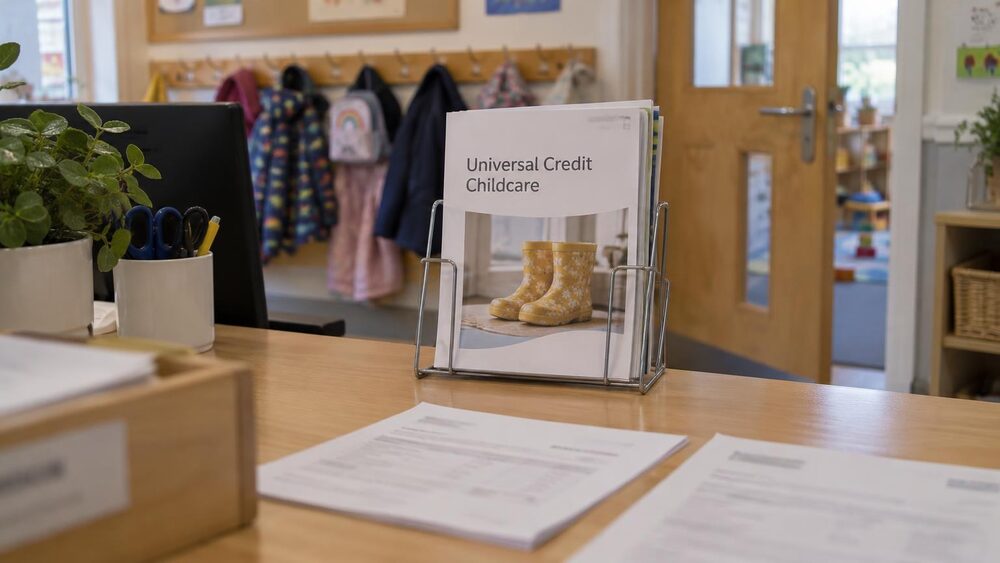
You cannot get Tax-Free Childcare and Universal Credit childcare help at the same time. You have to pick one, and the choice is not reversible in the way you might expect: opening a Tax-Free Childcare account stops your Universal Credit or tax credits completely, not just the childcare part of them1.
The two schemes work in opposite directions. Tax-Free Childcare is a UK-wide scheme to help working parents pay for registered childcare: for every £8 you pay into a childcare account, the government adds £21. Universal Credit pays up to 85 per cent of your childcare costs, but you pay the provider first and claim the money back4.
For most people entitled to Universal Credit, the 85 per cent route is worth more than the 20 per cent top-up. Most people who are entitled to Universal Credit will be better off getting help with their childcare costs through Universal Credit instead of through the Tax-Free Childcare scheme4. Families getting only a small amount of Universal Credit might in some cases be better off with Tax-Free Childcare, so the answer depends on your own numbers6.
You can use Tax-Free Childcare or Universal Credit childcare, not both
The rule is absolute. You cannot get both Tax-Free Childcare and Universal Credit childcare at the same time1. The same exclusion runs through the benefit rules: you cannot receive Tax-Free Childcare and Universal Credit or tax credits at the same time2, and you cannot get help with childcare costs through Universal Credit if you have a tax-free childcare account or childcare vouchers from your employer8.
There is a second layer to it. Universal Credit childcare costs support is not available if you get other approved childcare payments, so a parent already receiving help from another scheme may find the Universal Credit route closed to them as well9. Childcare vouchers sit in the same space: Universal Credit does not help towards any childcare cost payments made using childcare vouchers, though a claimant can apply for Universal Credit help towards additional amounts above the voucher value10.
The schemes also differ in who pays whom. Help with childcare through Universal Credit is paid to you and not to your childcare provider5. Tax-Free Childcare works through an account you hold and pay into, with the government adding its share as you go1.
Who can get Tax-Free Childcare
Tax-Free Childcare is a UK-wide scheme to help working parents pay for registered childcare3. It is run by HMRC, and you open an account to access it11. The scheme has been extended to self-employed parents12.
The money can go to any approved childcare, including nurseries, childminders, holiday clubs, breakfast clubs and after-school clubs13. You may be able to use Tax-Free Childcare to pay a provider based in a European Economic Area country, though you need to contact HMRC to check1. It can be used alongside the government funded childcare hours, subject to eligibility13.
The top-up works on a simple ratio. If your childcare bill is £250, you pay £200 into your childcare account, which is 80 per cent of the bill, and the government adds £50, which is 20 per cent of the bill1. The scheme covers 20 per cent of up to £10,000 of each child's costs1.
The exclusions are the part that catches people out. You cannot get Tax-Free Childcare at the same time as Working Tax Credit, Child Tax Credit or childcare vouchers14. You also cannot use it at the same time as childcare vouchers from an employer10. Parents cannot use Tax-Free Childcare at the same time as receiving childcare vouchers from an employer or Universal Credit15.
Opening a Tax-Free Childcare account stops Universal Credit and tax credits
This is the single most important thing to understand before you apply. If you claim Universal Credit, you cannot open a Tax-Free Childcare account until you close your Universal Credit claim7. If you are already getting Tax-Free Childcare, your account will be closed as soon as you claim Universal Credit16.
The effect on an existing award is broader than the childcare element. If you apply for and are awarded Tax-Free Childcare, your Universal Credit or Tax Credit award will be terminated, including all elements, not just the childcare element2. Your Universal Credit award will be terminated6. If you are claiming tax credits, your Working Tax Credit and Child Tax Credit awards will be terminated, not just the childcare element2.
That matters because Universal Credit is not only a childcare payment. If eligible, Universal Credit can help with the costs of raising a child and childcare17, and it replaces the help that used to be given through Child Tax Credits for new claimants18. Losing the whole award to gain a 20 per cent top-up on childcare is rarely the trade a parent wants to make by accident.
There is a way back. You will be able to switch back if claiming Tax-Free Childcare was not the right choice for you or your circumstances change later6. That does not make the first decision costless, because rebuilding a Universal Credit claim takes time and a fresh assessment period.
Why most people entitled to Universal Credit are better off claiming through it
The headline comparison is 85 per cent against 20 per cent. Universal Credit can pay up to 85 per cent of your childcare costs19, and the legislation behind that figure raised the entitlement for working families on Universal Credit to up to 85 per cent of eligible childcare costs20. Under the older tax credit system the reimbursement rate was 70 per cent21, so the Universal Credit rate is the more generous of the two.
The independent advice is consistent. Most people who are entitled to Universal Credit will be better off getting help with their childcare costs through Universal Credit instead of through the Tax-Free Childcare scheme4. The Low Incomes Tax Reform Group puts it more cautiously: some people will be better off claiming tax-free childcare than universal credit, and some better off than childcare vouchers or directly contracted childcare, while some will be better off staying on the other schemes12.
The catch is cash flow. With Universal Credit, the claimant must make the initial payment directly to the provider and then get this reimbursed22, and claiming in arrears leaves low-earning parents having to cover the full childcare fee before claiming 85 per cent back23. Families on low incomes have been offered upfront payments rather than asked to make a claim for reimbursement24, and if you cannot pay that upfront cost, you may be able to get help with the first month of childcare costs from the Flexible Support Fund25.
Scale matters here. Roughly 400,000 families were likely to claim support for childcare costs within Universal Credit23. The gain for families still in receipt of Universal Credit is in part due to the more generous treatment of housing costs26.
Tax-Free Childcare or Universal Credit: how to decide which suits you
Work out what each route is actually worth to you, then look at what else you would lose.
| Tax-Free Childcare | Universal Credit childcare | |
|---|---|---|
| Share of costs covered | 20 per cent added to your payments1 | Up to 85 per cent of eligible costs19 |
| How you get the money | Government adds £2 for every £8 you pay in1 | Paid to you, not the provider, after you pay5 |
| Upfront cost to you | You pay 80 per cent of the bill1 | You pay the full fee first, then claim back22 |
| Effect on other benefits | Terminates Universal Credit or tax credits in full2 | None, it is part of the award |
| Who it tends to suit | Families getting only a small amount of Universal Credit6 | Most people entitled to Universal Credit4 |
The decision usually turns on three things. First, whether you are entitled to Universal Credit at all, because if you are not, Tax-Free Childcare is the route open to you. Second, how much Universal Credit you get: families getting only a small amount of Universal Credit might in some cases be better off with Tax-Free Childcare6. Third, whether you can carry the upfront cost, because Universal Credit childcare does not cover it and the Flexible Support Fund is the fallback25.
If you are moving into work, the timing of your claim matters. If you pay for childcare, you may prefer to start your Universal Credit claim on the 1st of the month27. Universal Credit childcare cost support is aimed at people who must pay childcare costs upfront and who are starting work or increasing the hours they work7.
Eligibility for the Universal Credit side has its own conditions. To get help with your childcare costs, you, or you and your partner in joint claims, must be in work, self-employed or about to start work9. If you are a full-time student, or students in a couple, you will not get Universal Credit payments towards childcare costs for attendance on an education course9. You will only be able to get help with your childcare costs through Universal Credit if you are claiming Universal Credit, and to claim it you claim Universal Credit or, if already getting it, report the costs in your journal5.
Childcare vouchers and where they fit in
Childcare vouchers were a salary sacrifice scheme which has been replaced by Tax-Free Childcare and is no longer open to new applicants7. You can only get childcare vouchers if you have already joined a scheme1. If you are already getting help with childcare costs through childcare vouchers, you can continue getting it15.
The voucher scheme closed to new claims in October 2018, after rollout delays to tax-free childcare28. Tax-free childcare itself began for some parents in April 2017, covering 20 per cent of up to £10,000 of each child's costs29.
If you are on vouchers, the interaction with Universal Credit is narrow. Universal Credit does not help towards any childcare cost payments made using childcare vouchers, but you can apply for Universal Credit help towards additional amounts above the voucher value10. The tax rules treat a voucher used for childcare as disregarded income in the relevant circumstances30.
Once you make a claim for tax-free childcare, you cannot go back to the voucher scheme31. That is a one-way door, so it is worth checking what you would be giving up before you move.
Where to get free help working it out
The choice between the two schemes depends on your earnings, your hours, your childcare bill and what else you claim, so a general answer only goes so far. Free and impartial help is available.
Turn2us and Entitledto both publish guidance on how the schemes interact, and Entitledto notes that you will be able to switch back if claiming Tax-Free Childcare was not the right choice for you or your circumstances change later6. Gingerbread covers the working parent side, including the point that opening a Tax-Free Childcare account while on Universal Credit or tax credits stops those benefits completely4. Advice NI covers family entitlements in Northern Ireland11, and mygov.scot covers childcare cost help in Scotland32.
If you are already on tax credits rather than Universal Credit, the position is different again. Working Tax Credit and Child Tax Credit have been replaced by Universal Credit, and it is no longer possible for someone to make a new claim for either33. Universal Credit will replace tax credits including Child Tax Credit32. This includes Working Tax Credit and the childcare component of that benefit34. Child Tax Credit also stops if your child starts working 24 or more hours a week or claiming benefits such as Universal Credit themselves35.
If you are on Child Tax Credit, with or without Working Tax Credit, and you have another child or go from two children to one, you have a choice: remain on adjusted tax credits or claim Universal Credit if you will be better off36. If you claim Working Tax Credit only and your household becomes responsible for a first child, you have a choice either to remain on existing benefits with added Child Tax Credit or to claim Universal Credit if you will be better off36.
For free, independent help with the numbers, checking what you are entitled to sets out the calculators and advisers that can run your circumstances. If you are weighing up a move between benefits more broadly, moving to Universal Credit from legacy benefits covers the migration rules, and claiming childcare costs through Universal Credit explains how the childcare element is claimed and reported.
Sources36 cited
- Tax-Free Childcare GOV.UK, 2026-09-25
- Tax-Free Childcare Entitledto, 2026-09-26
- Childcare Gingerbread, 2025-05-29
- Childcare costs frequently asked questions Turn2us, 2025-10-10
- Help with childcare costs when you are working Turn2us, 2026-09-26
- Getting the most help with childcare Entitledto, 2026-09-26
- Universal Credit if you have children GOV.UK, 2025-11-17
- Benefits for people on a low income Gingerbread, 2026-04-13
- Universal Credit payments for children and childcare nidirect, 2026-06-30
- Help paying for approved childcare nidirect, 2026-07-02
- Family Advice NI, 2026
- Tax-Free Childcare: interaction with other schemes Low Incomes Tax Reform Group, 2026-09-26
- Make the most of Playday with Tax-Free Childcare GOV.UK, 2026-08-04
- Other help with childcare costs mygov.scot, 2026-04-01
- Money for parents and babies Maternity Action, 2026-03
- Switching from other benefits to Universal Credit Turn2us, 2026-02-25
- Costs living: other organisations could help Business Debtline, 2026
- Bringing up a child Turn2us, 2026-09-26
- How much Universal Credit you get and how you're paid nidirect, 2026-07-15
- The Universal Credit Regulations (Northern Ireland) 2016 legislation.gov.uk, 2022
- A Minimum Income Standard for the United Kingdom in 2019 Joseph Rowntree Foundation, 2019-07-03
- Replacement for Universal Credit TUC, 2022-09-06
- Three steps to make it a happier new year for Universal Credit Resolution Foundation, 2018-12-18
- Free childcare expanded and Universal Credit childcare cap boosted in Spring Budget Which?, 2023-03-15
- UK and multiple nation wide schemes Turn2us, 2026-09-26
- Universal Challenge: making a success of Universal Credit Resolution Foundation, 2016-05-03
- When should I start my Universal Credit claim Turn2us, 2026-09-26
- Welfare trends report December 2019 Office for Budget Responsibility, 2018-10
- The government's £1bn tax and benefit giveaway will leave poorer households worse off Resolution Foundation, 2017-04
- The Working Tax Credit (Entitlement and Maximum Rate) Regulations 2002 legislation.gov.uk, 2002-07-30
- Help for parents expecting parents Law Centre NI, 2022-11-21
- Get help with money and children mygov.scot, 2026-08-10
- Public funds: accessible GOV.UK, 2025-04-09
- Tax credits One Parent Families Scotland, 2026-02-03
- Benefits when a child turns 16 Gingerbread, 2026-07-27
- Changes that trigger Universal Credit Entitledto, 2026-09-26






 Turn2usFree benefits calculator and grants search from a charity
 Citizens AdviceFree advice on money, consumer and legal problems in England and Wales
 GOV.UKOfficial information on tax, benefits and government services
 MoneyHelperFree, impartial money and pensions guidance, set up by government