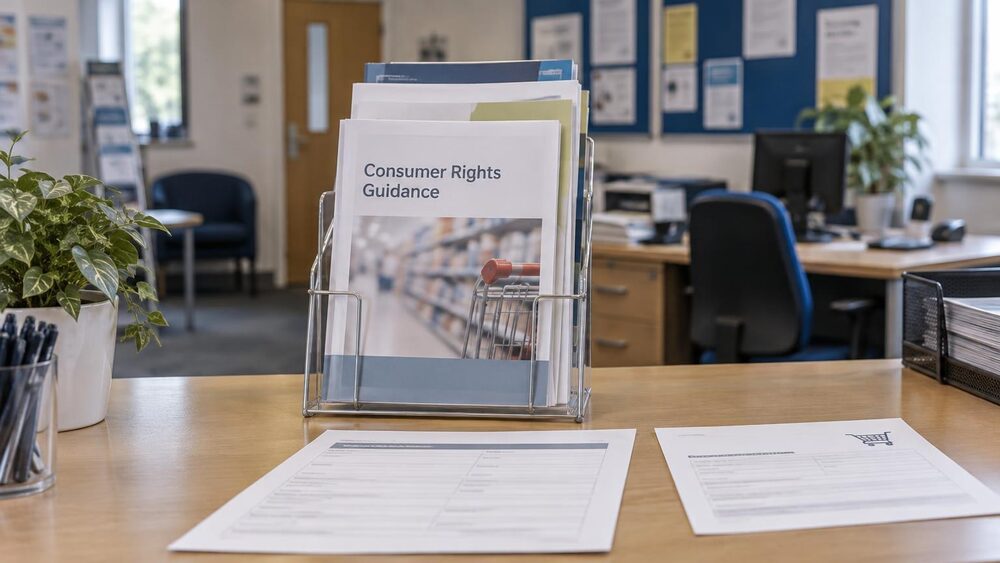
Trading standards guidance covering phone scams, dating and health scams, competition scams and the evidence needed to prove a consumer claim was updated in October 2025 to reflect the coming into force of the Digital Markets, Competition and Consumers Act 2024 (DMCCA), Part 4, Chapter 1, on protection from unfair trading1. Each of the four guides carries the same note of the change and a "Last reviewed / updated: October 2025" date1. The guidance is written for England, Scotland and Wales, with one page stating it applies to England and Wales1.
The DMCCA contains provisions giving consumers rights of redress where a trader has used an unfair commercial practice involving a misleading action or an aggressive practice: the right to unwind the contract, the right to a discount and the right to damages3. Those rights are not yet in force1. Until they are, the equivalent rights under the Consumer Protection from Unfair Trading Regulations 2008 continue to apply, and the DMCCA provisions will replace them4.
"The Digital Markets, Competition and Consumers Act 2024 includes provisions that give you rights of redress if a trader has engaged in an unfair commercial practice involving a misleading action or an aggressive practice: the right to unwind the contract, the right to a discount and the right to damages. However, this is not yet in force."
The updated pages restate existing card payment protections. Where bogus goods or services were bought by credit card and the cost was more than £100 and less than £30,000, the Consumer Credit Act 1974 applies, and Section 75 makes the card provider as responsible as the trader for a breach of contract or a misrepresentation; this does not cover charge cards or debit cards1. For debit card purchases, or credit card purchases under £100, the chargeback scheme may apply, under which a card provider can attempt to recover a payment from the trader's bank1. Where someone was misled or tricked into agreeing to a continuous payment authority, the Payment Services Regulations 2017 require the bank or card provider to cancel it, and any later payments must be reimbursed if the matter is reported as soon as possible or within 13 months of the unauthorised payment1.
| Item | Detail |
|---|---|
| Section 75 (credit card) | Purchases over £100 and under £30,000; not charge cards or debit cards1 |
| Chargeback | Debit cards, or credit card purchases under £1001 |
| Continuous payment authority | Bank or card provider must cancel; report within 13 months1 |
| DMCCA redress rights | Right to unwind, discount and damages; not yet in force3 |
On pensions, the guidance states it is illegal to make cold calls in most circumstances, with exceptions where the caller is a trustee or manager of a pension scheme or a firm authorised by the Financial Conduct Authority, where the recipient consented, or where they are an existing customer who expects such calls and has been given the chance to withhold their details1. The Telephone Preference Service is described as a free service for registering a preference not to receive unsolicited sales and marketing calls, which may not stop overseas calls, with registration on 0345 070 0707 or online1.
Why it matters for households
The practical effect of the October 2025 update is limited for now. The redress route that would let a consumer unwind a contract, seek a discount or claim damages for a misleading or aggressive practice under the DMCCA is not available, so complaints about unfair trading still rest on the 2008 regulations3. Anyone disputing faulty goods, services or digital content may need evidence to prove the claim, and the guidance sets out what to keep, including receipts, correspondence, photographs and, where needed, an expert report4. Under the Consumer Rights Act 2015, a fault found within six months of receiving goods or digital content is assumed to have been present from the start, with the burden on the trader to prove otherwise; after six months the burden returns to the consumer4. The small claims track limit in the County Court is £10,0004.
What happens next
No commencement date for the DMCCA redress provisions is given in the guidance, which states only that they are not yet in force1. Consumers in England and Wales can contact the Citizens Advice consumer service on 0808 223 1133, or 0808 223 1144 for a Welsh-speaking adviser, and in Scotland Advice Direct Scotland on 0808 164 60001. Fraud can be reported to Action Fraud, and in Scotland to Police Scotland on 1011.
Sources4 cited
- Phone scams anglesey.gov.wales
- Dating, health, psychic and work scams anglesey.gov.wales
- Competition scams anglesey.gov.wales
- Trading Standards Wales tradingstandards.gov.wales

 Citizens AdviceFree advice on money, consumer and legal problems in England and Wales
 Financial Ombudsman ServiceFree, independent help when a complaint about a firm is not put right
 MoneyHelperFree, impartial money and pensions guidance, set up by government
 Citizens Advice ScotlandFree advice across Scotland