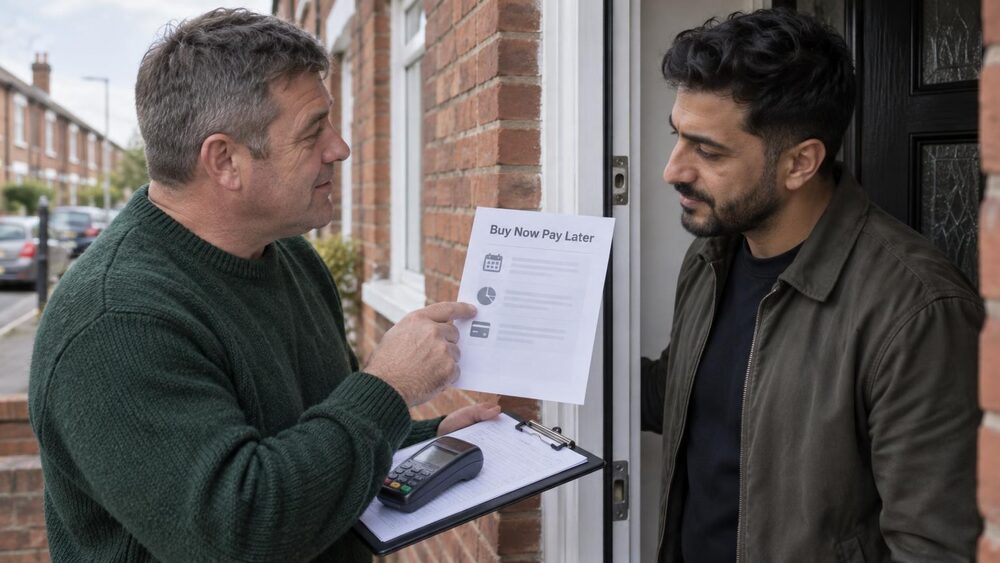
HM Treasury announced on 16 June 2025 that it will lay a negative statutory instrument exempting domestic premises suppliers from requiring credit broking permissions to offer buy now pay later (BNPL) products as a payment option1. The decision followed engagement with industry and the Financial Conduct Authority (FCA)1.
Domestic premises suppliers are defined in law as businesses that sell goods and services in people's homes, such as plumbers, double glazing companies, and mobile hairdressers or beauticians2. The exemption applies when they offer BNPL products as payment options to their customers, whether in the home or after a sale has been agreed, such as through an invoice2. These businesses will still need regulatory approval if they wish to offer other forms of regulated credit2.
The government had originally excluded domestic premises suppliers from the BNPL credit broking exemption for merchants, citing historical concerns about pressure selling in customers' homes2. Those concerns generally related to high-value, long-term credit agreements running to several thousands of pounds, such as those brokered by double glazing companies and kitchen or bathroom fitters2. By contrast, the FCA has estimated an average agreement value of £88 for BNPL agreements, which typically run for two months and by law cannot run for more than 122.
"Following industry and FCA engagement, the government decided to exempt domestic premises suppliers from requiring credit broking permissions to offer BNPL products as a payment options."
The government laid the main statutory instrument bringing BNPL into regulation on 19 May 2025, having committed to reviewing the approach to domestic premises suppliers with industry and the FCA2. BNPL firms raised concerns with the FCA shortly before that order was introduced in Parliament, arguing the approach was disproportionate and could discourage businesses from offering BNPL for essential, low-value services such as plumbing repairs2. The government said the concerns were raised too late to alter the legislation without delaying consumer protections, and that insufficient evidence was provided at the time2.
Subsequent analysis of evidence from Klarna, PayPal and Clearpay, alongside trade body Innovate Finance, indicated that affected domestic premises suppliers present low consumer risk, principally supplying low sums of credit often for essential and emergency expenditures2. As of May and June 2025, there are estimated to be at least 620 domestic premises suppliers offering BNPL products through these firms2. One BNPL firm reported nearly 5,000 transactions through its network of approximately 139 domestic premises suppliers in the 12 months to June 2025, with each purchase averaging around £2002.
| Item | Figure |
|---|---|
| Estimated domestic premises suppliers offering BNPL (May/June 2025) | At least 6202 |
| FCA full permission credit broking application fee | £1,120 (2025/26 figures)2 |
| Aggregate one-off saving across affected cohort | £694,4002 |
| Estimated yearly saving per business (FCA annual fees and levies) | £1,597.072 |
| Aggregate yearly saving | £990,183.402 |
Why it matters for households
From 15 July 2026, interest-free BNPL products will be subject to a new regulatory regime overseen by the FCA2. Under that regime, most merchants offering BNPL from BNPL firms as a payment option are exempt from credit broking regulation, but domestic premises suppliers were not covered by that exemption2. Without the change announced on 16 June 2025, these businesses would have needed regulatory approval for credit broking, or entry to the transitional regime, to keep offering BNPL to customers when the regime goes live2.
The government's impact assessment states that without the exemption many merchants would withdraw BNPL as a payment option because of new compliance costs, and that millions of consumers would then lose interest-free ways of spreading the cost of purchases2. For customers of domestic premises suppliers, the assessment says the alternative would have been debit cards, bank transfers or interest-bearing credit cards, and that debit cards and bank transfers settle immediately so do not let consumers spread costs2. The government said it cannot provide a precise estimate of consumer savings because comparable data from other BNPL providers is not available and credit card interest rates vary2.
The exemption does not remove the requirement for BNPL firms themselves to obtain regulatory approval for consumer credit lending, or to enter the transitional regime while an application for permanent FCA authorisation is assessed2.
What happens next
The measure comes into force on 3 December 20252. The first review report is due in July 2030, with reviews required every five years2. The government has not reported a date for when the negative statutory instrument will be laid.

 Financial Ombudsman ServiceFree, independent help when a complaint about a firm is not put right
 FSCSProtects your money if a bank, insurer or investment firm fails
 FCA Warning ListCheck whether a firm is authorised before you deal with it
 MoneyHelperFree, impartial money and pensions guidance, set up by government
 Citizens AdviceFree advice on money, consumer and legal problems in England and Wales