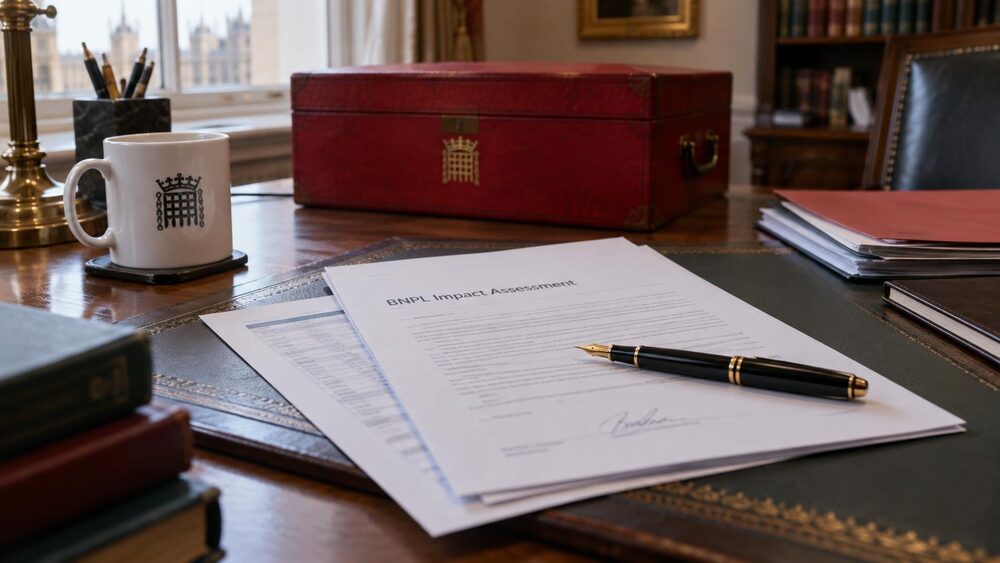
The responsible minister signed the final stage impact assessment for the order bringing buy now, pay later (BNPL) products under Financial Conduct Authority regulation on 28 April 20251. The assessment, published alongside the legislation on 19 May 2025, covers the Financial Services and Markets Act 2000 (Regulated Activities etc.) (Amendment) Order 20251.
BNPL is described in the assessment as interest-free instalment credit allowing borrowers to divide the cost of purchases into regular payments over no more than 12 months1. Such agreements are currently exempt from consumer credit regulation under article 60F(2) of the Regulated Activities Order 2001, meaning firms offering them need not be authorised by the FCA, are not required to comply with the Consumer Credit Act 1974 and fall outside the Financial Ombudsman Service1. The government announced its intention to regulate unregulated BNPL products in February 2021 in response to the Woolard Review; a consultation in February 2023 drew 53 responses, and a further consultation followed in October 20241. Legislation was not introduced before Parliament was dissolved in May 20241.
The assessment cites FCA data that around 14 million UK adults, or 27 per cent, used BNPL in the six months to January 2023, with an average outstanding balance of £236 for a current user1. The total value of BNPL transactions rose from £6.4bn in the 12 months to March 2022 to at least £9.6bn in the 12 months to March 20231. It reports that 44 per cent of frequent BNPL users are over-indebted, according to the FCA Financial Lives 2022 survey, that a Money and Pensions Service survey found 14 per cent of users had paid a late fee, and that 19 per cent of users of fee-charging providers were unaware of the fees1. It also states that 38 per cent of users spent more than planned because BNPL was available at checkout, and that almost a third of users surveyed in November 2023 had borrowed elsewhere to repay BNPL debts in the previous 12 months1.
The government's preferred option is to disapply the Consumer Credit Act's information requirements for BNPL agreements and replace them with FCA rules, while extending FSMA scope to cover the products1. Under the proposed regime, borrowers would gain access to the Financial Ombudsman Service and to section 75 of the Consumer Credit Act, which makes the creditor jointly and severally liable for breaches of contract or misrepresentation by suppliers in debtor-creditor-supplier agreements, and lenders would have to carry out affordability assessments under FCA rules1.
"The Government will lay this legislation at the same time as publishing this IA. Regulation is set to come into force twelve months and one day after the secondary legislation is made."
The assessment puts the best estimate of total net present social value at minus £25.1m in 2024 prices, with a business net present value of minus £20.1m and a net cost to business of £2.3m per year1. It estimates one-off compliance costs of £6,121,950 and ongoing annual costs of £511,350, annual FCA fees and levies of £8,585,697 for 20 identified firms, and one-off costs to the FCA of approximately £5,100,0001. Ten unauthorised firms would each pay a £5,440 authorisation fee, with additional administrative costs estimated between £2,441.25 and £4,068.75 per firm, and registration under the Temporary Permissions Regime would cost £350 per firm1. Monetised benefits are given as zero, with the assessment stating that data limitations and uncertainty around FCA rules prevent precise estimates1.
Why it matters for households
Around 14 million adults used BNPL in the six months to January 2023, according to the figures cited1. Under the proposed regime, users would gain statutory rights under section 75 of the Consumer Credit Act and access to the Financial Ombudsman Service when things go wrong, and lenders would be required to assess affordability before lending1. The assessment states that a levy to fund the regime will commence when the amended framework takes effect, expected in April 20261. It also notes that domestic premises suppliers who introduce customers to third-party BNPL lenders would need to be authorised as credit brokers, or act as appointed representatives of an authorised firm1. The assessment says the government proposes to review the legislative provisions and publish a report at least every five years, with a review date of Q3 20301.
What happens next
The legislation was laid on 19 May 2025, and regulation is set to come into force twelve months and one day after the secondary legislation is made1. The assessment states the levy will commence when the amended framework takes effect, expected in April 20261. The FCA will conduct a cost benefit analysis on its future rules, which the assessment says are not yet designed1.

 Financial Ombudsman ServiceFree, independent help when a complaint about a firm is not put right
 FSCSProtects your money if a bank, insurer or investment firm fails
 FCA Warning ListCheck whether a firm is authorised before you deal with it
 MoneyHelperFree, impartial money and pensions guidance, set up by government
 Citizens AdviceFree advice on money, consumer and legal problems in England and Wales