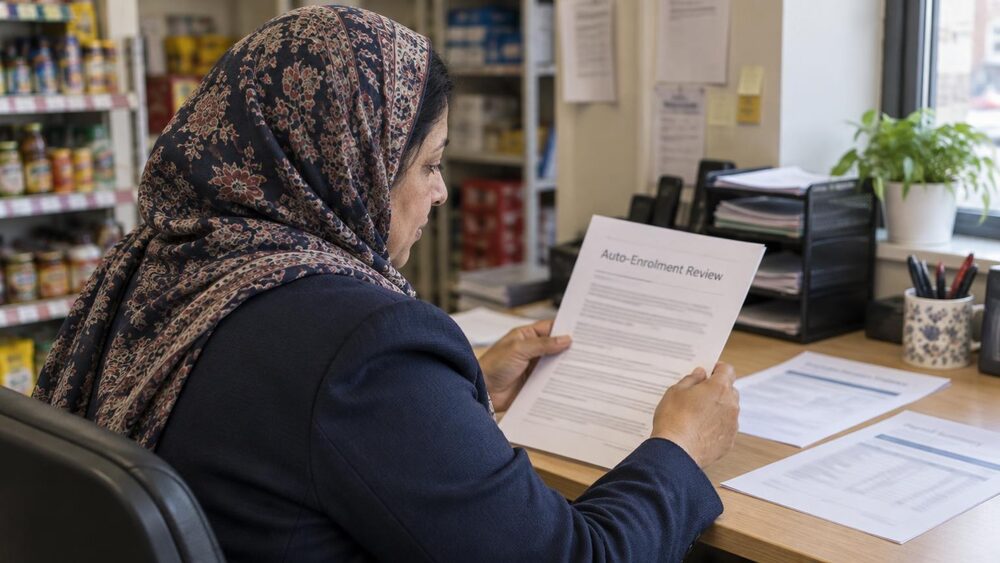
The Labour government said in November 2024 that it would consider whether and when to change automatic enrolment, the workplace pension system that employers must use for eligible staff. The statement followed the 2024 general election and was made in answer to a written parliamentary question1.
Under automatic enrolment, employees are eligible if they are not already in a workplace pension scheme, are between 22 years old and State Pension age, and earn more than the minimum earnings threshold, which has been £10,000 since 2015/161. In 2025/26, employers must make contributions on earnings between £6,240, the lower earnings limit, and £50,270, the upper earnings limit1.
Minimum contributions were last increased to 8% of earnings in April 2019. Employers contribute a minimum 3% and employees 5%, including tax relief1. The policy was phased in by employer size between October 2012 and February 20181. The House of Commons Library reports a tenfold increase in members contributing to defined contribution occupational pension schemes, from 0.9 million in 2011 to 10.6 million in 20191.
Two changes have been legislated for but not introduced. The Pensions (Extension of Automatic Enrolment) Act 2023 gave the Secretary of State the power to reduce the lower age limit for automatic enrolment and to remove the Lower Earnings Limit for qualifying earnings, so that contributions would be paid from the first pound earned1. A 2017 review of the policy had proposed lowering the age threshold from 22 to 18 and removing the lower limit of the qualifying earnings band1. During the passage of the 2023 Act, the Conservative government confirmed its intention to reduce the lower age limit to 18 years old1. The government has not yet introduced the changes1.
The November 2024 statement set out the current position:
"if and when to make changes to [auto enrolment], balancing the need for improved pension outcomes with the effects on businesses"
The Library notes that automatic enrolment is widely agreed to have been a success, but that there are concerns many people are still under-saving for retirement1.
Why it matters for households
The rules that decide who is enrolled and what is paid in are unchanged. Employees aged 22 or over and below State Pension age, earning more than £10,000, remain eligible, and the 8% minimum on qualifying earnings still applies, with the employer paying at least 3% and the employee 5% including tax relief1. The minimum contribution rates therefore stay as they have been since April 20191.
The two changes under consideration would affect different groups. Lowering the age limit to 18 would bring younger workers into workplace pensions earlier, and removing the lower earnings limit would mean contributions calculated from the first pound earned rather than from £6,240, which would raise the amount deducted for many part-time and lower-paid workers and the amount their employers pay in1. Both changes would also raise costs for employers, which is the trade-off the government's wording refers to1. No date has been given for either change, and the government has not said whether it will proceed1.
What happens next
The government has said it will consider if and when to make changes, but no timetable has been reported1. The powers in the Pensions (Extension of Automatic Enrolment) Act 2023 remain unused, and the changes confirmed by the previous government have not been introduced1.
Sources1 cited
- Pensions: Automatic enrolment - current issues - House of Commons Library commonslibrary.parliament.uk

 Pension WiseFree guidance on your options for a defined contribution pension, from age 50
 FSCSProtects your money if a bank, insurer or investment firm fails
 GOV.UKOfficial information on tax, benefits and government services