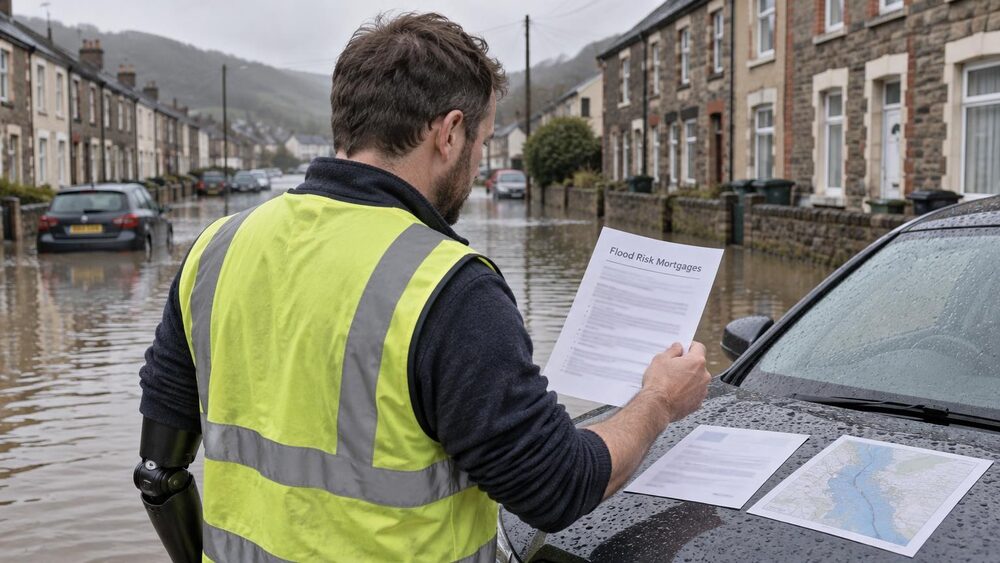
Nationwide Building Society, the UK's second largest mortgage provider, is reported to be stopping lending on properties at a high risk of flooding, according to a Welsh Government report on insurance and Flood Re published on 17 March 20251. The report, an evaluation of the Flood Re insurance initiative by the Wales Flood and Coastal Erosion Committee, states that "there are reports the UK's second largest mortgage provider, the Nationwide Building Society, are stopping lending on properties at a high risk of flooding"1. The report does not name the mapping technology involved, and no announcement by Nationwide itself is cited in it1.
The report sets the lending report against the wider flood insurance picture. Flood Re launched in 2016 as a government-industry partnership under the Water Act 2014, and has the explicit aim, described in the report as a statutory responsibility, of restoring an effective insurance free market over a temporary 25-year life span1. It is only available to households in properties built before 2009, and excludes certain leasehold and all commercial properties, as well as coastal flooding risk1. The report says more households at risk of flooding are claimed to be able to access multiple insurance quotes because of Flood Re, from 1% in early 2016 to 93%1.
The report also records limits on the scheme. It says Flood Re does not cover buildings insurance for a block of more than three leasehold flats, and that its reinsurance rates are based on Council Tax Bands, "as a proxy to reflect the householder's ability to pay rather than reflecting the risk faced by the property"1. A levy is paid by all insurers, with costs passed on through increased premiums to all household insurance policies1. The report cites detailed evidence of 800,000 properties in Britain at risk of flooding yet ineligible for the scheme, 70,000 of them at high risk1.
On resilience measures, the report says that from 2021 insurance claim payments have been permitted to include an element of "resistant and resilient repair, above and beyond the loss" under Flood Re's Build Back Better strategy, with householders able to access funds up to the value of £10,000 to install property level protection measures as part of repairs after a flood1. It notes that eligibility varies by insurer, quoting Flood Re's own answers that each insurer has a different initiative and sets its own limit1.
"there are reports the UK's second largest mortgage provider, the Nationwide Building Society, are stopping lending on properties at a high risk of flooding"
Why it matters for households
For anyone buying or remortgaging a home in an area mapped as high flood risk, the reported change affects whether a mortgage is available at all, not just what it costs. A declined mortgage application can stop a purchase, and a lender's flood mapping may not match the Environment Agency or Natural Resources Wales flood zones, or an individual insurer's view of the same property. The report does not say which properties, which areas or which mapping product are affected, and Nationwide has not been reported as confirming the position1.
The insurance side matters alongside the mortgage. Flood Re covers properties built before 2009 only, so homes built from 2009 onwards sit outside it, as do blocks of more than three leasehold flats, commercial properties and coastal flooding risk1. Where a property is ineligible, cover and pricing depend on the individual insurer. The report also notes a lack of data in Wales on insurance coverage levels, premium prices, successful claims and pay-out times, beyond Flood Re's own access-to-quotes figures1.
What happens next
The report states that Flood Re has a statutory aim to restore an effective insurance free market over a temporary 25-year life span, and that this necessitates a managed transition to risk reflective premium prices by 20391. It also records that the results of a Welsh Government review of property flood resilience had not been made public at the time of writing1. No timetable for any change to Nationwide's lending position is given in the report1.
For background on lenders and mortgages, including how building societies differ from banks, see our guides to Nationwide Building Society and bank or building society for a mortgage.

 MoneyHelperFree, impartial money and pensions guidance, set up by government
 StepChangeFree debt advice and solutions from a charity
 Financial Ombudsman ServiceFree, independent help when a complaint about a firm is not put right
 Citizens AdviceFree advice on money, consumer and legal problems in England and Wales
 ShelterFree housing advice from a charity