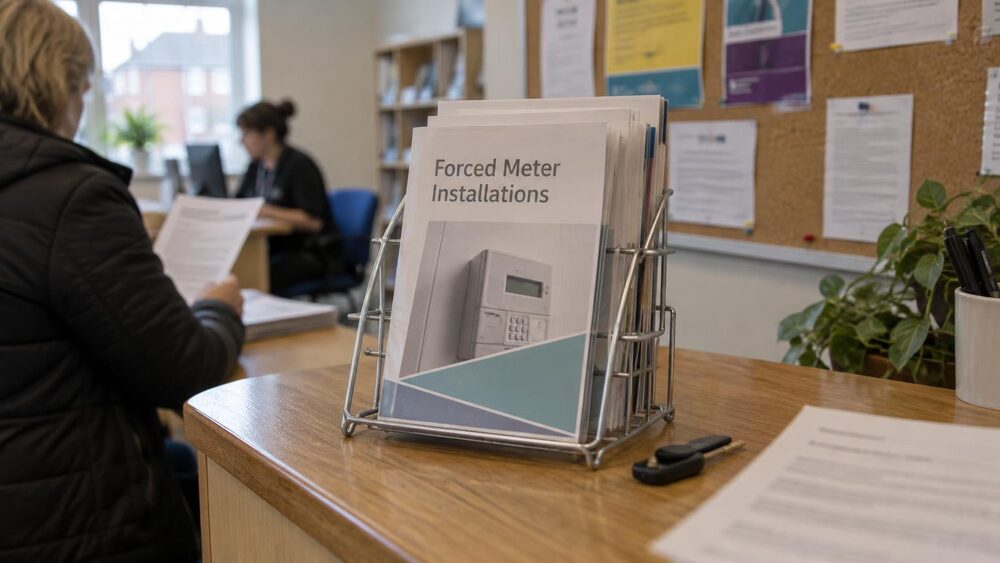
Ofgem has published a new voluntary Code of Practice on involuntary prepayment meter (PPM) installations, and Fair By Design responded to it on 18 April 20231. The charity said the code offers suppliers clearer guidance on forced installations of prepayment meters1.
Maria Booker, Head of Policy at Fair By Design, said the code requires suppliers to consider a household's financial situation alongside whether anyone in the home is physically vulnerable when deciding whether an unwanted prepayment meter is appropriate1. Fair By Design also supported the clarification that remote switching should be treated in the same way as a forced physical installation, and that smart meters should be the default option for involuntary installations1.
"We welcome Ofgem's new voluntary Code of Practice, offering clearer guidance to suppliers on forced installations of prepayment meters."
Fair By Design describes itself as dedicated to reshaping essential services such as energy, credit, insurance and payments so that they do not cost more if you are poor, a problem it calls the poverty premium1. It is managed by the Barrow Cadbury Trust on behalf of a group of foundations1.
The code is voluntary, and the response does not set out which suppliers have signed up to it, nor the date it takes effect. Fair By Design said it now looks to see the new Code immediately adopted across the sector and enforced by the regulator1. Ofgem's own announcement of the code is not among the published material, so its full terms, including any exemptions or timescales for suppliers, have not been reported here.
Why it matters for households
The code concerns prepayment meters installed without the household's agreement, usually where a customer has fallen into debt. Under the guidance as described, a supplier deciding whether to install one would have to take account of the household's financial circumstances and whether anyone living there is physically vulnerable1. Remote switching of a smart meter to prepayment mode would be treated the same way as sending an engineer to force-fit a meter, and smart meters would be the default option for involuntary installations1.
Because the code is voluntary, its practical effect depends on suppliers adopting it. Fair By Design's statement does not say how many have done so, or what happens to a household if a supplier has not1. Households on prepayment meters generally pay for energy in advance and can be cut off remotely if credit runs out, which is why the conditions attached to involuntary installation matter for people already struggling with bills.
What happens next
Fair By Design said it now looks to see the new Code immediately adopted across the sector and enforced by the regulator1. No further dates, review points or enforcement measures are given in the published response. The regulation and policy hub covers how energy rules and codes are set and enforced.

 Financial Ombudsman ServiceFree, independent help when a complaint about a firm is not put right
 FSCSProtects your money if a bank, insurer or investment firm fails
 FCA Warning ListCheck whether a firm is authorised before you deal with it
 MoneyHelperFree, impartial money and pensions guidance, set up by government
 Citizens AdviceFree advice on money, consumer and legal problems in England and Wales