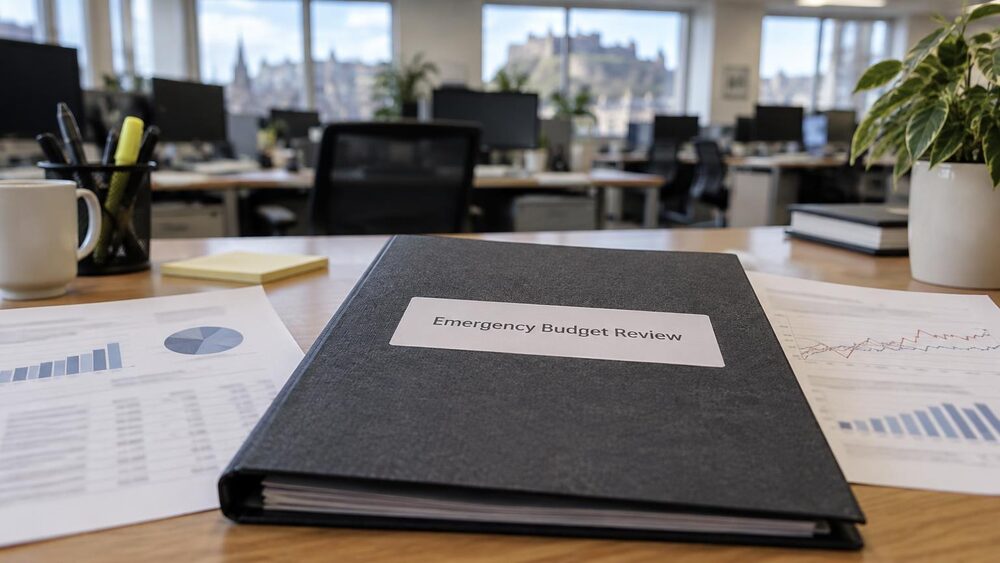
The Scottish Government published an Emergency Budget Review on 2 November 2022, setting out around £35 million for cost of living initiatives1. The review followed the First Minister convening the Scottish Government Resilience Committee on 11 August 2022 to discuss urgent steps to mitigate the cost of living crisis1.
The review was published against a backdrop of rapidly rising prices. UK inflation, as measured by the Consumer Prices Index, rose from under 0.5% in February 2021 to a peak of 11.1% in October 2022, the highest rate for 41 years1. The Scottish Government's analytical working group, set up in May 2022, later reported that the Finance Minister had estimated the Scottish Budget "was worth around £1.7 billion less than it was worth in December 2021"1.
"On 2 November 2022 the Scottish Government published an Emergency Budget Review (EBR)"
The review sat alongside other measures. The Cost of Living (Tenant Protection) (Scotland) Act 2022, passed by the Scottish Parliament in early October 2022, imposed a temporary in-tenancy rent cap and a moratorium on the enforcement of evictions1. Following the expiry of those measures on 31 March 2024, the rent adjudication process in the private rented sector was modified for a period of one year1.
The wider economic picture moved through distinct phases. Energy prices rose sharply in 2022, then food price inflation accelerated, reaching 19.2% in March 2023, the highest rate of increase in food prices since 19771. Producers' input costs peaked at 24.1% in June 20221. The Bank of England raised interest rates 14 consecutive times from 0.1% in December 2021 to 5.25% in August 2023, before reducing them twice in 2024, in August and November, from 5.25% to 4.75%1. CPI gradually reduced from October 2022 to reach the Bank's 2% target by June 20241.
| Measure | Detail | Date |
|---|---|---|
| Emergency Budget Review | Around £35 million for cost of living initiatives | 2 November 20221 |
| Cost of Living (Tenant Protection) (Scotland) Act 2022 | Temporary in-tenancy rent cap and eviction moratorium | Passed early October 2022; measures expired 31 March 20241 |
| Scottish Government Resilience Committee | Convened to discuss urgent steps | 11 August 20221 |
Why it matters for households
The review set out funding while household costs were rising fastest. Fuel poverty in Scotland increased from 24.6% in 2019 to 31.0% in 20221. The working group found that low income households were more financially vulnerable entering the crisis, faced higher rates of inflation than better off households in its earlier acute phase, and often pay more for essential goods and services1. Women, disabled people, ethnic minorities, rural households, larger households, young people, students and carers, lone parents and single person households, households in receipt of income-related benefits, people narrowly ineligible for benefits and people with no recourse to public funds were particularly adversely affected, with some households carrying several of these characteristics at once1.
The group also noted that lower inflation does not mean prices are falling, only that they are rising less quickly, and that the large increases of the previous three years have effectively been locked in1. It said the benefits of interventions such as the Energy Price Guarantee were relatively short lived and that think tanks and research organisations suggested support could have been better targeted at households most in need1.
What happens next
The working group's February 2025 report expands on a more detailed report it published in November 20221. It states that the longer term effects of the cost of living crisis continue to present serious economic and social challenges for Scotland and may negatively affect people's health, wellbeing and future resilience for years to come1. No further Emergency Budget Review has been reported. Readers looking at how benefits, tax and banking work across the UK's nations can find background in the nations hub, including living in Northern Ireland and working in Ireland.
 Citizens Advice ScotlandFree advice across Scotland
 Citizens AdviceFree advice on money, consumer and legal problems in England and Wales
 MoneyHelperFree, impartial money and pensions guidance, set up by government
 GOV.UKOfficial information on tax, benefits and government services