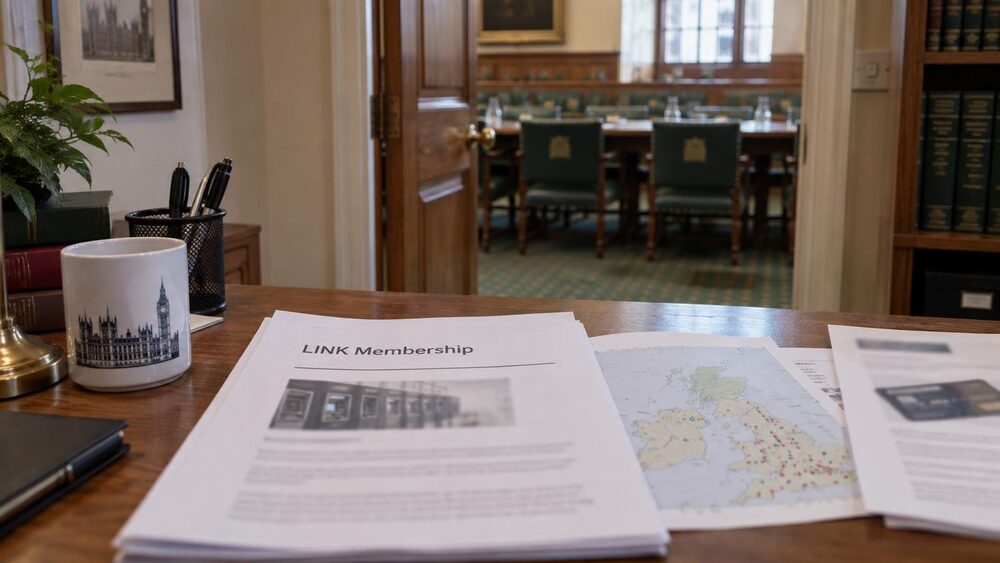
The Scottish Affairs Committee recommended on 11 July 2022 that the UK Government consider legislating in the Financial Services and Markets Bill to mandate membership of LINK for card issuers and ATM operators1. The recommendation appears in the committee's report on access to cash in Scotland, published as its Second Report of Session 2022-231.
The report sets out the wider legislative background. HM Treasury published the Summary of Responses to the Access to Cash Consultation in May 2022, which set out the Government's planned approach to legislating for access to cash1. As announced in the 2022 Queen's Speech, the Financial Services and Markets Bill contains provisions to ensure people across the UK can continue to be able to access their own cash1. Under the Bill, the Financial Conduct Authority would be granted new powers over the UK's largest banks and building societies to ensure cash withdrawal and deposit facilities are available in communities across the country, and the Government intends to appoint the FCA as lead regulator for retail access to cash1. HM Treasury would be enabled to specify geographic baselines for reasonable access to cash withdrawal and deposit facilities, with separate baselines possible for withdrawal and deposit facilities and for urban and rural areas1.
The committee also repeated its predecessor's recommendation that the UK Government set up a working group with industry to introduce network-wide deposit-taking ATMs1.
The report gives figures on the decline in cash infrastructure and on cash use. Since 2015, 53% of Scotland's bank branches have closed, the highest percentage loss of the four UK nations, according to Which?1. Since 2018, 20% of Scotland's free-to-use ATMs have closed1. The Minister, John Glen MP, told the committee that in 2009, 56% of transactions were in cash, but today cash payments represent only 17% of all transactions1. LINK told the committee that approximately 500,000 people in Scotland are dependent on cash, about 1 in 10 people in Scotland1.
The committee's own survey of people in Scotland received 225 responses1. Of those, 48% said they "often" use cash to pay for goods and services, 15% "almost always" use it, and only 4% never use cash1. Asked about the UK becoming a cashless society, 67% said it would be "very negative" and only 6% said it would be "very positive"1.
The report also notes the Post Office's role. In December 2021, the Cash Action Group announced that the Post Office will deliver enhanced cash services in up to 30 branches, to address local cash access issues1. The third instalment of the Banking Framework Agreement will start in January 2023, meaning consumers of 30 UK banks and building societies can continue to access cash and basic banking facilities via the Post Office until 20261.
Why it matters for households
The recommendation concerns who must belong to LINK, the network that connects cash machines across the UK. If the Government were to mandate membership for card issuers and ATM operators, that would affect the companies that issue cards and run cash machines, rather than setting a rate or fee for consumers. The committee has only recommended that the Government consider legislating; no decision has been reported.
The report's figures describe the direction of travel for household access to cash. Branch and free-to-use ATM closures in Scotland are set out above, and the committee heard that the impact can be most severe in remote and rural areas because of connectivity and distance to the next available location1. The committee heard that the nearest alternative branch for customers of the closed Virgin Money branch in Portree is 80 miles away including a ferry transfer, and 101 miles for the closed Wick branch1.
The report also records disagreement about how well served people are. UK Finance told the committee that 95.5% of the population live within a mile and a quarter of free cash access, and 99.7% within three miles, with 98.3% within three miles in rural areas1. Cardtronics told the committee that the "lived experience of that is somewhat different" once geographical access and the operating hours of cash services are taken into consideration1.
The Financial Services and Markets Bill provisions would place duties on the largest banks and building societies, which the Government intends to designate as firms in scope, considering market share by number of accounts and the value of deposits in those accounts1. The FCA would monitor coverage of access to cash, and HM Treasury would set the geographic baselines1.
What happens next
The Government has two months to respond to the committee's report1. The report notes that the specific geographic baselines will be set by HM Treasury, informed by the FCA's monitoring of coverage, and that the Government intends to legislate through the Financial Services and Markets Bill1. The committee said it looks forward to reviewing the more detailed proposed legislation when Parliamentary time allows1. The report also notes the possibility that aspects of policy may evolve quickly between publication and the Government's formal response1.
Sources1 cited
- Access to cash in Scotland - Scottish Affairs Committee publications.parliament.uk
 Financial Ombudsman ServiceFree, independent help when a complaint about a firm is not put right
 FSCSProtects your money if a bank, insurer or investment firm fails
 FCA Warning ListCheck whether a firm is authorised before you deal with it
 MoneyHelperFree, impartial money and pensions guidance, set up by government
 Citizens AdviceFree advice on money, consumer and legal problems in England and Wales