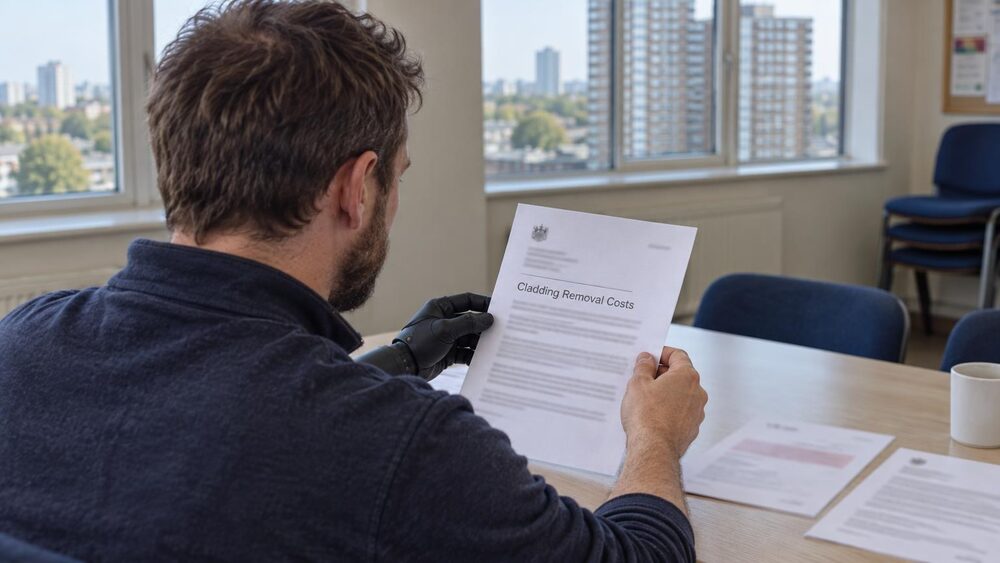
The Government announced on 10 January 2022 that no leaseholder living in their own flat would have to pay to fix unsafe cladding, and that it will pay for the removal of unsafe cladding in buildings over 11 metres1. The Building Societies Association (BSA), which published a consumer question and answer page on the issue on 5 February 2022, confirmed the date of the announcement1.
The BSA set out what the announcement does and does not cover. Work completed before the announcement will not be covered retrospectively, so leaseholders who have already contributed to remediation cannot claim that money back under the scheme1. The Government has written to the residential property developer industry asking it to contribute to a fund which would protect leaseholders from the cost of removing cladding1. The BSA said it was waiting for further details from the Government on support for those in lower-rise buildings under 11 metres1.
"The Government announced that no leaseholder living in their own flat would have to pay to fix unsafe cladding and that it will pay for the removal of unsafe cladding in buildings over 11 metres."
Separately, in a letter to lenders on 12 January 2022, the Government confirmed that issues of building safety could be considered as exceptional circumstances for shared ownership flats requiring a consent to let1. Decisions on whether to grant consent to sub-let a mortgage flat potentially affected by unsafe cladding remain with individual lenders, based on their own risk appetite1.
The BSA also explained the role of the EWS1 form, a cross-industry initiative from the BSA, the Royal Institution of Chartered Surveyors (RICS) and UK Finance to enable a fire safety assessment on properties clad with potentially combustible materials1. It was designed for mortgage valuation purposes, in line with government guidance, to give surveyors the information needed to assess the value of flats and help lenders lend1. Many lenders have implemented RICS guidance, which has resulted in an EWS1 not being required for 92% of mortgage valuations on flats1.
| Point | Detail |
|---|---|
| Announcement date | 10 January 20221 |
| Who is covered | No leaseholder living in their own flat has to pay to fix unsafe cladding1 |
| Government funding | Removal of unsafe cladding in buildings over 11 metres1 |
| Retrospective claims | Work completed before the announcement is not covered1 |
| Lower-rise buildings | Further details awaited for buildings under 11 metres1 |
The BSA noted that expert advice published on 21 July 2021 states there are no systemic fire risks in properties under 18 metres, but that RICS guidance does not reflect this advice and lenders may still request an EWS1 for some properties under 18 metres to support lending decisions1. Buildings with neither cladding nor a combustible timber balcony do not, and have never, required an EWS1, though some buildings that look brick or stone built have a brick or stone slip external wall system that constitutes cladding1. A valuer's decision not to require an EWS1 is no guarantee that fire safety remediation works will not be required in future1.
Why it matters for households
Leaseholders who live in their own flat in a building over 11 metres are covered by the 10 January 2022 announcement, so the cost of removing unsafe cladding in those blocks falls to the Government rather than to them1. Those who paid for work completed before that date are not covered retrospectively1. Households in buildings under 11 metres are not covered by the funding commitment as described, and the BSA said details of support for them had not yet been published1.
For mortgage holders, the BSA said anyone in a flat affected by the cladding issue whose fixed rate deal is ending can re-mortgage with their current lender, provided they are not borrowing more than their current mortgage and their repayments are up to date, whether or not an EWS1 is available1. Borrowers should not have to move onto their lender's standard variable rate1. Switching lender or taking a further advance may be difficult, as these are treated as new loans and require a valuation that could trigger a need for an EWS assessment1.
What happens next
The BSA said it was waiting for further details from the Government on support for those in lower-rise buildings under 11 metres1. The Government has written to the residential property developer industry asking it to contribute to a fund protecting leaseholders from cladding removal costs1. No further dates have been reported.
Sources1 cited
- Cladding - consumer Q&A bsa.org.uk
 Financial Ombudsman ServiceFree, independent help when a complaint about a firm is not put right
 FSCSProtects your money if a bank, insurer or investment firm fails
 FCA Warning ListCheck whether a firm is authorised before you deal with it
 MoneyHelperFree, impartial money and pensions guidance, set up by government
 Citizens AdviceFree advice on money, consumer and legal problems in England and Wales