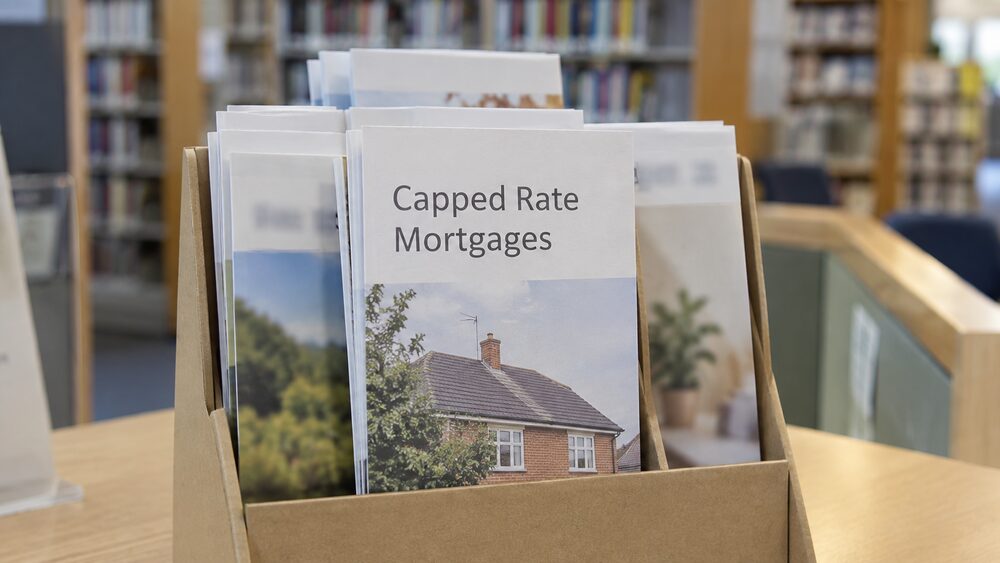
A capped rate mortgage is a variable rate deal where the interest rate is guaranteed not to go above a certain level during the capped period, often between three and five years1. If the lender's rate falls, your payments fall with it. If the rate rises, your payments stop rising once they hit the cap.
These deals were more common in the past. Today they are rare, and only a handful of capped mortgage products are usually available at any one time. That means finding one can take effort, and the choice of lenders is likely to be limited.
If you are weighing up whether a capped rate could work for you, the key questions are how it behaves compared with a fixed or tracker deal, what it costs in fees, and what happens when the capped period ends. This page sets out how each of those works.
How a capped rate mortgage works
A capped rate mortgage is a type of variable rate mortgage. Your interest rate can go up or down, but it cannot go above the cap during the capped period1. The cap is a ceiling, not a fixed rate.
Most mortgages in the UK are repayment mortgages, where each monthly payment covers the interest charged and pays off some of the capital borrowed2. By the end of the term, the loan is fully repaid3. A capped rate deal works the same way, except the interest rate has a maximum.
The capped period is the length of time the cap applies. This is often between three and five years1. During that time, if the lender's variable rate rises above the cap, you pay the capped rate instead. If the rate falls below the cap, you pay the lower rate.
A cap is different from a collar. A collar sets a minimum interest rate, meaning your rate cannot fall below a certain level4. Some tracker and discount mortgages come with a collar3. A capped rate mortgage has a ceiling, not a floor.
Rate falls pass through, rises stop at the cap
The appeal of a capped rate is that you benefit when rates fall but are protected when they rise. If the lender's variable rate drops, your monthly payments drop too, because the cap only limits how high the rate can go1.
This is different from a fixed rate mortgage, where your interest rate stays the same during the deal5. With a fixed rate, you know exactly what you will pay each month, but you do not benefit if rates fall. If the lender's standard rate falls below your fixed rate, you lose out1.
With a capped rate, you get some of the benefit of falling rates. But the cap means you are protected from sharp rises. The trade-off is that capped rate deals are rare, and the cap may be set at a level that is higher than the rate you would get on a fixed deal.
The cap itself is a percentage rate. If the lender's variable rate rises above that percentage, you pay the cap instead. The exact cap level depends on the deal and the lender.
Capped, fixed or tracker: how each one behaves
The three main types of mortgage deal behave differently when rates change. Understanding the differences helps you see where a capped rate fits.
| Deal type | How the rate behaves | What you pay when rates rise | What you pay when rates fall |
|---|---|---|---|
| Capped rate | Variable, but cannot rise above the cap1 | Capped at the maximum rate1 | The lower variable rate1 |
| Fixed rate | Stays the same during the deal5 | The same rate, no change5 | The same rate, no benefit from falls1 |
| Tracker | Tracks the Bank of England base rate plus a set margin3 | Rises with the base rate6 | Falls with the base rate6 |
Tracker mortgages follow, or track, the Bank of England's base rate7. They are variable rate deals that track the base rate plus a set percentage, for example the base rate plus 1%6. Tracker mortgages usually track above the base rate, so you agree to a fixed percentage over the base rate for a fixed term8.
Some tracker mortgages come with a collar, which means the rate can only fall to a set level3. This protects the lender if the base rate falls very low.
A capped rate mortgage works in the opposite way: it protects you if rates rise, but lets you benefit if they fall. The cap is the maximum you will pay.
Why capped rate mortgages are rare
Capped rate mortgages are not widely available. Only a handful of such products are usually on the market at any one time1. This is not a new development: some mortgage types have always had limited availability. Offset mortgages, for example, are offered by not many lenders, so choice can be limited9.
The rarity of capped rate deals means that if you want one, you may need to search harder or work with a broker who knows the market. It also means there is less competition on price, which can make capped rate deals less competitive than fixed or tracker deals.
When a mortgage type is rare, the trade-off is often between flexibility and cost. With flexible mortgages, for example, you are unlikely to get both the flexibility and a very cheap interest rate1. The same principle applies to capped rate deals: the protection of a cap may come at a cost compared with other deal types.
If you are considering a capped rate mortgage, it is worth checking whether the lender offers other deal types that might suit you better. A fixed rate gives certainty. A tracker gives you the full benefit of falling rates, with the risk of rising ones. A capped rate sits between the two.
Costs to check: arrangement fees and early repayment charges
The interest rate is not the only cost of a mortgage. Arrangement fees and early repayment charges can significantly affect what you pay.
Arrangement fees vary by lender and deal. Remortgagers are typically charged higher fees, with many close to £2,00010. These fees are usually added to the mortgage or paid upfront.
Early repayment charges (ERCs) apply if you repay your mortgage early or switch to a better deal during the deal period. There may be a big redemption penalty if you repay your loan early or switch to a better deal in the early years of your mortgage1. These fees can add up to tens of thousands of pounds.
The Financial Ombudsman Service has handled cases where lenders did not properly explain early repayment charges. In one case, a borrower faced a £1,500 early repayment charge that had not been taken into account11. This shows the importance of checking the terms of your deal carefully.
If you are remortgaging to pay off debt, there is often an early redemption fee if you remortgage early12. The same applies to capped rate deals: if you want to leave the deal before the capped period ends, you may face a charge.
What happens when the capped period ends
When the capped period ends, your mortgage usually moves to the lender's standard variable rate (SVR)2. The SVR is the rate the lender charges when your deal period finishes. Standard variable rates tend to be significantly higher than the rates on other types of mortgage13.
Each lender has its own SVR, and it can set the rate at whatever level it wants2. A lender can raise or lower its SVR by any amount and at any time13. This means your payments can go up or down after the capped period ends.
You have options when the capped period ends. You can move to a new mortgage deal with either the same lender or a different one, or do nothing and your mortgage will usually move onto the lender's standard variable rate14. Most people choose to remortgage to avoid the higher SVR.
If you do nothing, your payments will usually increase. The SVR is often much more expensive than the rate you were paying during the capped period2. Remortgaging to a new deal can reduce your payments, but you will need to check for early repayment charges on your existing deal and arrangement fees on the new one.
Where to get help choosing a mortgage
Choosing a mortgage is a significant financial decision. Free and impartial help is available if you need it.
Mortgage brokers can search the market for you. Online-only mortgage brokers exist, but human mortgage brokers will always be used at some point in the process to make sure your application is correct and legally binding15. Broker fees vary: some charge between a few hundred pounds up to 1% of your mortgage16.
If you are struggling with your mortgage payments, help is available. A government mortgage scheme may be able to help if you own your home17. The Mortgage Charter includes help with high interest rates and repayment problems18. Support for Mortgage Interest payments can help you pay the interest element of your mortgage, not any capital19.
Some lenders agree to help if you are selling your home to avoid repossession. They may pay your selling fees, pause court action, lower your mortgage payments, or give you a deposit and rent in advance to rent a home20.
If you receive Income Support, you may be able to get help with the cost of your mortgage and other home loans21. You can also get money to help with mortgage payments22. Support for mortgage interest is available to help with a mortgage23.
StepChange offers mortgage advice, but it cannot help people under 50 find a different mortgage24. If you are over 50 and struggling with your mortgage, it may be able to help.
For free, impartial guidance on mortgages and debt, you can contact MoneyHelper or a debt advice charity. The Financial Ombudsman Service can help if you have a complaint about your lender that has not been resolved.
Sources24 cited
- Repayment options Shelter Cymru, 2026-08-28
- Mortgage types explained Which?, 2026-04-02
- Mortgage types explained Which?, 2026-04-02
- What is a mortgage? Which?, 2026-06-08
- What is a mortgage? Experian, 2026
- Bank of England base rate and your mortgage Which?, 2026-06-23
- Interest rates applied to mortgages Financial Ombudsman Service, 2026-09-26
- Variable rates explained Furness Building Society, 2026-09-26
- Offset mortgages Which?, 2026-04-02
- Fixed rate mortgages Which?, 2026-04-02
- Lender didn't say early repayment charge Financial Ombudsman Service, 2026-09-26
- Remortgaging to pay off debt StepChange, 2026-09-25
- Standard variable rate mortgages Which?, 2026-04-02
- A guide to fixed rate mortgages Leeds Building Society, 2026-05-08
- Online mortgage brokers Which?, 2026-06-03
- Cost of buying house calculator HomeOwners Alliance, 2026-06-11
- Your financial situation and health StepChange, 2026-09-25
- Rent and mortgage Scottish Government, 2026-09-26
- Carer's Allowance and other benefits Carers UK Scotland, 2026-08-13
- Selling your home to avoid repossession Shelter England, 2025-09-16
- Your priority debts Business Debtline, 2026-09-26
- Income Support Entitledto, 2026-09-26
- Ways to increase your income Shelter Cymru, 2026-08-29
- How we help with mortgages StepChange, 2026-09-25






 MoneyHelperFree, impartial money and pensions guidance, set up by government
 StepChangeFree debt advice and solutions from a charity
 Financial Ombudsman ServiceFree, independent help when a complaint about a firm is not put right
 Citizens AdviceFree advice on money, consumer and legal problems in England and Wales
 ShelterFree housing advice from a charity