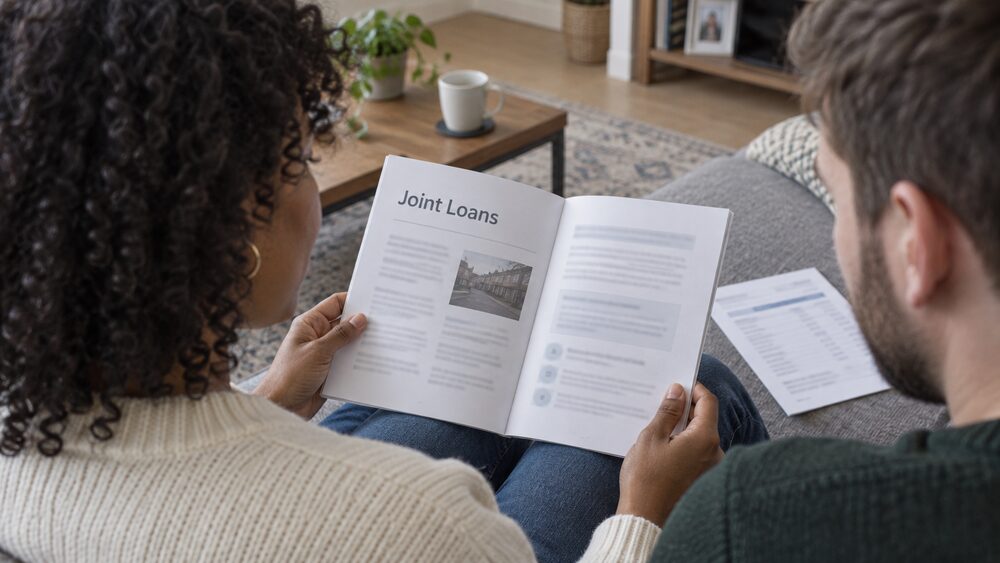
A joint loan is a credit agreement you sign with another person, and the rule that governs everything about it is joint and several liability: you are both liable for the whole debt, regardless of who spent the money1. That means you are not responsible for "your half". If the other borrower stops paying, dies, or goes bankrupt, the lender can come to you for the full amount outstanding1.
Joint borrowing is common in the UK, most often as a joint mortgage between couples, but also between friends or family members buying a home together2. Two incomes can mean a lender will offer more than one income alone would, and lenders usually allow a maximum of 5 times annual income on a joint mortgage3. The trade-off is a lasting financial link: a joint loan connects your credit files, so the other person's money troubles can affect your ability to borrow, even after you separate4.
What a joint loan is and who can take one out
A joint debt is any financial contract you share with someone else, such as a mortgage, loan or bank account2. It is a credit agreement you sign with another person, and from the moment both signatures are on it, you are each on the hook for everything borrowed1. StepChange describes the position plainly:
"You are both liable of the debt, regardless of who spent the money. This is called 'joint and several liability'."1
The people on the agreement do not have to be a couple. Joint mortgages, for example, allow a parent and child to buy a property together, with both names on the mortgage and the property deeds7. Joint mortgages are usually shared by two people, but some lenders allow up to four borrowers8. Friends, siblings and other combinations can borrow together, though lenders will assess the arrangement on its own merits.
The legal definition is broad. Under the Debt Respite Scheme (Breathing Space) regulations, a "joint debtor" is a person who is jointly or severally liable, or jointly and severally liable, with a debtor for a debt, with one exception: someone whose liability arises solely as a result of an indemnity or guarantee, and who has no other liability in relation to the debt, is not treated as a joint debtor9. In practice this means a guarantor stands in a different legal position from a co-borrower, a distinction covered on the page about guarantor loans.
Sharing a rental agreement or a mortgage means you have joint debts, and action can be taken against both of you if the debt goes unpaid10. That is worth weighing before signing anything with anyone whose finances you do not know well, because the link you create follows both of you for as long as the debt exists.
Secured, unsecured and overdraft: the types of joint borrowing
Joint borrowing comes in the same forms as sole borrowing, and the type matters because it determines what the lender can take if things go wrong. The broad split is between secured and unsecured credit, and the most common form of secured lending is a mortgage11.
Unsecured joint borrowing includes personal loans, overdrafts and credit cards. Most overdrafts, credit cards, catalogues, store cards and personal loans are unsecured, meaning they are not tied to an asset such as your home12. An overdraft is a type of loan that often has interest, borrowed through your current account13. Credit cards, unsecured loans, store cards and unsecured overdrafts are usually treated as non-priority debts when a borrower gets into difficulty, which affects the order in which they must be repaid14. Commonly used credit products include credit cards, overdrafts and payday loans15.
Secured joint borrowing is tied to an asset, usually property. The most common form is a mortgage, where the loan is secured on the home11. Bridging loans are another form of secured short-term lending, offered by providers including LendInvest, MT Finance, Precise Mortgages, Together Mortgages and United Trust Bank16. The Bank of England breaks repayments of lending secured on dwellings into three types: regular repayments, repayments on redemption, and other lump sums17, which reflects how large and structured this market is.
Joint bank accounts with an overdraft are a form of joint borrowing in their own right. Each account holder can withdraw money without asking the other person, and an overdraft on the account is a debt both are liable for18. The page on secured versus unsecured borrowing compares the two in more detail.
| Type | Examples | What secures it |
|---|---|---|
| Unsecured | Personal loans, credit cards, overdrafts, store cards12 | Nothing: not tied to an asset |
| Secured | Mortgages, bridging loans11 | Usually the property |
| Overdraft | Borrowing through a joint current account13 | Nothing, but attached to the account |
One specific joint arrangement worth noting: you can guarantee a loan for a spouse or partner, but only if you have separate bank accounts10. This is the guarantor route, where one person backs the other's borrowing rather than sharing it, and it is explained on the page about guarantor loans.
Combined income can mean borrowing more
The main practical attraction of borrowing in two names is capacity. How much you can borrow on a joint mortgage depends on both your incomes19, and lenders usually allow a maximum of 5 times annual income3. Two incomes can therefore support a larger loan than one, which is why most couples buying a home take a joint mortgage.
Lenders run a credit check on each applicant before granting a mortgage, and if one party has a poor credit score, it could impact the lender's decision5. In other words, the weaker credit file can drag down the application for both. If there are more than two people on a mortgage, lenders will normally only take the income of the two highest-earning people into account when deciding how much to lend8.
Joint borrowing is also used for debt consolidation, where existing debts are rolled into a single loan, either through secured borrowing against an asset such as a property, or through further unsecured borrowing20. Consolidation can bring a lower rate of interest, lower monthly payments, a known end date, a single monthly payment and dealing with only one lender21. But the risks are real and apply to joint consolidation loans as much as sole ones:
- The payments could be bigger or last longer, and you might end up paying more overall22
- The added interest may not be cheaper than what you are paying now23
- Interest could be higher than what you are paying now24
- Repayments may be spread over a much longer period, possibly costing more in the long run25
- Missed or late payments can create more problems, so you need to be really sure you can keep up with the repayments23
Taking out a loan also means taking out more credit, which could itself affect your credit score23. The page on debt consolidation loans covers the trade-offs in full, and the page on loan affordability checks explains what lenders must check before lending.
Each borrower owes the full amount, not just half
This is the single most important rule on this page, and the one most often misunderstood. You and the other person are both responsible for the whole amount of money owed in a joint debt, not just your own share or "half"2. Joint and several liability means you agree to pay back the whole debt if the other person does not pay, and you are responsible for the whole amount borrowed4.
The rule bites hardest in Scotland on joint accounts. Where a creditor takes money from a joint bank or building society account, the creditor is entitled to the full amount if: only the account holder who is in debt paid money into the account, the debt was incurred jointly, or the account is in the joint names of a couple with equal liability for the debt26. So a lender recovering a debt can take the whole balance from a joint account, not just the other person's "share" of it.
In practice, this means an informal arrangement between borrowers, such as "you pay half, I pay half", binds nobody but the two of you. The lender is not a party to it. If one of you breaks it, the lender can pursue the other for everything, and any private agreement to split the debt is a matter between the two borrowers to sort out themselves.
How a joint loan links your credit files
Taking out a joint loan creates a financial association between the borrowers on their credit files. Lenders can look at the other person's credit history when you apply for credit, even if you apply in your own name only4. The Information Commissioner's Office puts it directly: where partners are financially linked, the lender can have full access to your credit file in the same way it could if it were you applying for credit27.
The link arises from joint credit applications, joint bank accounts or joint financial products, and it continues after divorce or separation6. Opening a joint account adds a financial link, so companies look at both credit histories, and a poor history on the other side might lower your chances of acceptance28. MoneyHelper's guidance on choosing a bank account is blunt about the risk: only consider opening a joint bank account with someone you trust, as it could damage your credit score if they have poor credit, and you could be responsible if they run up debt29.
The association matters most when the other person's finances deteriorate. If you have a joint debt with an ex-partner, such as a mortgage or a loan, your credit files are connected, and how you manage your debts will affect your ex-partner if they apply for credit, and vice versa30. The page on how loans affect your credit file explains the mechanics in more detail.
Closing the joint account will not remove the link from your credit file28. A notice of disassociation can be requested from the credit reference agencies, but only once there is no other financial connection between you, which in practice means the joint debt must be dealt with first28. How to do that is covered below.
Missed repayments: what happens to both borrowers
Missed payments on a joint debt are marked on both credit files, regardless of who missed the payment4. National Debtline makes the point in terms of separation, but it holds at all times: if a payment is missed, it will be recorded on your credit file as well as the other borrower's, even if the other person agreed to repay the debt6. On a joint mortgage, a missed payment shows up on both credit reports, regardless of whose fault it was5.
Both borrowers feel every stage, from the first missed payment to the lender pursuing either one for the full amount.
The lender can pursue any one of the borrowers for the money if someone fails to pay19. If one person cannot or will not pay, this leaves the other responsible for the whole debt4, and StepChange's guidance on separation states the rule without qualification: you need to repay the full amount yourself if your partner cannot pay33.
There is one boundary to the damage. Missed payments on debts that are solely in the other person's name do not show on your credit file6. The financial association lets lenders see the other person's history, but their sole-name arrears are recorded as their liability, not yours. The distinction between joint and sole debts after a split is covered in the next section.
If you are already struggling, the page on what to do if you can't repay a loan sets out the first steps, and the debt section explains the free help available.
Separation and divorce do not end the debt
A divorce only ends the marriage; it does not end the financial connection between you and your ex-partner6. Getting divorced does not change who is responsible for credit debts such as credit cards, loans or overdrafts: the person whose name the debt is in remains liable, and on a joint debt, both of you remain liable6. Any private agreement between divorcing partners about who pays what does not bind the lender, which can still pursue either borrower for the full amount.
The credit file link survives too. The financial association created by a joint application, joint account or joint loan continues after divorce or separation6, and while a joint debt remains, there is no way to remove the link until the account is closed, repaid in full, or the ex-partner's name is removed. For a loan, that means the link can only be removed once the loan is repaid in full; for a joint bank account, removal is only likely once there is no overdraft to repay6.
Once the joint account is closed, you can write to the credit reference agencies to request a disassociation from that individual27. Until the underlying debt is settled, that request will not succeed.
Two pieces of official support are relevant here. In Scotland, legislation on debt payment programmes extends the circumstances for a payment break to cover cohabitees separating34. And under the Debt Respite Scheme (breathing space), if one joint debtor is granted a breathing space, creditors can still charge the other people interest or fees, and the breathing space does not affect the other people's debts and liabilities in their own names35. In other words, protection granted to one borrower does not automatically shield the other.
When one borrower dies
Joint debts do not go away if one of the people named on the agreement dies. Instead, the other person becomes responsible for repaying the full amount of the debt1. On a joint bank account, if an account holder passes away, the account continues in the remaining names28. On a joint mortgage, the surviving borrower owes the whole balance.
This is why protection insurance matters for joint borrowing. Shelter Cymru's guidance on joint mortgages notes that it is likely to be important to have mortgage protection insurance to pay off the loan if one of you dies19. Joint life insurance is a policy taken out by two people, typically a couple, that pays out on the death of the first policyholder during the term, after which the policy ends and does not cover the surviving partner36. First-to-die cover pays out on the first death, while second-to-die, or survivorship, cover pays out only after both policyholders have passed away36.
The main disadvantage of joint life insurance is that you get only a single payment per policy, even if both policyholders die during the term36. Some households combine policies to work around this: one example given by Which? is a couple with a £250,000 mortgage and children holding a joint decreasing term policy of £250,000 plus a joint level term policy of £250,000, giving £500,000 of cover in total36. The protection insurance section explains the options.
When someone dies, repayment of personal loans, credit cards and credit debt must generally wait until other debts have been settled, and if cards are held jointly, any debts will be the joint holder's responsibility37. The rules on debts after death are covered in nidirect's guidance37.
How to apply for a joint loan
Applying for a joint loan follows the same process as a sole application, with both applicants involved at every stage. If you are buying a property with someone else, you will need a joint mortgage19. The lender runs a credit check on each applicant, and both incomes are taken into account when working out how much to lend5. The page on how to apply for a loan covers the practical steps.
Both applicants must sign the credit agreement. For loans secured on a home, the paperwork requirements are strict: for Support for Mortgage Interest loans, both people named on the mortgage need to sign the correct loan documents before the loan can be granted38, and for joint claimants, both members of the claim are required to sign both the Loan Agreement and the Charge Form39. The same principle, both signatures required, runs through secured joint lending generally.
Ownership of the property interacts with the borrowing. If you own as joint tenants or tenants in common, additional loans cannot be taken out on the property without your agreement8. Before applying, it is worth checking how the property is held, because it affects what either borrower can do unilaterally.
If the worst comes to it, joint bankruptcy is also a joint procedure: a couple must submit two sets of forms and pay two lots of bankruptcy fees40. And when only one of you goes bankrupt, the other person named on the joint debt becomes responsible for the whole debt40, which is the same rule as always, arriving by a different route.
Where to get help if a joint loan goes wrong
Free, independent help exists, and joint debts are a standard part of what these services deal with. StepChange, National Debtline and Citizens Advice all publish guidance on joint debts, and MoneyHelper offers free guidance on joint accounts and on dividing the family home and mortgage during divorce or dissolution30.
For mortgage arrears specifically, when faced with repossession, contact your solicitor or a free advice agency41. If your lender has signed up to the Mortgage Charter, you could get help from them if you are having problems with your mortgage42. In Scotland, the cost of living campaign signposts support with rent and mortgage difficulties42.
If a complaint about the lender itself is needed, the route is set out on the page about complaining about a lender, and the debt section explains the full range of debt solutions and where to get free advice about them.
Sources42 cited
- Dealing with joint debts StepChange, 2026-09-25
- Joint debts StepChange, 2026-09-25
- Mortgage types explained Which?, 2026-04-02
- How joint debts affect me StepChange, 2026-09-25
- Mortgage types explained Which?, 2026-04-02
- What happens to debts when you get divorced National Debtline, 2026-09-25
- Guarantor mortgages Which?, 2026-04-02
- Joint tenants vs tenants in common Which?, 2026-06-08
- Debt Respite Scheme regulations legislation.gov.uk, 2020
- Debt solutions for homeowners StepChange, 2026-09-25
- What is secured debt National Debtline, 2026-09-25
- What is unsecured debt National Debtline, 2026-09-25
- Overdrafts explained MoneyHelper, 2026-09-25
- Selling assets to clear debt Business Debtline, 2026-09-26
- Consumer credit trends and debt StepChange, 2026-09-25
- Bridging loans explained Which?, 2026-06-23
- Total lending to individuals data Bank of England, 2024-05-13
- Dementia and managing money nidirect, 2026-09-03
- Joint mortgages Shelter Cymru, 2026-08-28
- Debt consolidation Debt Advice Foundation, 2026
- Consolidating debts nidirect, 2025-09-11
- Credit confidence StepChange, 2026-09-25
- Debt consolidation calculator StepChange, 2026-09-25
- Debt consolidation and debt management StepChange, 2026-09-25
- Consolidating debts Shelter Cymru, 2026-08-30
- When a creditor takes money from your bank account Citizens Advice Scotland, 2026-09-25
- Credit: your questions answered Information Commissioner's Office, 2026-09-25
- Joint accounts MoneyHelper, 2026-09-25
- Choosing a bank account for your Universal Credit payment MoneyHelper, 2026-09-25
- Dividing the family home and mortgage during divorce MoneyHelper, 2026-09-25
- Credit card payment holidays StepChange, 2026-09-25
- Car finance Advice NI, 2026-09-26
- Divorce and separation StepChange, 2026-09-25
- Debt payment programme regulations note legislation.gov.uk, 2026
- Debt respite breathing space scheme GOV.UK, 2021-04-30
- Joint life insurance explained Which?, 2025-08-06
- Debt when someone dies nidirect, 2026-06-26
- Repaying your mortgage on a low income nidirect, 2026-09-01
- Support for Mortgage Interest guidance UK Parliament, 2025
- Joint bankruptcy StepChange, 2026-09-25
- When a lender takes action against you nidirect, 2025-09-05
- Rent and mortgage support in Scotland Scottish Government, 2026-09-26



 MoneyHelperFree, impartial money and pensions guidance, set up by government
 StepChangeFree debt advice and solutions from a charity
 National DebtlineFree debt advice by phone, webchat and online
 Financial Ombudsman ServiceFree, independent help when a complaint about a firm is not put right
 Citizens AdviceFree advice on money, consumer and legal problems in England and Wales