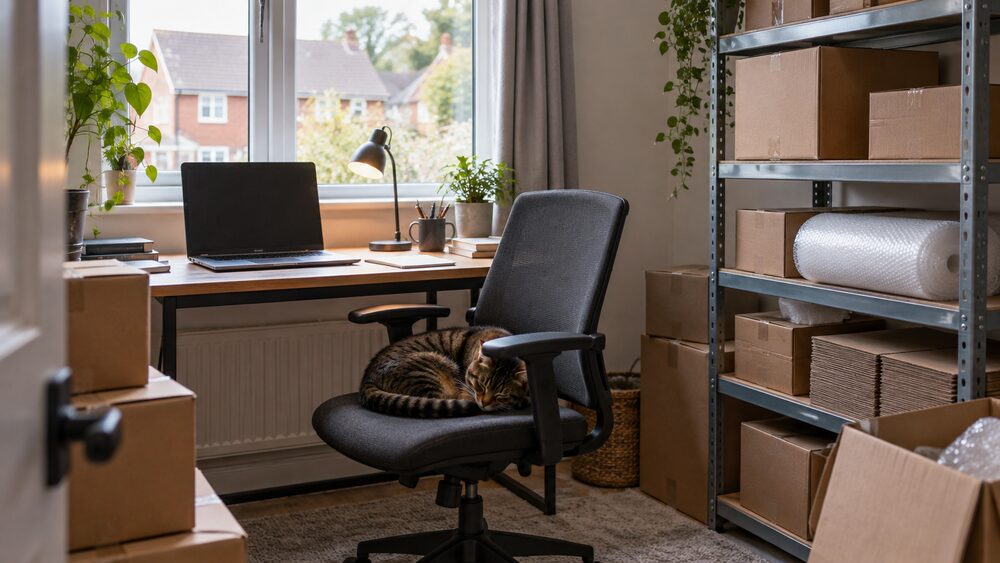
For most people who work at a desk at home, the answer is yes: home insurance covers you as standard, and you do not need to tell your insurer. esure says that if you have its home insurance and are doing general office work from home, you are covered as standard by your policy1. Nationwide says you are covered if you are doing desk-based work from home, such as working on a computer or laptop, without needing to notify it2.
The picture changes when your work stops looking like office work. Visitors to your home related to your work, business stock kept at the property, tools, or running a trade rather than an office job can all fall outside a standard policy, and some of those changes need to be declared. Home insurance itself is not a legal requirement, though a mortgage lender may make buildings insurance a condition of the loan3.
This page sets out what insurers count as office work, when you need to tell your insurer, where standard cover stops, and what to do if a claim linked to home working is refused.
Desk-based work at home is usually covered as standard
The starting point is that home insurance is built for the home, and a laptop on the kitchen table does not change what the policy is insuring. Home insurance is usually made up of two main parts: cover for the building itself and cover for the contents within it6. Working at a desk touches the contents side more than the buildings side, and standard contents cover already reaches the equipment involved.
Accidental damage to possessions in your home, including electronic devices such as mobile phones and laptops, is part of a standard contents insurance policy7. That matters for home working because the most common accident is a spilled drink or a dropped laptop, not a fire. esure puts a figure on the contents side: if you already have home contents insurance with esure, your laptop is covered up to a value of £1,5004.
The buildings side of the policy is largely unaffected by desk work. Standard home insurance policies typically cover damage caused by fire, including wildfires8, and most policies offer storm damage cover as standard, though the level of cover may differ between providers7. Flood cover is a standard feature of home insurance9, and policies generally also include cover for temporary accommodation if your home has been made uninhabitable9. None of that turns on whether you were working at the time.
Where the two parts of the policy meet your working life is the equipment. If the laptop, monitor and chair are yours, they are contents. If they belong to your employer, they are a different question, covered below.
What insurers count as office work from home
Insurers draw the line at the nature of the work, not the number of hours. esure's wording is "general office work from home"1, and Nationwide's is "desk-based work from home, such as working on a computer or laptop"2. Both describe administrative, professional or clerical work done at a screen. Neither requires a dedicated room, and neither sets a time limit in the wording quoted.
What falls outside that description is work that brings the outside world into the property or stores business property there. esure asks customers to tell it about visitors to the home related to their work1. That is the clearest dividing line in the sources: a screen and a chair are office work, a stream of clients through the front room is not.
There is a tax parallel that shows how the same distinction is drawn elsewhere. Self-employed people working from home can claim a proportion of the costs of insurance, mortgage interest and council tax10. If you work from home, you may want to include a proportion of your household costs, for example heating and lighting11. Those rules are about tax, not insurance, but they show that "working from home" is treated as an ordinary arrangement rather than an unusual one.
For disabled people, the workplace can include the home. The Access to Work grant states that your workplace can include your home if you work from there some or all of the time12. That is a support scheme rather than an insurance rule, but it confirms that home working is a recognised working arrangement in its own right.
Do I need to tell my home insurer I work from home?
For desk-based work, no. Nationwide states plainly that you are covered for desk-based work from home without needing to notify it2. esure's position is the same for general office work, which it says is now covered as standard1.
There are specific changes that do need telling, and they are about risk rather than job title:
- Visitors to your home related to your work. esure lists this among the things to tell it about1.
- Taking in a lodger. A home insurance provider is told about a lodger being taken in, and the policy may need updating13.
- Work done on your home. An insurance provider is told if work is done on the home, especially if there is anything that may affect the security of the home, such as scaffolding14.
- Renting out your home. Renting out a home can affect its buildings insurance; some insurers increase premiums, and the insurer is told, or the insurance may be invalid15.
The general principle behind all of these is that an insurer prices the risk it thinks it is carrying. Giving wrong information to an insurer is misrepresentation, and it can affect a claim. If you are unsure whether a change matters, the cheapest step is to ask before the claim, not after.
Where standard home insurance may not cover your work
Standard cover has edges, and home working can push against several of them. The most important is equipment you do not own. Nationwide states that employer-owned business equipment is not covered under its home insurance policy, unless you are responsible for any damage under the terms of your employment, and that it is the employer's responsibility to insure it2. esure says cover for office equipment such as a laptop will usually be the employer's responsibility, but advises checking with your employer1.
Equipment you own yourself is treated differently. Nationwide says that if the business equipment is owned by you, it will be covered under your contents insurance, subject to the policy documents for details and limitations2. That is a meaningful distinction for anyone who has bought their own laptop, monitor or tools for work.
Other limits that can catch a home worker:
- Personal possessions cover, comprehensive accidental damage cover and home emergency cover may not be included as standard16. If your laptop travels to and from a workplace, cover outside the home is a separate question.
- Home emergency cover does not usually cover any damage the emergency has caused11. Most home emergency policies are only meant to cover stopping the emergency, and they do not usually cover consequential damage11.
- Wear and tear is excluded. Standard home insurance will not usually cover damage caused by wear and tear7, and you might not be covered if the damage is a result of general wear and tear, for example water entering through a poorly maintained roof17.
- Unoccupied property. Your standard policy may not pay out if the loss or damage was caused while the home was unoccupied7.
- Garden and outbuilding items vary. Some policies include cover for garden furniture, trees, hedges, lawns and fences, while others do not18. Some insurers require evidence of forced entry, indoor items left outside may be excluded, and potted plants are often not covered at all19.
If your work involves stock, tools or equipment stored in a shed, garage or garden office, those variations matter more than they would for a purely desk-based worker.
Work from home cover added during the pandemic
Several insurers changed their approach to home working during the pandemic, and the wording in the sources reflects that. esure's own wording says that if you have its home insurance and are doing general office work from home, you are now covered as standard by your policy1. The word "now" is doing real work: this was a change, not something that was always true.
The guidance for consumers at the time was to check rather than assume. If you are working from home you may need to check whether your insurer has applied work from home cover during the pandemic, and all insurers are different, so check with your broker or insurer20. That advice still has value for anyone whose policy was taken out before the change, or who has moved insurer since.
Where the work goes beyond office work, specialist cover exists. NFU Mutual offers homeworker insurance with legal liability in connection with the homeworker business, as an employer for injury to employees or damage to their property, of up to £10 million, and legal liability for injuries to others or damage to their property from £2.5 million5. The same policy provides up to £100,000 of business legal costs for advice and legal representation5. Those are the kinds of limits that a standard home policy does not carry, because a standard home policy is not insuring a business.
If you use a broker, the broker's role is to help personal and business customers manage the risks they face through access to suitable insurance21. That is the route for anyone whose home working has grown into something a standard policy was not written for.
How to check what your own policy says
The policy wording is the document that decides, and it is worth reading the sections that touch your working life rather than the whole thing. Start with the contents section for equipment, the exclusions section for what is ruled out, and the definitions section for how the policy describes business or office use.
A practical checklist, drawn from the guidance sources:
- Check the cover is current and paid up to date22.
- Check whether personal possessions cover, comprehensive accidental damage cover and home emergency cover are included, because they may not be standard16.
- Check the exclusions on weather damage, for example garden items22.
- Check your sums insured on the buildings side are sufficient23.
- Check whether you have other policies covering the same events and costs, because duplicate cover does not pay twice. AXA's home assistance cover states that you must check you do not have any other insurance policies that may cover the same events and costs that this cover does24.
If you are comparing policies, it helps to know how much variation there is. Which? analysed 72 home insurance policies from 30 providers in the summer of 2026 and found that only 18% included home emergency cover, with most offering it as an optional extra7. An earlier analysis looked at 58 home insurance policies from 29 insurers19. The point is not which policy is better but that the same label covers different things.
Cost is not fixed either. Most insurers will offer a discount if you insure both buildings and contents with them25. You may be able to reduce your home insurance premiums if you have good security, such as alarms, good quality locks or Neighbourhood Watch membership16. If you agree to pay a higher excess in the event of a claim, your premium will be lower25. Your insurance premium may be increased if the insurer thinks you are more likely to make a claim, which is known as premium loading26.
If a claim linked to home working is refused
A refusal is not always the end of the matter. The first step is a formal complaint to the insurer. The insurer is appealed to first, clearly explaining what went wrong from the policyholder's perspective and how they would like it resolved27. Put it in writing, head it "Complaint", include dates and the names of people spoken to, and say how the problem should be resolved27.
If the refusal rests on how the policy wording applies to your circumstances, the wording itself is the argument. A template letter used to challenge a rejected claim refutes the insurer's argument on the basis of the wording of the policy, quoting the policy wording, and encloses a report from a relevant expert backing up the claim28. That structure, policy wording plus independent evidence, is the shape of most successful challenges.
If the insurer does not resolve the complaint, the Financial Ombudsman Service can look at it, and its service is free to consumers. The volume of complaints in this area gives a sense of scale: in the first quarter of 2026/27 the ombudsman opened 550 complaints about home emergency insurance, 307 about household warranties and 277 about mobile phone insurance29.
The ombudsman decides cases on what is fair and reasonable, which is why its published outcomes are worth reading before you escalate. In one case, a consumer complained about misleading information provided at policy renewal, and the ombudsman did not uphold the complaint30. In another, a couple complained after a wrongly diagnosed boiler issue left them without hot water; their home insurer also provided home emergency cover31. Outcomes go both ways, and the facts of the individual case decide.
For free, impartial help with a complaint or with understanding your cover, the Financial Ombudsman Service handles disputes once the insurer has had its say, and its consumer pages set out how home insurance complaints work6. If the problem is paying for cover rather than a dispute about it, a debt advice charity can help with the household budget side, including working out what a policy actually costs you each month11.
Sources32 cited
- Home insurance customer support FAQs esure, 2026
- Home insurance whilst working from home Nationwide, 2026
- Santander home insurance review Which?, 2026-09-17
- Laptop insurance esure, 2026
- Homeworker insurance NFU Mutual, 2026-09-26
- Home insurance complaints Financial Ombudsman Service, 2026-09-26
- Revealed: the disasters your home insurance policy might not cover Which?, 2026-09-26
- The ABI shares advice following recent wildfires across the UK Association of British Insurers, 2026-08-14
- Home insurance and flooding Which?, 2026-09-17
- Self-employed tax allowable expenses Which?, 2026-04-06
- Home emergency insurance Financial Ombudsman Service, 2026-09-26
- Access to Work GOV.UK, 2026-09-26
- Taking in a lodger Shelter Scotland, 2025-10-07
- Maintaining your home Independent Age, 2026-09-26
- Cynyddu eich incwm Shelter Cymru, 2026-09-14
- Shopping around for insurance Independent Age, 2026-09-26
- Does your insurance cover damage caused by bad weather? Which?, 2025-12-08
- The ABI offers advice to anyone affected by wildfires in Suffolk and across the UK Association of British Insurers, 2026-07-31
- Does your home insurance cover your garden? Which?, 2025-05-15
- Home insurance guides British Insurance Brokers' Association, 2022-10-28
- Why use a broker? British Insurance Brokers' Association, 2025-04-02
- Property damage from bad weather British Insurance Brokers' Association, 2022-09-06
- Myths about self assessment expenses busted Which?, 2024-01-17
- Home emergency cover AXA, 2026-09-26
- Cost of home insurance British Insurance Brokers' Association, 2022-11-18
- Mental health and insurance cover Mental Health and Money Advice, 2023-09-05
- How to complain about your insurance company Which?, 2025-09-10
- Letter to refute your insurer's rejection of your insurance claim Which?, 2025-06-18
- Quarterly complaints data Q1 2026/27 Financial Ombudsman Service, 2026
- Consumer complains about misleading information provided at policy renewal Financial Ombudsman Service, 2026-09-26
- Couple complain after wrongly diagnosed boiler issue leaves them without hot water Financial Ombudsman Service, 2026-09-27
- Do you need to declare an undiagnosed condition for travel insurance? Which?, 2026-07-17
 MoneyHelperFree, impartial money and pensions guidance, set up by government
 Financial Ombudsman ServiceFree, independent help when a complaint about a firm is not put right
 FSCSProtects your money if a bank, insurer or investment firm fails
 Citizens AdviceFree advice on money, consumer and legal problems in England and Wales
 GOV.UKOfficial information on tax, benefits and government services