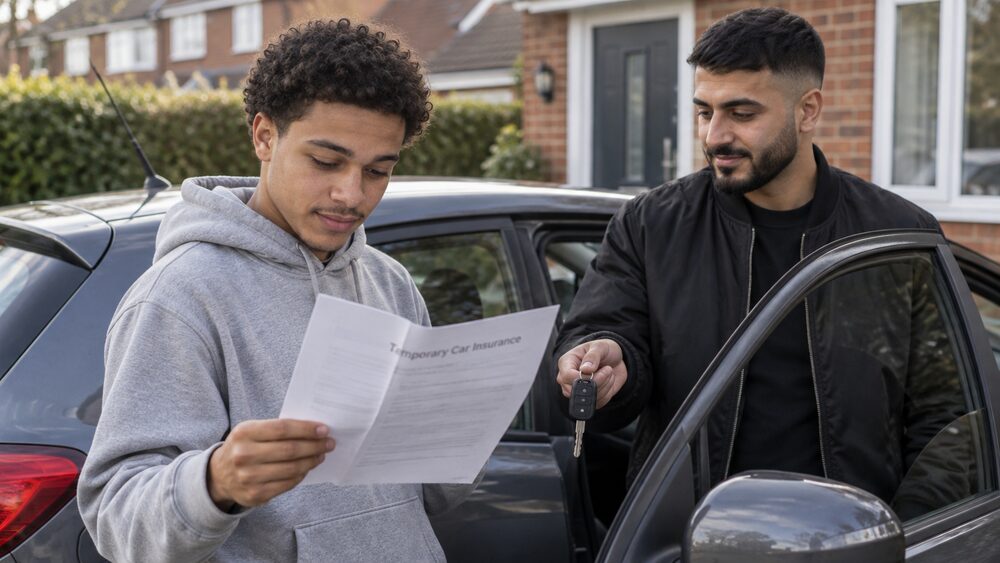
Temporary car insurance, also sold as short-term car insurance, is a comprehensive policy that lasts a set number of days rather than a year. Aviva describes it as "cover for when you only need insurance for a shorter block of time, rather than the whole year"1. It is taken out in the driver's name, so it can cover someone who does not own the car they are driving.
Cover runs from 1 to 28 days on Aviva's product2. Learner driver cover is sold separately and lasts from two hours to one day2. A standard annual car policy, by contrast, runs for 12 months, though Hastings Direct notes that in some cases a first period of cover may be less than 12 months3.
The minimum cover the law requires is third party insurance, which pays for injuring someone or damaging another car but not for repairs to your own4. Short-term policies are usually comprehensive, which adds damage to the vehicle itself4. What follows is how the cover works, who can buy it, what drives the price, and how it compares with being added to someone else's policy.
What temporary car insurance is and when people use it
A short-term policy is a standalone contract. The driver buys it, the driver is insured, and the car does not have to belong to them. That is the main difference from being added to someone else's annual policy, where the cover sits inside the owner's contract.
People use it for a defined trip or a defined job. Aviva sells it for "day trips, weekends away, test drives and more"2. It also suits driving a car home after buying it, borrowing a car while your own is off the road, or sharing the driving on a long journey.
It is not a substitute for an annual policy for a car you use regularly. Classic car insurance, for example, is not suitable for a vehicle used frequently7, and the same logic applies here: short-term cover is priced for occasional use, and buying it repeatedly for everyday driving is not what it is built for.
The car itself still needs to be insured by its owner for the rest of the time. A short-term policy covers the named driver for the stated period; it does not replace the owner's own cover, and it does not cover anyone else driving the car.
How long cover can last, from one hour to a few weeks
The standard short-term product runs from 1 to 28 days2. Within that window you choose the start and end, so a single day, a weekend or a fortnight are all normal.
Learner driver cover is shorter still, from two hours to one day2. It is designed for a practice session rather than a trip, and it is a separate product from the main short-term policy.
| Policy type | How long it runs | What it is for |
|---|---|---|
| Short-term car insurance | 1 to 28 days2 | Day trips, weekends away, test drives, borrowing a car2 |
| Learner driver cover | Two hours to one day2 | Practice sessions in a car that is already insured2 |
| Annual car insurance | 12 months, though a first period may be less3 | Regular use of a car you own or keep |
If you need cover for longer than a few weeks, the options change. Adding a driver to an existing annual policy, or taking out your own annual policy, is the route for regular use. Short-term cover is priced for a block of days, not for months.
Who can get short-term cover: age, licence and car limits
Eligibility is set by the insurer, and the rules vary. Age, licence type, driving history and the car itself all feed into whether a quote is offered and at what price.
Younger drivers pay more. Which? notes that it is possible for a driver under 25 to get classic car insurance, but they will probably pay more than older drivers7. The same pattern applies across motor cover: youth is priced as risk.
The car matters too. Modifications affect both whether cover is offered and what it costs, and performance-related changes such as adding a turbo or supercharger tend to carry the greatest insurance cost8. Illegal modifications will not be covered at all8.
Learner drivers are served by a separate product with its own term of two hours to one day2. Provisional licence holders should check the provider's rules before buying, because the eligibility conditions for learner cover are narrower than for a full short-term policy.
What it costs and what pushes the price up
There is no single price for short-term cover. The premium reflects the driver, the car, the length of the cover and the level of protection chosen, and it is set by each insurer.
Several things push motor premiums up across the market. The FCA has identified rising claims costs driven by more complex and expensive cars, supply chain delays, a shortage of skilled labour, increased costs for replacement vehicles, rising bodily injury costs, increasing numbers of car thefts and a rise in costs associated with uninsured drivers9.
On the driver's side, penalty points and convictions affect premiums, and giving wrong information to an insurer can have worse consequences than a higher price: the insurer may cancel the policy and any claims may be rejected10.
For telematics policies, which use a device or app to monitor driving, high-risk drivers may face a premium increase, a specific one-off charge, or in the most serious cases cancellation of the policy11. If a telematics policy is cancelled early, there could be a charge to recover the cost of the device11.
Temporary cover or adding a named driver: how each one works
These are two different products, and the choice changes who carries the risk.
A short-term policy is a contract in the driver's name. The driver buys it, the driver is insured, and a claim sits against that policy. The owner's no-claims bonus is not used, because the owner's policy is not the one providing cover.
Adding a driver to an existing policy is a change to the owner's contract. AXA sets out the process: choose "Add a temporary driver" next to the policyholder details, enter the temporary driver's details, follow the steps on each screen, then confirm payment details and press "Continue"12. For a permanent addition, the policyholder chooses "Add a driver", sets the date the change should start, enters the new driver's details and gets a quote for the changes13. AXA says it will let you know of any price difference before you decide12.
The policyholder has to supply accurate information. AXA states that as the policyholder, you will need to make sure you have details about any claims and convictions the new driver may have before starting13.
Where a driver is added to the owner's policy and a fault claim follows, the owner's no-claims bonus is exposed. The Financial Ombudsman Service says a no-claims bonus is normally reduced by 2 years after a fault claim, though insurers should explain in their policy how any reduction will work5. A protected no-claims bonus means the amount of the bonus will not change if a fault claim is recorded, but that does not mean the price is protected5.
| Short-term policy | Adding a driver to an existing policy | |
|---|---|---|
| Whose contract | The driver's own, standalone1 | The owner's policy, changed12 |
| Whose no-claims bonus is exposed | The driver's own policy record | The owner's, normally reduced by 2 years after a fault claim5 |
| How it is arranged | Bought directly, starting on a chosen date1 | Through the policyholder's online account, avoiding the admin fee12 |
| Price difference shown first | Premium quoted at purchase | Yes, before the change is confirmed12 |
How to buy a policy and when cover starts
Short-term cover is bought directly from insurers and brokers, usually online, and the policy is set to start on a date you choose. The cover does not apply to anything that happened before that date: Aviva states it will not cover "any loss, damage, accident or insured event that happened before your policy start date"1.
That timing rule matters most when you are collecting a car. The policy needs to be in force before you drive away, not arranged afterwards.
You will need the car's details, including its registration, and the owner's permission to drive it. You will also need to answer questions about your licence, your driving history and any claims or convictions accurately. Giving wrong information can lead to the policy being cancelled and claims being rejected10.
If you are adding a driver to an existing policy instead, doing it through the online account avoids the admin fee12. The change takes effect from the date you select, and the price difference is shown before you confirm12.
Where temporary cover does not apply
Short-term cover is comprehensive, but comprehensive does not mean everything. The exclusions are the same kind that apply to annual motor policies.
- Third party only cover does not pay for repairs to your own car14.
- Third party, fire and theft adds fire and theft but still does not cover storm or flood damage to your own vehicle15.
- Comprehensive cover adds damage to the vehicle itself, and usually includes damage to upholstery and the entertainment system, though the insurer may not pay out for personal possessions left in the car15.
- Wear and tear is never covered. Accidental damage cover pays for one-off incidents but not for general wear and tear16.
- A warranty on a car does not change your consumer rights17.
Some things are outside motor cover altogether. Personal possessions left in a vehicle may be covered by "contents outside the home" cover as part of a contents insurance policy15. Home insurance may cover certain possessions away from the home, but it will not cover medical care or cancellations18.
Claims, complaints and where to get help
If something goes wrong, tell the insurer as soon as possible. For a stolen car, notify the police and get a crime reference number, and submit the claim promptly7. If a stolen vehicle is later found, tell your insurance company and give them precise details of its whereabouts19.
Keep records. Photographs, receipts for emergency expenses and a written note of dates and names all help20. If a claim is refused, ask for the reasons in writing and quote the section of the policy document that shows the work or event is covered17.
If you are unhappy with how a claim or a policy change was handled, complain to the insurer first. Which? advises making a formal complaint headed "Complaint", including dates and the names of people you spoke to, and saying how you would like the problem resolved6. If the insurer does not resolve it, the Financial Ombudsman Service can look at the case.
The ombudsman has set out how it approaches no-claims bonus disputes. It says it does not think it is fair for an insurer to withhold a no-claims bonus you have earned, though it might not interfere if the insurer has done this because you owe them money5. It also says no-claims bonuses and the way they are applied vary between insurers, so each case is looked at individually21.
Free, impartial help is available from MoneyHelper and from debt advice charities if cost is the problem. StepChange notes that automatic renewal ties you in for another year, often at a higher price22, and that running a car brings costs beyond insurance, including road tax, MOT, fuel, parking, warranty and maintenance such as repairs and replacement tyres23.
Sources23 cited
- Short-term car insurance Aviva, 2026-09-26
- Car insurance Aviva, 2026-09-26
- Car insurance policy document Hastings Direct, 2026
- Motor insurance explained nidirect, 2026-05-27
- Fault claims and no-claims bonuses Financial Ombudsman Service, 2026-07-10
- How to complain about your insurance company Which?, 2025-09-10
- Classic car insurance explained Which?, 2026-01-22
- Modified car insurance Which?, 2026-01-22
- Motor insurance taskforce final report leaves people in poverty behind Fair By Design, 2025-12-11
- Have my penalty points pushed up my car insurance premiums? Which?, 2025-12-29
- Pay-as-you-drive insurance Association of British Insurers, 2026-09-27
- Adding a temporary driver AXA, 2026-09-26
- Adding a permanent driver AXA, 2026-09-26
- Vehicle insurance GOV.UK, 2026-09-26
- Is your car covered for flood damage? Which?, 2025-11-08
- 6 questions to ask before you choose a home insurance policy Which?, 2025-10-15
- What to do if your car warranty company won't pay for repairs Which?, 2025-08-05
- Travel insurance ABTA, 2026
- Vehicle theft British Insurance Brokers' Association, 2026-09-26
- The ABI offers advice to anyone affected by wildfires in Suffolk and across the UK Association of British Insurers, 2026-07-31
- Fault claims and no-claims bonuses: our approach Financial Ombudsman Service, 2026-09-16
- Save money on insurance StepChange, 2026-09-25
- Buying a car when on a DMP StepChange, 2026-09-25

 MoneyHelperFree, impartial money and pensions guidance, set up by government
 Financial Ombudsman ServiceFree, independent help when a complaint about a firm is not put right
 FSCSProtects your money if a bank, insurer or investment firm fails
 Citizens AdviceFree advice on money, consumer and legal problems in England and Wales
 GOV.UKOfficial information on tax, benefits and government services