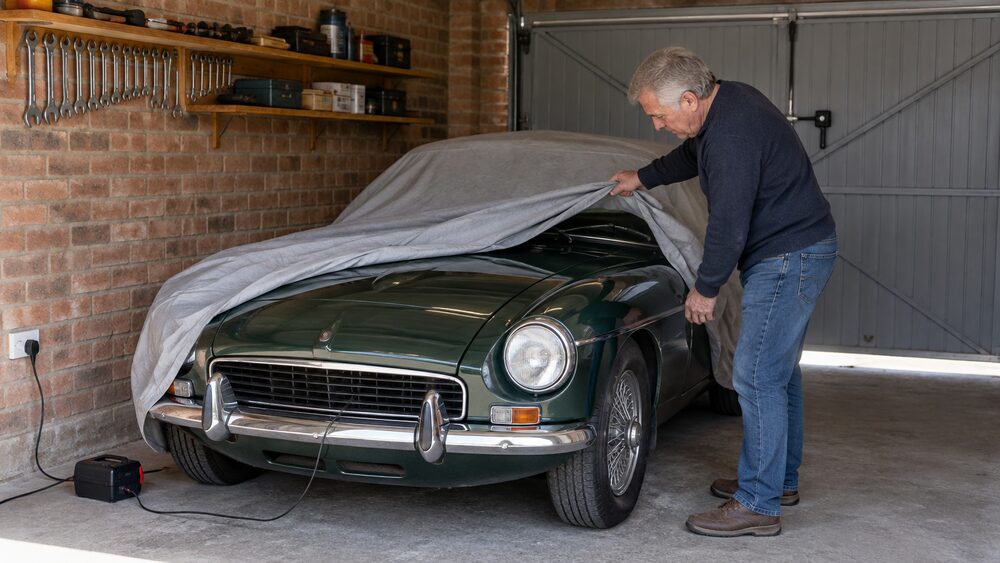
Classic car insurance is cover built around a car you keep and value rather than one you drive every day. A car can be classed as classic if it is more than 15 years old and has a value of at least £15,000, and classic car insurance is not suitable for a vehicle you use frequently1. As with ordinary car insurance, there are usually three levels of cover to choose from: third party only, third party fire and theft, and comprehensive1.
The trade-off is use. Because the car is not a daily driver, insurers price on limited mileage, storage and condition rather than on the commuting and business miles that drive an ordinary premium. In return, most classic policies include a garaging clause, which means the car must be stored in a garage between specific times when it is at your home address1. Policies commonly allow up to 90 days in Europe, with options to buy cover for longer stays1.
This page sets out what counts as a classic, the three levels of cover, how storage and use conditions work, what is and is not covered at shows and track events, driving abroad, and how premiums are set when there is no no claims bonus to bring across.
What counts as a classic car: over 15 years old and worth at least £15,000
There is no single legal definition of a classic car for insurance. The working rule used in the market is age plus value: a car can be classed as classic if it is more than 15 years old and has a value of at least £15,0001. Age alone is not enough, and value alone is not enough.
The second test is use. Classic car insurance is not suitable for a vehicle you use frequently1. Insurers expect the car to be a second or occasional vehicle, kept off the road for most of the year, and they price on that basis. A car that is more than 15 years old and worth at least £15,000, used for the daily commute, is not what this cover is designed for1.
Where a car is off the road entirely, laid up cover insures classic cars that are no longer driven on the road but still require damage, fire and theft insurance, including SORN vehicles, race cars and vehicles in restoration1. That is a different product from a road policy, and it is the route for a project car that is not being driven at all.
Some insurers set their own boundaries. Aviva and Hagerty classic car insurance, for example, requires the car not to have a Gross Vehicle Weight greater than 3.5 tonnes or be used on the water2. High-value motor policies exist for luxury vehicles alongside bespoke classic policies, and one such policy covers a total vehicle collection value of £15 million3.
Three levels of cover: third party, fire and theft, comprehensive
The structure mirrors ordinary car insurance. Third party insurance is the minimum level of insurance the law allows, but it only covers damage to other people, their vehicles and property4. It does not pay for repairs to your own car, and it is the minimum level of cover required5.
Third party fire and theft adds two things. It will not pay out to cover damage to your vehicle after an accident or act of vandalism6. If your insurance is third party only or third party, fire and theft, storm or flood damage to your own car is not covered7.
Comprehensive is the highest level of protection available and covers third party costs and damage to your vehicle8. Comprehensive policies can be extended with optional extras such as breakdown cover and extra cover for legal expenses, such as Motor Legal Protection9. Legal cover for car insurance is an optional extra and is not a legal requirement like standard car insurance10.
| Level of cover | Other people and their property | Your car: fire and theft | Your car: accident damage |
|---|---|---|---|
| Third party only | Yes | No | No |
| Third party, fire and theft | Yes | Yes | No |
| Comprehensive | Yes | Yes | Yes |
Cover levels and their scope as set out by the Northern Ireland government and independent guidance11.
Classic cover suits a car you don't use every day
The defining feature of a classic policy is the assumption of low use. Classic car insurance is not suitable for a vehicle you use frequently1, and the discount structure reflects that: insurers often give a discount on your premium in other ways, for example if you limit your mileage1.
That has practical consequences. A limited-mileage policy is cheaper because the car spends most of its time off the road, but it also means the cover is built around that pattern. If the car becomes a daily driver, the policy is no longer the right shape for the risk, and the insurer needs to know.
Laid up cover is the other end of the same idea. It insures classic cars that are no longer driven on the road but still require damage, fire and theft insurance, including SORN vehicles, race cars and vehicles in restoration1. Aviva and Hagerty offer protection against fire, damage and theft when your car is off the road2.
For campervans, some insurers do not split the product at all. NFU Mutual provides the same coverage for all campervans, as long as it is roadworthy, and bases the quote on the age of the vehicle, with no specialist insurance needed, including vintage models such as a T2 VW Transporter12.
Garaging and storage conditions
Most classic car insurance policies include a garaging clause, which means your classic car must be stored in a garage between specific times when it is at your home address1. The clause is not decorative. It is a condition of the cover, and breaching it can affect a theft claim.
The Financial Ombudsman Service has looked at how these terms are applied. It is common for motorcycle policies, as well as some high value car insurance policies, to require a vehicle to be kept in a locked garage when at the address on the policy schedule; many policies require garaging at all times unless in use, others only overnight, and motorcycle policies can require additional security conditions such as engaging the steering lock while parked13. The ombudsman generally thinks these terms are reasonable, but they should be adequately highlighted when sold13.
There is a counterweight. Most motor insurance policies have an exclusion saying people should take reasonable care to protect their vehicle from loss or damage; if there is no evidence the customer recognised the risk, the ombudsman might say they have not been reckless and it is unfair to apply the exclusion13.
Storage also affects price in the other direction. Premiums may be reduced by parking in a garage or driveway, Thatcham-approved security devices, low annual mileage, a cheap-to-repair popular model, advanced driving training such as Pass Plus, paying annually, and a no claims discount5.
Cover for shows, track events and spare parts
A number of classic car insurance policies protect your car if you take it to a car show, exhibition or track event, but not for mishaps while driving a vehicle not named on the policy1. That distinction matters: the cover follows the named car, not whatever you happen to be driving on the day.
Racing is a different matter. On Aviva and Hagerty classic car insurance, if you are taking part in or preparing for racing, rallies, trials or speed-testing in an organised or pre-arranged event, you are not covered for loss or damage2. A track day run as an organised event can fall inside that exclusion, so the terms of the specific policy decide.
Spare parts are covered by some insurers. Some classic car insurers will cover the cost of spare parts that you already own for your classic car, with limited cover levels and optional additional cover1. Parts and garage cover is also sold as a standalone product by some providers14. Where parts are fitted to the car, cover usually runs for the length of the guarantee given by the part manufacturer or supplier, and wear and tear is not covered15.
Personal number plates attract their own limit on at least one classic policy, with up to £5,000 cover if your personal plate is stolen2. Personal accident cover of £10,000 for death, or loss of limbs or eyes, is included for you or a named insured person on the same policy2.
Driving a classic abroad: up to 90 days in Europe
It is fairly common for policies to allow you to spend up to 90 days on the continent, although there are often options to buy cover for longer stays1. That is the classic market norm, and it is more generous than many ordinary car policies.
The range across standard policies shows how much this varies. Post Office Over 50s Car Insurance gives cover while travelling within the EU to the same level as your UK cover, up to a maximum of 60 days in any period of insurance16. Santander Car Insurance gives up to 60 days cover at the same level as your UK car insurance policy17. Sainsbury's Money car insurance covers you to drive in certain European countries for up to 35 or 90 days depending on which policy you choose6. esure gives the same cover for 90 days as you have in the UK, at no extra cost, when driving in the listed countries18, and its policy allows up to 90 days cover per policy year19.
There is a trap in the minimum legal cover. Basic cover abroad does not automatically include theft or damage to your car11, and the same exclusion appears in industry guidance: nor will it cover you for theft or damage to your car20. If you want the car itself protected while it is parked abroad, that has to come from the policy's own overseas cover, not from the legal minimum.
It is also worth asking whether the insurer needs to be told. Industry guidance suggests asking your broker if you have the option for cover while driving in the EU/EEA and if it is necessary to tell insurers about journeys to Europe of less than 30 days20.
How premiums are set without a no claims bonus
Classic policies usually do not build up a no claims bonus. Insurers often give a discount on your premium in other ways, for example if you limit your mileage1. That is the main lever on a classic policy, alongside storage, security and the value of the car.
On ordinary motor policies the mechanics are different. For every year of driving without making an insurance claim, a policyholder is awarded one year of no claims bonuses21, and an extra year is only added if you have not had any claims in the policy year21. The first year usually amounts to a reduction of 30% on your premium22. A no claims bonus is a rebate of premium given to an insured person by an insurer where no claims have been made by that insured, and it is very common in motor insurance23.
Where a classic policy does carry some form of no claims recognition, the rules vary. No claims bonuses and the way they are applied varies between insurers, so each case is looked at individually24. Only one person can be the main driver on an insurance policy, and the other named driver cannot themselves build up more no-claims years on the policy, though some insurers reward named drivers who do not claim, but only if they renew with the same insurer25.
Age is the other big input. Insurers generally apply a basic rate to drivers aged 30 to 49; if you are younger than that, your premium is likely to be higher due to the higher risk posed, and if you are older, you could qualify for a discount22. It is possible to get classic car insurance if you are a younger driver under 25, but you will probably pay more than older drivers1.
Fees are worth checking separately from the premium. On one set of scored car policies, a Plus policy scored 80% on fees with a £30 setup fee and a £30 renewal fee, a Cover + policy scored 77% with a £25 offline change fee, and an Extra policy scored 69% with a £10 change fee, a £50 renewal fee and a £15 payment default fee26. esure charged £15 for making a policy change yourself on policies bought or renewed before 28 February 202527.
If something goes wrong
The first step on any claim is speed. You need to contact your insurer as soon as possible to avoid any delays in processing your claim1. For a theft, that means gathering supporting evidence, notifying the police and getting a crime reference number, and submitting the claim as soon as possible1.
If a repair is at issue rather than a theft, the picture is different. You might lose your no claims bonus if you claim for the damage on your car insurance28, and you do not have to submit your claim to your insurer if you pay for repairs yourself or recover them from the other driver, if you wish to preserve your no claims discount29. A failure to report an accident can give your insurance company the right to refuse to cover you in the future, so the choice not to claim is not the same as the choice not to tell29.
Where an insurer withholds a no claims bonus, the ombudsman's position is that it does not think it is fair for your insurer to withhold a no claims bonus you have earned, but it might not interfere if they have done this because you owe them money21. If a claim is settled with the policyholder at fault, the insurer should release proof of no-claims bonus, taking off a loss of discount for the claim, and should not withhold a no claims bonus which has been earned24.
On the protection side, the Financial Services Compensation Scheme protects 100% of any compulsory element of insurance, such as third-party car insurance30. For compulsory insurance such as Third Party Car Insurance, a claim would be covered in full without any upper limit31.
Free, impartial help is available. The Financial Ombudsman Service handles complaints about motor insurance, including vehicle theft claims and disputes about fault claims and no claims bonuses13. MoneyHelper and Citizens Advice offer free guidance on consumer problems, including problems with a car repair32.
Sources32 cited
- Classic car insurance explained Which?, 2026-01-22
- Classic car insurance Aviva, 2026-09-26
- High value motor insurance Hiscox, 2026
- Which insurance policies are worth keeping Which?, 2023-08-07
- Shopping around for insurance Independent Age, 2026-09-26
- Car insurance Sainsbury's Bank, 2026-09-25
- Is your car covered for flood damage Which?, 2025-11-08
- Type of car insurance cover Aviva, 2026-09-26
- Third party only esure, 2026
- Legal cover with car insurance AXA, 2026-09-26
- Motor insurance explained nidirect, 2026-05-27
- Campervan insurance NFU Mutual, 2026-09-26
- Vehicle theft Financial Ombudsman Service, 2026-09-16
- Breakdown cover contract information The AA, 2026-09-28
- Electric car insurance Aviva, 2026-09-26
- Over 50s car insurance Post Office, 2026
- Car insurance Santander, 2026
- Driving abroad esure, 2026
- Motor policy booklet esure, 2025
- Driving abroad British Insurance Brokers' Association, 2023-02-13
- No claims bonus British Insurance Brokers' Association, 2023-02-13
- How much will it cost British Insurance Brokers' Association, 2026-09-26
- Jargon buster British Insurance Brokers' Association, 2025-02-11
- Fault claims and no claims bonuses Financial Ombudsman Service, 2026-09-16
- Can we both accumulate no claims discounts driving the same car Which?, 2025-01-06
- Car insurance add-ons, fees and charges Which?, 2025-12
- Past esure car insurance administration fees esure, 2026
- Problems with a car repair Citizens Advice, 2026-09-25
- I've been in a car accident, do I have to claim on my insurance Which?, 2026-03-31
- FSCS protecting your money Virgin Money, 2026
- AA home insurance about the AAIS The AA, 2026-07
- Fault claims and no claims bonuses Financial Ombudsman Service, 2026-09-16

 MoneyHelperFree, impartial money and pensions guidance, set up by government
 Financial Ombudsman ServiceFree, independent help when a complaint about a firm is not put right
 FSCSProtects your money if a bank, insurer or investment firm fails
 Citizens AdviceFree advice on money, consumer and legal problems in England and Wales
 GOV.UKOfficial information on tax, benefits and government services