Scottish Child Payment is a weekly payment of £28.20 for each child under 16, paid to low-income families living in Scotland1. It is paid by Social Security Scotland, the executive agency of the Scottish Government, and to qualify you or your partner must receive one of a short list of benefits, such as Universal Credit, Income Support or Pension Credit1. There is no limit on the number of children in a family who can get it, so a family with three eligible children receives three payments1.
The payment is not taxable and does not reduce any other UK or Scottish Government benefits you receive2. It is paid every four weeks, which works out at £112.80 per child for each four-week payment1. As of 30 June 2026, 320,390 children were actively benefitting from the payment, and over £1.7 billion has been issued since it launched3.
The payment opened for applications in November 2020 and was first paid from 15 February 2021, initially only for families with children under six2. It was extended to all children aged under 16 on 14 November 20224.
Scottish Child Payment: £28.20 a week for each child under 16
Scottish Child Payment is a payment to help low-income families with children under 161. It is worth £28.20 per week for each child in an eligible family, up until their 16th birthday5. The rate is reviewed on a yearly basis, so it could increase1.
The payment started at £10 a week per child when it was introduced, with no limit to the number of eligible children4. It has risen since, and the current rate of £28.20 applies from April 2026 to April 20276. The Joseph Rowntree Foundation, which reviewed the payment's design, recommended a "double-lock" to protect its value each year, increasing it by the higher of earnings growth or the inflation rate faced by low-income families7.
The scale of the payment is substantial. As of 30 June 2026, 188,255 clients were actively in receipt, and 320,390 children aged 0 to 15 years were benefitting3. Over 10.5 million payments have been issued to 251,510 individual clients since launch, and £118.3 million was paid in the April to June 2026 quarter alone3. The highest number of children benefitting as of June 2026 was in Glasgow City at 53,020 (17%), followed by North Lanarkshire at 24,550 (8%) and Fife at 23,940 (7%)3.
There is no restriction on what the money is spent on. It can be used for anything that incurs a cost while raising a child, for example childcare, clothes, nappies or family days out8.
Who can get it: qualifying benefits and the 14-day rule
To get Scottish Child Payment you must live in Scotland, and you or your partner must be responsible for a child under 161. You must also receive one of the following qualifying benefits1:
- Universal Credit
- Income Support
- Pension Credit
- Job Seeker's Allowance (income based)
- Employment Support Allowance (income related)
Child Benefit on its own is not an accepted benefit for Scottish Child Payment9. The person responsible for the child, or their partner, can apply, and this includes kinship carers1. A kinship carer can apply if they can show they look after the child, with a letter from the local authority or a copy of a legal order such as a Kinship Care Order, a Residence Order or a Guardianship Order10.
There is a timing rule that catches some families out. The qualifying benefit must be awarded within 14 days of the Scottish Child Payment application being made1. If a decision on your qualifying benefit is not made within 14 days, Social Security Scotland will decide you are not entitled to Scottish Child Payment, and you would need to reapply once the qualifying benefit is in place11. You can apply before the Department for Work and Pensions has approved your qualifying benefit, but Social Security Scotland must wait until that benefit is awarded before processing the application1.
Two special rules extend eligibility further:
- Nil awards from sanctions. If your Universal Credit is reduced to £0 by a sanction or a deduction, you can still get Scottish Child Payment11. The regulations were changed specifically so that people with a nil award of a qualifying benefit as a result of sanctions or deductions remain eligible4. You may need evidence, such as a Universal Credit statement or a DWP benefit award letter showing the sanction or deduction9. If a sanction or deduction happens while you are already getting the payment, you must tell Social Security Scotland, as you might still meet the conditions9.
- Run-on after a qualifying benefit stops. The qualifying benefits allow a run-on of up to 12 weeks of payment in the same circumstances, which protects families during short gaps12.
You cannot get Scottish Child Payment for a child you are fostering, and the same applies to Child Benefit13. Foster carers normally receive support for the child through their fostering service instead.
How payments work: every four weeks, no part payments
Scottish Child Payment is paid every four weeks, directly into your bank account10. Because the weekly rate is £28.20, each four-week payment is £112.80 for each eligible child1.
There are no part payments. As long as you are eligible for one day in a week, you receive a full payment for that week11. This matters at the start and end of an award: if your qualifying benefit starts mid-week, or your child's 16th birthday falls part-way through a payment period, the week still counts in full.
Your first payment may be different from the payments that follow it, and Social Security Scotland will tell you when to expect it8. This can happen because the first payment covers the period from your application date, which may not line up exactly with the four-week cycle that follows.
The four-weekly frequency was a design choice that not everyone welcomed. The Joseph Rowntree Foundation recommended the payment be made fortnightly rather than four-weekly, with a choice of payment frequency for families developed over time7. As it stands, four-weekly is the only frequency offered.
How to apply for Scottish Child Payment
Applications can be made in four ways1:
- Online, through mygov.scot4
- By phone
- By paper application form
- Through local delivery, where someone from Social Security Scotland can help you in person
Around 91% of applications received by 30 June 2026 were made online, and 7% were made through a telephone application3.
There are some limits on applying online. You cannot apply online if you do not have a bank account and need to be paid another way, or if you are applying for someone else, for example as an appointee or a legal acting body1. The online form must also be completed all at once, as there is no save and resume function1. If you already get Scottish Child Payment for children under 6, you can add other children to your existing claim online or by calling 0800 182 222210.
You can apply before your qualifying benefit has been approved, but as explained above, the qualifying benefit must be awarded within 14 days of the application for it to proceed1. If you include your mobile number, you will receive a text every two weeks updating you on the progress of your application until you receive your decision letter10.
How long a decision takes and when an award starts
A decision about your application can take up to 2 months11. In practice, official statistics show the median processing time was 32 working days between April and June 2026, compared with 22 working days in the 2025/2026 financial year as a whole3.
Social Security Scotland aims to make a decision after getting your completed application and any further information it needs1. The decision letter is called a notice of determination, and the law says it must be clear and accessible and give guidance and explanations about the decision that has been made1.
Scottish Child Payment cannot usually be backdated. The date your application is received by Social Security Scotland is normally the date your award starts11. The one exception noted in the guidance is where the reason you did not apply sooner was related to coronavirus11. This makes the timing of an application important: applying while a qualifying benefit decision is still pending carries the 14-day risk described above, but waiting until everything is confirmed means the award starts from the later date.
The volume of applications gives a sense of how the system is performing. 9,090 applications were received between April and June 2026, and 460,660 have been received since launch3. Of the 8,725 applications processed in that quarter, 71% were authorised, 26% were denied and 3% were withdrawn3. Authorisation rates varied by area, from 62% in East Ayrshire and the Orkney Islands to 79% in the Shetland Islands3.
Changes you must report, and when payments stop
A change in circumstances must be reported to Social Security Scotland promptly8. Changes that must be reported include8:
- Stopping living in Scotland
- Your benefits stopping
- Name changes
- Bank or contact details changing
- Moving house
- Starting to look after another child
Social Security Scotland's own guidance makes the same point: people need to let the agency know if their circumstances change at any point, including changes to what benefits someone gets or where they live14. If you are not sure whether a change needs to be reported, you can call and ask1. Social Security Scotland will contact you to let you know if the changes you reported may affect your payments and if more information is needed to make a decision1.
The most common reason payments stop is a child turning 16. Social Security Scotland will send a letter 2 months before your child's 16th birthday telling you that the payment will stop soon11. The payment stops after the 16th birthday, but a payment is still made for the week the child turns 168.
Payments can also be suspended in specific circumstances. The legislation provides that the Scottish Ministers may suspend payment to protect an individual from the risk of financial abuse, or where the person receiving the payment on the individual's behalf cannot continue. The individual may require a review, which must be completed within 31 days15.
If a child to whom a claim relates dies, the rules provide for a payment equivalent to the value of the Scottish Child Payments made in the 12 weeks prior to the child's death12. In practice this means you get the amount you received in the 12 weeks before the child died, multiplied by 211. After a death, Social Security Scotland should be contacted to cancel the person's benefits and entitlements from the Scottish Government, including Scottish Child Payment16.
Getting a decision looked at again: redetermination and appeal
A decision on a claim that a person disagrees with can first be looked at again by Social Security Scotland. This is called a redetermination6. If the disagreement continues after the redetermination, an appeal can be made to the First-tier Tribunal6. An appeal form and instructions on how to appeal come with the redetermination decision6.
The time limit for asking for a redetermination is normally 31 days from the date of the decision you are challenging17. You have 31 days from the day you got the decision letter to ask for a redetermination, and this period can be extended to up to 12 months if you have a good reason11. The time limit for an appeal is also normally 31 days, and it too can be extended to one year, but only if you have good reason for a late request17. If you miss the deadline, you can still make a late request, but you will need to explain why it is late6.
The process is used relatively rarely. By 30 June 2026, 8,150 redetermination requests had been received since launch, and 380 appeals in total3. Of the 330 redeterminations completed in the 2026/2027 financial year to date, 170 were allowed, 120 were disallowed, 40 resulted in no decision being made, and none were withdrawn3. The median response time for redetermination requests in that period was 14 working days3. Of the 265 appeals completed by 30 June 2026, 95 (35%) were upheld in clients' favour and 175 (65%) were not3.
Free help is available with challenging a decision. The general guide to challenging a decision explains the redetermination process across benefits, and appealing to a tribunal covers the tribunal stage. If you miss the usual deadline, appealing after the deadline explains when a late request can be accepted.
Overpayments and paying money back
If you are paid a Scottish Child Payment by mistake, or you are paid too much, you might have to pay the money back to Social Security Scotland11. This is why reporting changes promptly matters: an unreported change that continues payments you are no longer entitled to can build up a debt.
The rules include some protections for families in difficult situations. Where a change of circumstances ends an award, reinstatement is allowed within 12 weeks of the effective change, rather than within 12 weeks of the original determination12. This gives a family whose circumstances change again (for example, a qualifying benefit being reinstated) a window to get the payment back without a fresh claim.
If you are already getting Scottish Child Payment for one child and you become responsible for another child, let Social Security Scotland know. Your existing award should be reviewed and an extra payment added, and you may be asked to complete a change of circumstances form18. Doing this promptly avoids both a gap in payment for the new child and the risk of an overpayment later being recovered.
If you disagree that an overpayment exists, or with the amount, the redetermination and appeal route described above applies to that decision too6.
Other family support alongside Scottish Child Payment
Scottish Child Payment is one of the 5 family payments you may be able to get from Social Security Scotland19. The others include Best Start Grant and Best Start Foods, and together they are designed to support families at different stages of a child's life19.
Two of the Best Start Grant payments are now automatic. If you get Scottish Child Payment and your child meets the age conditions, Social Security Scotland automatically pays the Best Start Grant Early Learning Payment and School Age Payment without the need to apply20. Auto-awards for these payments were introduced in November 2022 for people already receiving Scottish Child Payment2.
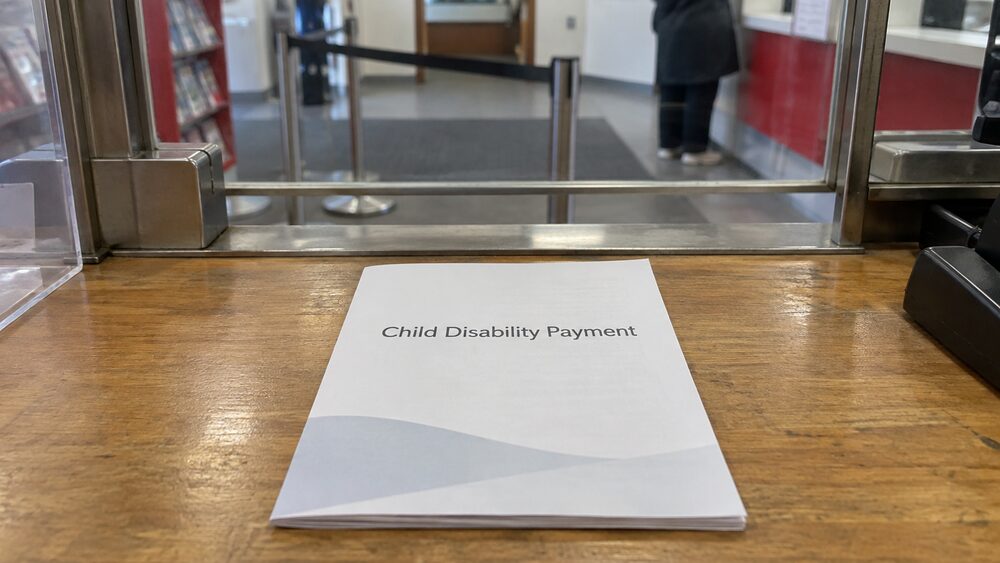
The payment is intended to work as a gateway to other support. The Joseph Rowntree Foundation recommended it act as a "gateway" to other forms of support for low-income families7. Families getting Scottish Child Payment may also qualify for help such as Child Benefit, Child Disability Payment, the Scottish Welfare Fund, Council Tax Reduction and help with rent. The guide to passported help explains what a qualifying award can unlock, and checking what you are entitled to lists free calculators and advisers.
Because Scottish Child Payment does not affect other benefits, it sits on top of this wider support rather than replacing any of it2.
Scottish Child Payment across the UK
Scottish Child Payment exists only in Scotland: to get it, the client must live in Scotland1. It is part of the Scottish Government's social security powers, administered by Social Security Scotland through an application-based process4. Families in England, Wales and Northern Ireland have no equivalent weekly payment, though UK-wide support such as Child Benefit and the child elements of Universal Credit continues to apply.
The Scottish Government's evaluation of the payment found that it does not negatively affect labour market participation at scale in the economy, addressing a concern sometimes raised about income top-ups2. The evaluation also found the payment has an impact on education for around 1 in 10 recipients or their partners2.
If your family moves between Scotland and the rest of the UK, your Scottish Child Payment will stop once you are no longer living in Scotland, which is one of the changes you must report8. The guide to disability and carer payments when moving between Scotland and the rest of the UK explains how the Scottish and UK systems connect, and the wider guide to money in Scotland sets out how the rules differ across the nations.
Contacting Social Security Scotland and getting help
You can call Social Security Scotland free on 0800 182 222221. Calls to this number are free22. Other ways to get in touch14:
- Text Relay: 18001 followed by 0300 244 4000, for people who are hard of hearing
- Webchat: chat.socialsecurity.gov.scot
- British Sign Language: the Contact Scotland video relay service
The same freephone number can be used to apply, to report a change of circumstances, to add a child to an existing claim, or to ask any question about the payment10. If you are not sure whether you need to tell Social Security Scotland about a change, or you need help completing a change of circumstances form, call and ask1.
After a bereavement, Social Security Scotland should be contacted to cancel the person's benefits and entitlements from the Scottish Government, including Scottish Child Payment; they can also check whether you are eligible for help with funeral costs16. The guide to help with funeral costs across the UK covers that support in detail.
Sources22 cited
- Scottish Child Payment guidance Social Security Scotland, 2026
- Evaluation of five family payments Scottish Government, September 2025
- Scottish Child Payment statistics to 30 June 2026 Social Security Scotland, August 2026
- Scottish Child Payment policy Scottish Government, 2026
- Benefits while studying: financial help in higher education One Parent Families Scotland, April 2026
- How do I challenge a Scottish Child Payment decision Turn2us, May 2026
- Making the most of the Scottish Child Payment Joseph Rowntree Foundation, October 2019
- Scottish Child Payment Mental Health and Money Advice, July 2025
- Scottish Child Payment: who should apply mygov.scot, November 2022
- Scottish Child Payment: benefits from the Scottish Government One Parent Families Scotland, April 2026
- Scottish Child Payment: help if on a low income Citizens Advice Scotland, 2026
- Social Security Miscellaneous Amendment and Transitional Provision Regulations 2022: impact assessment summary Scottish Government, October 2022
- Foster carers and benefits: can I get any other benefits Turn2us, September 2026
- Five Family Payments factsheet Social Security Scotland, 2025
- The Scottish Child Payment Regulations 2020 legislation.gov.uk, November 2020
- Report a death without Tell Us Once GOV.UK, 2026
- Challenging decisions Contact, May 2026
- Scottish Child Payment Contact, October 2025
- Scottish Child Payment mygov.scot, November 2022
- Other benefits you might be able to get mygov.scot, November 2022
- Pension Age Disability Payment factsheet Social Security Scotland, March 2026
- How do I claim a Scottish Child Payment Turn2us, May 2026


 Turn2usFree benefits calculator and grants search from a charity
 Citizens AdviceFree advice on money, consumer and legal problems in England and Wales
 GOV.UKOfficial information on tax, benefits and government services
 MoneyHelperFree, impartial money and pensions guidance, set up by government