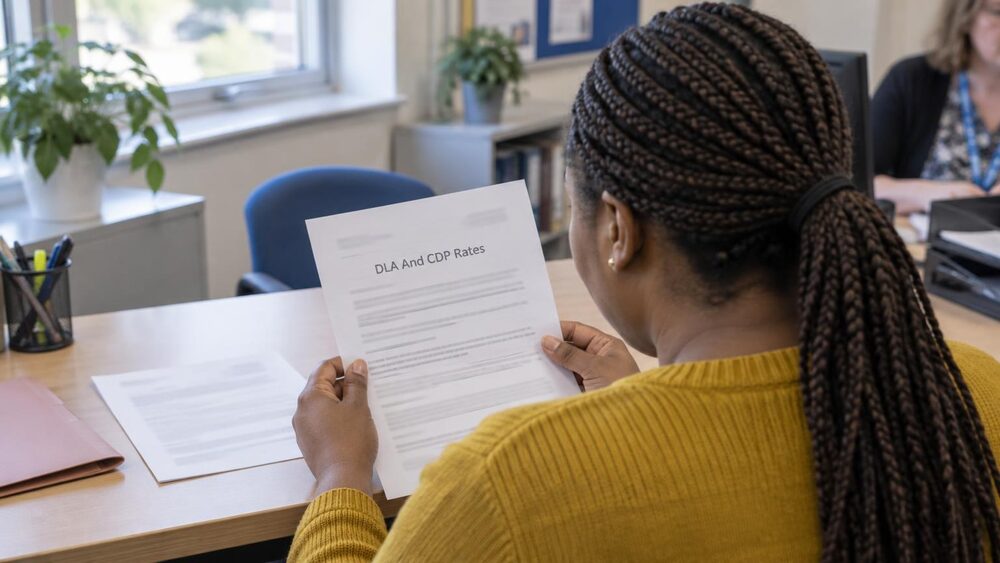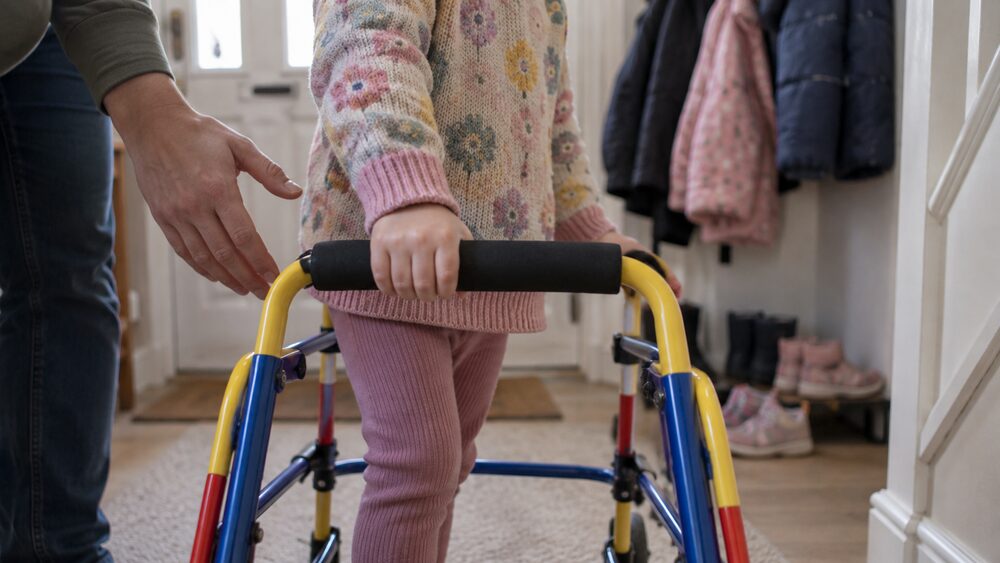
Disability Living Allowance (DLA) is a benefit that helps with the extra costs of looking after a child who is under 16, has difficulties walking or needs much more looking after than a child of the same age without a disability1. The weekly rate is between £30.30 and £194.60, depending on how much help the child needs1. It is paid on top of any other income, it is tax-free, and it is not means-tested, so it does not matter what you earn or have in savings.
New claims from adults are no longer possible: DLA has been abolished for new claims from people aged between 16 and State Pension age2. Adults are still in receipt of DLA, but new claims can only be made for children3. So today DLA matters in two situations: claiming for a disabled child, and being an existing adult claimant whose award has continued from before the replacement began.
Who can still get Disability Living Allowance
For children, DLA is open to a child who is under 16 and has difficulties walking or needs much more looking after than a child of the same age who does not have a disability1. A child can claim if they are under 16, disabled and need extra help to look after themselves or have difficulty walking or getting around8. No formal diagnosis is needed: you can apply even if your child does not have one9.
For adults, the position depends on age and on when the claim started. DLA has been abolished for all new claims from people aged between 16 and State Pension age10. People who were over 65 on 8 April 2013 continue to receive DLA for as long as they are eligible11, and those born on or before 8 April 1948 can continue to receive it as long as they still have care or mobility needs12. Existing claimants can also continue to get DLA when they become a part-time student, as long as they still meet the criteria13.
In Scotland, DLA for both children and adults has been replaced by Scottish benefits, covered later in this page. In England, Wales and Northern Ireland, the practical rule is simple: if you are claiming for a child under 16, DLA is the benefit to claim; if you are over 16, you cannot claim DLA but may be eligible for Personal Independence Payment instead14.
Care and mobility: the two parts of DLA
DLA is made up of two components: care and mobility4. A child may be eligible for one or both15. The care component pays for the extra looking after a child needs, and the mobility component pays for help with getting around.
The care component has three rates, and which one applies depends on how much extra care the child needs during the day and night. The mobility component has two rates. Help with mobility applies to children whose problems getting around are caused by learning or behavioural conditions as well as physical disability16, so a child does not need a physical condition to qualify.
There are minimum ages for the mobility component. You cannot claim it before your child reaches the age of three for the higher rate, or the age of five for the lower rate10. The care component can be claimed from the age of three months, or from birth if your child has a terminal illness7.
If your child's condition varies, they can still get DLA as long as there is a pattern of substantial care needs or mobility problems16. Fluctuating conditions do not rule out a claim; what matters is the overall pattern of need over time rather than a constant level of difficulty.
DLA rates: from £30.30 to £194.60 a week
The rates below apply from 6 April 202617. A child receiving both components at the highest rates would receive the maximum of £194.60 a week, the sum of the highest care rate and the higher mobility rate.
| Component | Rate | Weekly amount from 6 April 2026 |
|---|---|---|
| Care | Highest | £114.6017 |
| Care | Middle | £76.7017 |
| Care | Lowest | £30.3017 |
| Mobility | Higher | £80.0017 |
| Mobility | Lower | £30.3017 |
The official benefit and pension rates for 2026/27 confirm the same figures, with the care component's lowest rate rising from £29.20 to £30.3018. DLA is usually paid every four weeks19, and payments are normally made every four weeks in arrears into the account given as part of the claim20. Awards are usually made for a minimum of six months, or longer if the child continues to have care needs19. Some awards are indefinite, where the payment is ongoing, while others are fixed for a set period9.
The three-month and six-month qualifying rules
A DLA award does not start from the day a need first appears. Your child must have needed extra help for the past three months and be expected to need extra help for at least the next six months5. In other words, the child needs to have met the disability tests for three months before they can be paid, and must also be likely to continue to meet these tests for at least six months after the start of the award8.
The claim form asks for the date your child first started to have the care needs you describe, and that date is where the three-month period is measured from16. The same structure applies in Scotland's Child Disability Payment, where an applicant must have lived with a disability or long-term health condition for at least three months and be expected to continue for at least six months21.
There is one main exception. An exception to the three-month rule is made if a child is terminally ill under the special rules16. Claims under the special rules are handled differently and more quickly, and are covered under how to claim below.
How to claim DLA for a child
A claim starts by ordering or requesting the claim form. You can make an initial claim by calling the Disability Living Allowance Helpline on 0800 121 4600 (textphone: 0800 012 1574)22. Order a claim form from the DLA Unit by calling 0800 121 4600, or 0800 587 0912 in Northern Ireland. You have six weeks to complete the form and post it to the Department for Work and Pensions (DWP)7.
The form is long, and the answers matter more than the diagnosis. The DWP will ask for information about the child's health condition or disability, how much extra help the child needs, and whether the child can walk or move about23. Some parts of the form deserve particular attention:
- Question 38 can be filled in by a paid carer, relative or friend, health care professional, social worker or a teacher, ideally a professional with regular involvement in the child's care16.
- Questions 46 to 47 cover help to communicate with other people16.
- Question 52 should be completed to receive information about the Motability scheme, which allows higher rate mobility money to lease a car or wheelchair16.
- Question 65 covers blackouts, fits and seizures, including fits, convulsions, fainting, dizziness, loss of consciousness, or asthma attacks16.
- Question 71 asks the date the child first started to have the care needs described16.
- If the tick boxes are not enough, use the extra text boxes on pages 19, 34 and 37 to provide more information16.
Any document, letter or statement can be sent with the claim, but it is very important to check that any evidence sent accurately describes the child's needs, or it may harm the claim16. After the form is sent, an acknowledgement is normally issued within two weeks and a decision usually follows within three months7. If the decision maker is unclear about the child's needs, they can arrange for a DWP approved doctor to visit, examine the child and prepare a medical report, and this can lead to delays16.
Under the special rules for terminally ill children in England, Wales and Northern Ireland, a doctor or another health professional must complete an SR1 form10. If doctors say a child is terminally ill and reasonably expected to die within twelve months, the highest rate of the care component is paid automatically under the special rules10.
One group should also know about a specific review route. Families affected by the DLA congenital heart disease administrative exercise can contact Disability Living Allowance for children and ask for a review, quoting 'DLA CHD administrative exercise', by phone on 0800 904 7413 or by post24.
Tax-free, not means-tested and ignored as income
DLA is a tax-free benefit, so you will not have to pay tax on it if you qualify22. It is not taxable for adult recipients either25. It is paid in addition to other benefits and is not treated as income12.
The benefit is not means-tested, so it does not matter what other income or savings you have4. When a review takes place to see if a child is eligible, your income or savings are not taken into account22. This is why a parent starting work, increasing hours or saving money does not reduce a child's DLA: the award depends only on the child's care and mobility needs.
DLA is also ignored as income for Housing Benefit12, and the same principle applies across the main disability benefits, where any income, including student grants or loans, and savings are ignored13. This treatment is what makes DLA a foundation benefit: it adds to household income rather than displacing other support.
How DLA can increase other benefits
DLA will not reduce any other benefits you are receiving. In fact, it could even increase them, and it may also help you qualify for benefits such as Universal Credit or Carer's Allowance for the first time22. When a child is awarded DLA, you may be entitled to extra amounts in other benefits you receive, or become entitled to a new benefit for the first time4.
The mechanism is straightforward. Means-tested benefits such as Universal Credit include extra elements for a disabled child, and a DLA award is usually the evidence that unlocks them. Separately, caring for a child receiving the care component at the middle or highest rate can open a claim for Carer's Allowance, subject to its own earnings limit. The knock-on effects are why many families find a DLA award changes their household income by more than the DLA payment itself.
Because these extra amounts depend on the DLA award staying in place, it is worth reporting changes that affect the child's needs promptly. For a child's claim, you need to report changes like their address, the name of their doctor, if they need more help, and if their health condition changes23. More detail is in reporting a change of circumstances.
When DLA stops or changes: hospital, residential care and going abroad
DLA can stop or be suspended in particular circumstances, and knowing the triggers avoids surprises.
Hospital. For people aged 18 or over, DLA payments stop after 28 days in hospital26. After 28 days in hospital, payment of the mobility component of DLA will also stop for people who were living in a care home before going into hospital26. The stop is temporary: if payments stop, they will be paid again as soon as you come out of hospital, and you do not lose your entitlement26.
Residential care. For a child's claim, payments usually stop when the child spends 28 'linked' days in a residential care home, residential school or residential college, though the mobility component continues7. In Northern Ireland, if your local Trust is funding residential care or nursing home fees, both the care component and the mobility component of your DLA may be affected27. Moving into a home should not affect the mobility component of your DLA27. People who pay for the care home themselves can continue to receive the care and mobility parts of DLA28.
Going abroad. DLA is a benefit with residence conditions, and the rules on going abroad are set out in official guidance on social security abroad29. If your child moves from Scotland to England or Wales, a new claim for DLA for children is needed as soon as they move1. The general rules on holidays and moving overseas are covered in going abroad.
Renewals. Many children's awards are for a fixed period. Renewal claimants are usually contacted 20 weeks before the award is due to end15. You could miss out on payments if you return the renewal form after the end date15.
Turning 16: the move from DLA to PIP
DLA has been replaced by Personal Independence Payment (PIP) for people of working age, that is between the ages of 16 and State Pension age8. A child's DLA does not simply continue into adulthood: your child may move from DLA to PIP when they turn 1615.
The move is a fresh claim, not an automatic transfer. PIP has its own assessment, and the DLA award does not guarantee a PIP award at any particular rate. The differences between the two benefits, including how the assessment works and what the daily living and mobility activities cover, are set out in PIP vs DLA and in the guide to what happens to a child's DLA at 16. Because the claim is made by the young person rather than a parent, families often look at appointees and third parties if the young person cannot manage the claim themselves.
Existing adult claims and reassessment for PIP
Adults who have received DLA since before the replacement began keep their awards for now, but reassessment is built into the system. From 8 April 2013, the DWP started to replace DLA for working age people with PIP30. If you were under 65 on 8 April 2013, you will be reassessed for PIP at some point in the future11. If you live in England or Wales, you will get a letter telling you when this will happen and how you can apply for PIP2.
The reassessment is not triggered by a change in your condition: it follows the Department's own timetable, and the letter is the signal to act. Until that letter arrives, an existing award continues as long as you remain eligible. DLA is being replaced by other benefits, and the direction of travel is one-way: once reassessed, a claimant does not return to DLA2.
Disability benefits claimed under the special rules for terminal illness, including DLA, are backdated to when you applied, but not before14. For everyone else, the same rule applies: no payment is made for periods before the claim date.
Challenging a DLA decision
A DLA decision can be challenged, and the process has defined stages. You can challenge a decision about a DLA claim by asking for a mandatory reconsideration, where someone looks at the claim again23. The request must normally be made within one month of the date of the decision being challenged, by phone or in writing using form CRMR1 or a letter7. If you disagree with the DWP's decision after reconsideration, you can appeal it9.
The one-month deadline is the point most claimants lose their chance, so the date on the decision letter is the thing to check first. If the deadline has already passed, late challenges are sometimes possible, and appealing after the one-month deadline explains when. The stages are covered in more detail in challenging a decision and mandatory reconsideration vs tribunal appeal. If the complaint is about delay rather than the decision itself, you can complain to the customer services manager at the office dealing with the claim16, and complaining to the DWP and the Ombudsman sets out the escalation route.
Scotland and Northern Ireland: where the rules differ
There are differences to DLA if you live in other parts of the UK23. In England, Wales and Northern Ireland the benefit is DLA; in Scotland the equivalent benefits are Child Disability Payment and Adult Disability Payment4.
Scotland. Adult Disability Payment has replaced PIP and DLA for those aged between 16 and State Pension age32. It is made up of two parts, daily living and mobility, and people may qualify for one or both33. If you get PIP, it will be moved to Adult Disability Payment34. Scottish Adult Disability Living Allowance is for people who are over 18, already get DLA for adults from the DWP, and live in Scotland; there are no new applications35. Social Security Scotland publishes guidance for people moving to Scotland from the rest of the UK, covering how disability and carer benefits transfer36. The rules when crossing the border in either direction are explained in moving between Scotland and the rest of the UK, and the Scottish benefits are covered in Adult Disability Payment and Child Disability Payment.
Northern Ireland. DLA continues in Northern Ireland, administered locally, and the claim form is ordered on 0800 587 09127. The residential care rules differ in one respect from Great Britain: where a local Trust funds care home fees, both components may be affected27. People from abroad may also be eligible for Northern Ireland's DLA in certain circumstances37. Payments in Northern Ireland are made on the same every-four-weeks schedule20.
Where to get free help
The DLA claim form is long, and free help is available at every stage. The DLA helpline (0800 121 4600, or 0800 587 0912 in Northern Ireland) handles claims and queries7. Contact, the charity for families of disabled children, publishes detailed guidance on completing the form question by question16, and Scope publishes guidance on DLA claims and renewals9. Carers UK covers DLA alongside the benefits it unlocks for carers22, and Turn2us and Entitledto provide eligibility information and benefit calculators4. A free, independent benefits calculation before claiming is covered in checking what you are entitled to.
Sources37 cited
- Disability Living Allowance for children GOV.UK, 2026-09-25
- Disability Living Allowance (DLA) benefit GOV.UK, 2026-09-26
- Fraud and error in the benefit system, financial year ending 2024 Department for Work and Pensions, 2024-05-16
- Disability Living Allowance for children Entitledto, 2026-09-26
- How DLA care and mobility components work Advicenow, 2026-09
- Disability Living Allowance care component Entitledto, 2026-09-26
- Disability Living Allowance Contact, 2026-08-20
- Disability Living Allowance (DLA) Disability Rights UK, 2026-04-04
- Disability Living Allowance (DLA) Scope, 2026-01-26
- Can my child get DLA? Turn2us, 2026-06-24
- Changes to the benefit system Age UK, 2026-08-26
- Disability Living Allowance Age UK, 2026-08-26
- Can part-time students claim disability benefits? Turn2us, 2026-04-28
- Benefits if you are terminally ill Scope, 2025-10-27
- DLA renewals Scope, 2026-04-20
- Tips on completing the DLA form Contact, 2026-06-16
- The Social Security (Up-rating) Order 2026 legislation.gov.uk, 2026-03-02
- Benefit and pension rates 2026/2027 Department for Work and Pensions, 2026
- How much DLA will my child get? Turn2us, 2026-06-24
- How benefits and pensions are paid nidirect, 2026-07-15
- Child Disability Payment statistics to 30 June 2026 Social Security Scotland, 2026-08
- Disability Living Allowance Carers UK, 2026-09-26
- Disability Living Allowance Mencap, 2026
- Congenital heart disease: changes to DLA for children from 1 February 2017 GOV.UK, 2026-03-23
- What is Disability Living Allowance (DLA)? Turn2us, 2026-09-26
- Benefits that stop being paid if you go into hospital Turn2us, 2025-11-06
- Residential care and nursing homes and benefits nidirect, 2026-08-05
- Going into a care home: benefits GOV.UK, 2026-09-27
- Guidance on social security abroad NI38 GOV.UK, 2026-07-07
- Personal Independence Payment official statistics to April 2026 Department for Work and Pensions, 2026
- Paying for support for disabled children Sense, 2026-03
- Annual DWP Benefits Statistics Compendium: 2026 Department for Work and Pensions, 2026-09-15
- Adult Disability Payment factsheet Social Security Scotland, 2026
- Adult Disability Payment reviews: transferred from DWP mygov.scot, 2025-03-24
- Pension Age Disability Payment and Scottish Adult Disability Living Allowance statistics to 31 July 2026 Social Security Scotland, 2026-09
- Supporting clients moving to Scotland from the rest of the UK Social Security Scotland, 2026-01-27
- Child Disability Payment: applicants mygov.scot, 2025-08-21



 Turn2usFree benefits calculator and grants search from a charity
 Citizens AdviceFree advice on money, consumer and legal problems in England and Wales
 GOV.UKOfficial information on tax, benefits and government services
 MoneyHelperFree, impartial money and pensions guidance, set up by government