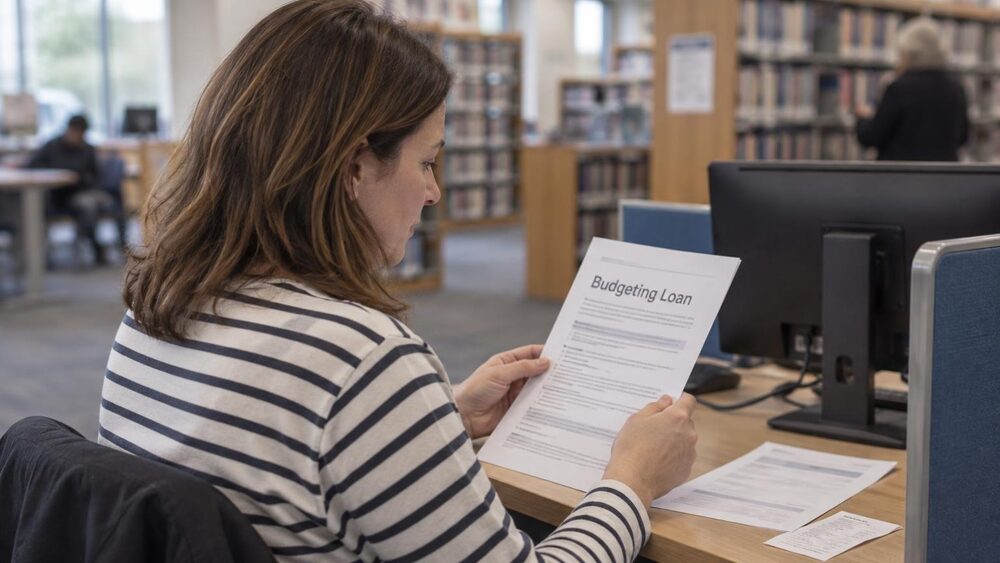
A Budgeting Advance and a Budgeting Loan are both interest-free loans from the Department for Work and Pensions (DWP) to help with a one-off cost you cannot cover from your benefit. They are not the same scheme, and you cannot choose between them: which one you can apply for depends on the benefit you claim. If you are on Universal Credit, you ask for a Budgeting Advance. If you are on an older benefit, you ask for a Budgeting Loan.
The amounts are modest. The smallest Budgeting Advance is £100, and the most either scheme pays is £8121. You repay the money out of your benefit payments, and you normally have two years to do it3. Nothing is added on top: both are interest-free5.
The two schemes exist because Universal Credit replaced the older benefits that fed the Social Fund. Budgeting Loans have been replaced by Budgeting Advances for people on Universal Credit, and you cannot hold both7. The rest of this page sets out what each one covers, what it costs, how to apply, and what to do if you are turned down.
Budgeting Advance and Budgeting Loan: the same help for different benefits
Both schemes do the same job: they spread the cost of something essential that you cannot pay for in one go. A Budgeting Loan is described as a loan to help pay for rent, things you need at home and some debts10. A Budgeting Advance is for emergency household costs, or for help getting a job or staying in work1.
The dividing line is your benefit. A Budgeting Advance is for people who have been claiming Universal Credit, Employment and Support Allowance, Income Support, Jobseeker's Allowance or State Pension Credit for six months or more2. A Budgeting Loan is for people on certain means-tested benefits who are not on Universal Credit11. If you or your partner currently claim Universal Credit, you cannot get a Budgeting Loan12.
There is a six-month qualifying period on both, with an exception: the six months does not apply if you need the money to start a new job or keep an existing one1. If you have been on Universal Credit for less than six months, you can still get an advance if you have been on Income Support, income-based Jobseeker's Allowance, income-related Employment and Support Allowance or Pension Credit for at least six months3.
One further condition applies to advances: you must have paid off any previous Budgeting Advances before you can take another1. You cannot get another advance while you are still paying back a previous one3.
What the money can be used for
The schemes are for one-off, essential costs, not for topping up your regular income. Budgeting Loans are not provided to cover living costs13. Within that limit, the list of eligible expenses is broad.
For a Budgeting Loan, the money can go towards rent or rent in advance, furniture and household equipment, removal expenses when you move home, essential home improvements, maintenance or security, clothes and shoes, maternity costs, funeral costs, and repaying hire purchase or other loans taken out for those purposes, including expensive payday loans8. A Budgeting Advance can cover rent in advance or the costs of moving home, important things like beds, cookers or fridges, and repairs or security improvements to your home3. It can also be used for work clothes and equipment, childcare costs, essential household items or help with rent14.
The schemes are also there for the costs of getting a job, and for funeral costs2. A Budgeting Loan may be available if you receive an eligible benefit and can be used for funeral payments16.
Can a Budgeting Advance pay for rent in advance or a deposit?
Yes, rent in advance and removal expenses to new accommodation are eligible expenses for both a Budgeting Loan and a Budgeting Advance17. The same applies to the cost of moving home and to things like furniture or white goods19. A Budgeting Loan can be used to spread the cost of things you need but cannot afford20.
There is a limit worth knowing about if you live in Scotland. The Scottish Welfare Fund, which runs its own Crisis Grants and Community Care Grants, specifically excludes rent in advance and rent deposits, on the basis that those can be provided by a Budgeting Loan or by discretionary housing payments from the council21. So in Scotland, a rent deposit is a matter for a Budgeting Loan or the council, not for a Crisis Grant.
A deposit is a different matter from rent in advance, and the schemes are aimed at the rent itself and the costs of moving, not at holding a deposit for a landlord. If you are applying, it helps to be clear about which of the two you are asking for.
Budgeting Advance repayments: up to 24 months
The repayment period has changed. Older guidance says you have up to 12 months to pay back a Budgeting Advance1. The current position is that you have up to 24 months22. The extension applies to loans taken out from December 2024 onwards, when the period increased from 12 months to 2423.
Most independent guidance now describes the standard term as two years for both schemes3. One source still states that you must repay the loan within one year, which reflects the older rule3. The newer figure is the one to work from.
Repayment is automatic. The DWP takes money from your benefits each month until the loan is paid off, and the first repayment is taken on the day of your next payment1. The amount you repay is based on your income17. In exceptional circumstances, repayments can be delayed for up to six months if you cannot afford them1.
There is a priority order when several deductions are being taken from Universal Credit at once. If total deductions would exceed 15 per cent of the Standard Allowance, they are made in this order: sanctions first, then a Universal Credit advance loan after a new claim or change of circumstances, then a Universal Credit advance loan after transferring from another benefit, then a budgeting advance loan25. UC advances and budgeting advances come before other DWP debts24.
How to apply for a Budgeting Loan or Budgeting Advance
Before applying, it is worth checking whether you qualify for a payment you do not have to pay back at all18. Grants and one-off payments exist alongside these loans, and a loan is only worth taking if a grant is not available.
For a Budgeting Advance, contact your work coach at Jobcentre Plus20. You can also apply through your Universal Credit account or your local jobcentre if you are eligible27. Universal Credit will give you a decision straight away when you apply for an advance22. You will usually be told the same day whether you will get a budgeting advance3.
For a Budgeting Loan, you can apply at your local Jobcentre Plus office, in person or by telephone, and claim forms are available online8. In England, Scotland or Wales you can complete an application online through the DWP website or download a claim form28. In Northern Ireland the route is through the Social Fund Budgeting Loan service5.
You will need to give your National Insurance number, details of who else lives with you, including a partner and children, and details of your savings and any current debt payments28. You must say the category of the expenses you want the money for and the amount you need; you do not have to say exactly what you need it for or why28.
Challenging a refused Budgeting Loan or Advance
A decision on a Budgeting Loan or Advance is made by looking at your circumstances, any existing Budgeting Loan or Advance you owe, your savings, and your ability to pay the money back9. If you are refused, or offered less than you asked for, there are steps you can take.
For a Budgeting Loan, you can ask for an explanation, have the decision looked at again, and have it looked at by the Independent Case Examiner's office29. For a Budgeting Advance, speak to your work coach or leave a message in your Universal Credit journal4. The route for challenging a benefits decision more generally is to ask for a mandatory reconsideration first, before appealing30.
It is worth knowing what the decision-maker is weighing. For a Budgeting Advance, you cannot get a full advance if you or your partner have more than £1,000 in savings9. The legislation behind the scheme also requires that no amount from a previous budgeting advance remains to be recovered, and that the Department is satisfied the advance can reasonably be expected to be recovered31.
If you are refused, it is also worth checking whether another source of help fits your situation better. A short-term advance has replaced crisis loans32. Personal budgeting support, which includes money advice and alternative payment arrangements, is available to some Universal Credit claimants33.
Other help with one-off costs
A Budgeting Loan or Advance is one option among several for a one-off cost, and it is not always the right one. Other routes include credit unions, bank overdrafts and salary advances34. Credit unions in particular are worth knowing about if you need to borrow and can repay over time.
If you are waiting for your first Universal Credit payment, there is separate support during the five-week wait, and a Budgeting Advance is different from an advance payment of Universal Credit itself35. A Budgeting Advance is a loan repaid from future benefit, while an advance payment of Universal Credit is a payment of your benefit early.
If you are behind on rent, help with rent is available through Housing Benefit, the Universal Credit housing element and Local Housing Allowance, and through Discretionary Housing Payments from your council. If you are struggling with several debts at once, free debt advice is available from charities including StepChange and National Debtline, and from Citizens Advice. MoneyHelper offers free, impartial guidance across money matters.
Sources36 cited
- Universal Credit advance payments nidirect, 2026-05-20
- Local welfare fund Entitledto, 2026-09-26
- Budgeting advance or loan Shelter Scotland, 2026-07-02
- Budgeting advances under Universal Credit Shelter England, 2026-06-25
- Social Fund Budgeting Loan nidirect, 2026-06-25
- Short-term loan debt StepChange, 2026-09-25
- Grants, loans and welfare schemes Contact, 2025-10-20
- Budgeting loans Shelter Cymru, 2026-08-29
- Can I get a Budgeting Loan/Advance Turn2us, 2026-03-02
- Benefits and support mygov.scot, 2026-08-10
- Help with urgent or one-off expenses Age UK, 2026-09-10
- Claim Social Fund Budgeting Loan nidirect, 2026-08-18
- Scottish Welfare Fund statutory guidance Scottish Government, 2026-03-25
- Additional help if you are claiming Universal Credit Law Centre NI, 2022-11-21
- Grants and schemes Carers UK Scotland, 2026-09-26
- Repayment plans Quaker Social Action, 2026
- How much Budgeting Loan/Advance will I get Turn2us, 2026-03-02
- What is a Budgeting Loan/Advance Turn2us, 2026-03-02
- Help to buy essential items Shelter Cymru, 2025-05-28
- Budgeting loan Shelter Cymru, 2026-09-26
- Scottish Welfare Fund statutory guidance Scottish Government, 2026-03
- Help while waiting for Universal Credit payment nidirect, 2026-06-30
- Spring Budget update March 2024 Entitledto, 2024-03-06
- Advances or overpayments Shelter England, 2026-07-02
- Money taken from your Universal Credit payments nidirect, 2026-05-15
- Debt Arrangement Scheme National Debtline, 2026-09-25
- Universal Credit Gingerbread, 2026-04-16
- How do I claim a Budgeting Loan/Advance Turn2us, 2026-09-26
- What are my options Turn2us, 2026-03-02
- How do I challenge a Support for Mortgage Interest loan decision Turn2us, 2026-02-25
- The Universal Credit Regulations (Northern Ireland) 2016 legislation.gov.uk, 2016-05-03
- Social fund Mental Health and Money Advice, 2025-07-23
- How to apply for personal budgeting support Mental Health and Money Advice, 2025-09-05
- Same day loan debt StepChange, 2026-09-25
- Support during the five week wait in England Turn2us, 2026-02-25
- Support during the five week wait in Wales Turn2us, 2026-02-25





 Turn2usFree benefits calculator and grants search from a charity
 Citizens AdviceFree advice on money, consumer and legal problems in England and Wales
 GOV.UKOfficial information on tax, benefits and government services
 MoneyHelperFree, impartial money and pensions guidance, set up by government